
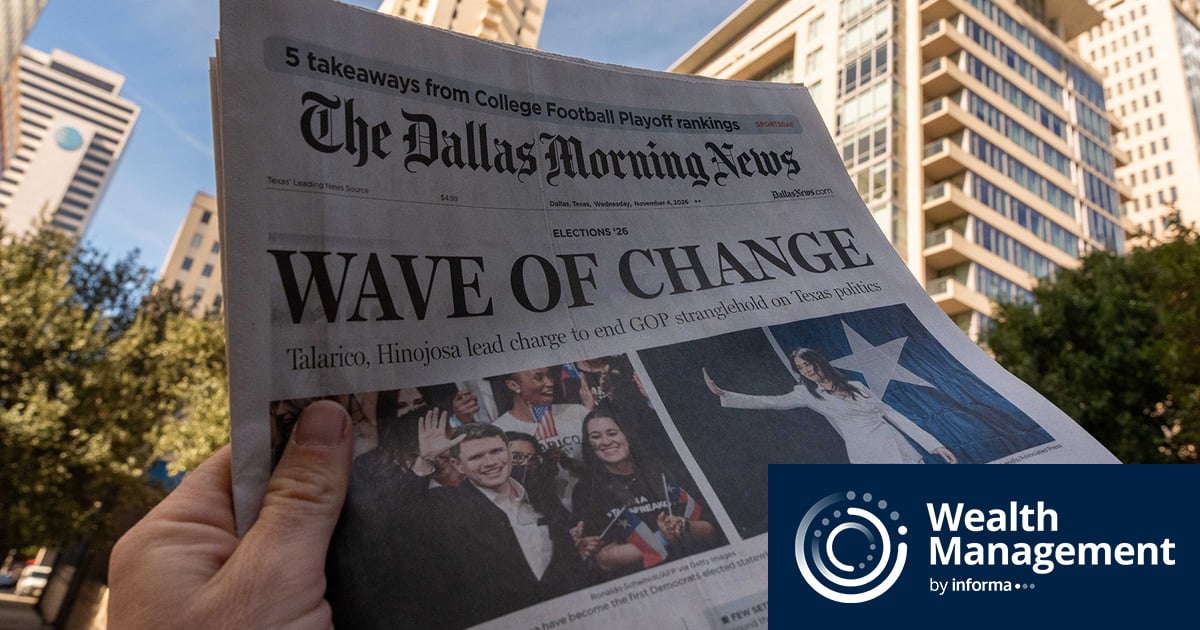
Wealth management heads of investment are maintaining guarded optimism in the wake of Democratic victories across the country in last week’s midterm elections, welcoming a divided government they expect will be unable to enact major legislative changes. Ultimately, wealth CIOs see macroeconomic fundamentals such as corporate earnings, inflation, interest rates and GDP growth as more critical to investment decisions and do not expect to make major changes to allocation strategies.
“Ultimately, the market is going to be driven by the interaction of economic growth, corporate earnings, inflation, interest rates and valuations. Elections can influence each of these, but they rarely replace them as the primary drivers of investment returns,” said Doug Huber, CIO at Wealth Enhancement, a Minneapolis-based RIA overseeing about $160 billion in assets. “If anything, I think the results reinforce the importance of looking beneath the surface of portfolio diversification.”
Those comments came amid a bumpy few days for markets in the immediate wake of the election, but pros ultimately expect lower volatility in the near term. Ultimately, they are pushing the same guidance as before the election: focusing on diversification and maintaining portfolios built for resilience.
“Moves like this are hard to time in the short run, but for long-term investors we have historically seen these episodes as opportunities rather than reasons to retreat,” said Nick Holuta, senior vice president, investments and portfolio manager at Dynasty Financial Partners, a St. Petersburg, Fla.-based support platform for RIAs. “We also think the episode is a reminder that risk management around portfolios is key, because correlations tend to rise during selloffs.”
Some said they are keeping an eye on potential tax or regulatory changes.
“I’m watching the fiscal negotiations, tariffs, taxes and regulation, but I want to see what actually gets done before changing an investment view,” said Jeffrey S. Neumeyer, principal partner and CIO at OpenArc Corporate Advisory, a roughly $130 billion Atlanta-based breakaway RIA. “One interesting question is whether uncertainty about the next tax and regulatory regime actually pulls some investment and M&A forward rather than slowing it down.”
CIOs also have their eyes on other risks, including persistent government deficits, increased federal borrowing needs, questions about AI and the need to modernize energy infrastructure.
“Fiscal policy is front and center as it impacts Treasury issuance and long-term yields, which in turn affect nearly every asset we own,” said Matthew Liebman, founding partner and CEO at Amplius Wealth Advisors, a Blue Bell, Pa.-based RIA with $1.7 billion in AUM. “We’re also watching trade and tariff policy and any attempts to revisit the 2025 tax law. None of these is a reason to trade today, but each could shift relative winners and losers over the next few years.”
Data Center Backlash
Aside from the headline results flipping hundreds of seats across all levels of government from Republican to Democrat, data centers were on the ballot across the United States. In all, there were nearly 50 ballot measures focused on data centers. In all, 46 passed that limit data centers while only 1 won election that favored data center development.
“They reinforce that AI’s growth depends on physical infrastructure and community approval,” said Jason Stephens, founder and managing partner at Evertern Wealth, a Naples, Fla.-based RIA managing about $1.6 billion in assets. “We remain constructive on AI, but we expect more pressure on investment returns as cities, municipalities and utilities seek a larger share of the economic benefits. Higher infrastructure costs and local requirements could make the outsized returns investors enjoyed in the past harder to repeat.”
CIOs reacting said that constraints on new supply could make existing capacity more valuable and shift economic returns toward incumbent operators and infrastructure providers. Some added that higher infrastructure costs could also pressure the returns on future AI investment, although they were ultimately still bullish on AI.
“Today’s AI leaders generate real revenue and cash flow. That said, the scale of AI investment means the return on that spending is the question that matters most, and we’ll be watching demand and utilization closely,” Holuta said. “We would also differentiate between companies with strong balance sheets and more leveraged infrastructure names, which are more exposed to higher financing costs and project delays.”
The Trump administration has heavily emphasized fossil fuels since its return to office while scaling back federal support and investment into renewables. When asked if the results had implications, CIOs said opportunities lie in economically viable energy delivery, not in picking politically favored sources.
“Democratic control of Congress may create more opportunities for clean energy oversight and legislative initiatives, but the administration will continue to exert significant influence through executive agencies,” Huber said. “That could shift the economics of certain projects, but it doesn’t change the fundamental need for additional energy supply. Policy can certainly influence which technologies receive incentives and how quickly projects are approved, but the underlying demand for reliable, affordable energy is unlikely to change.”
In terms of defense, investment heads don’t see the results changing much. There remains a structural demand for national security spending, although the focus of spending could change to emphasize technological shifts.
Lastly, CIOs also have an eye open for unexpected implications.
“The second-order effects are interesting,” Neumeyer said. “AI is a good example: restricting data-center construction might be a negative for someone supplying a project that gets delayed, a positive for someone who already owns powered compute, and potentially a positive for bonds if it slows incremental capital spending. Pay attention to where policy intersects with earnings, capital spending, and the cost of capital instead of trying to trade an election headline.”