
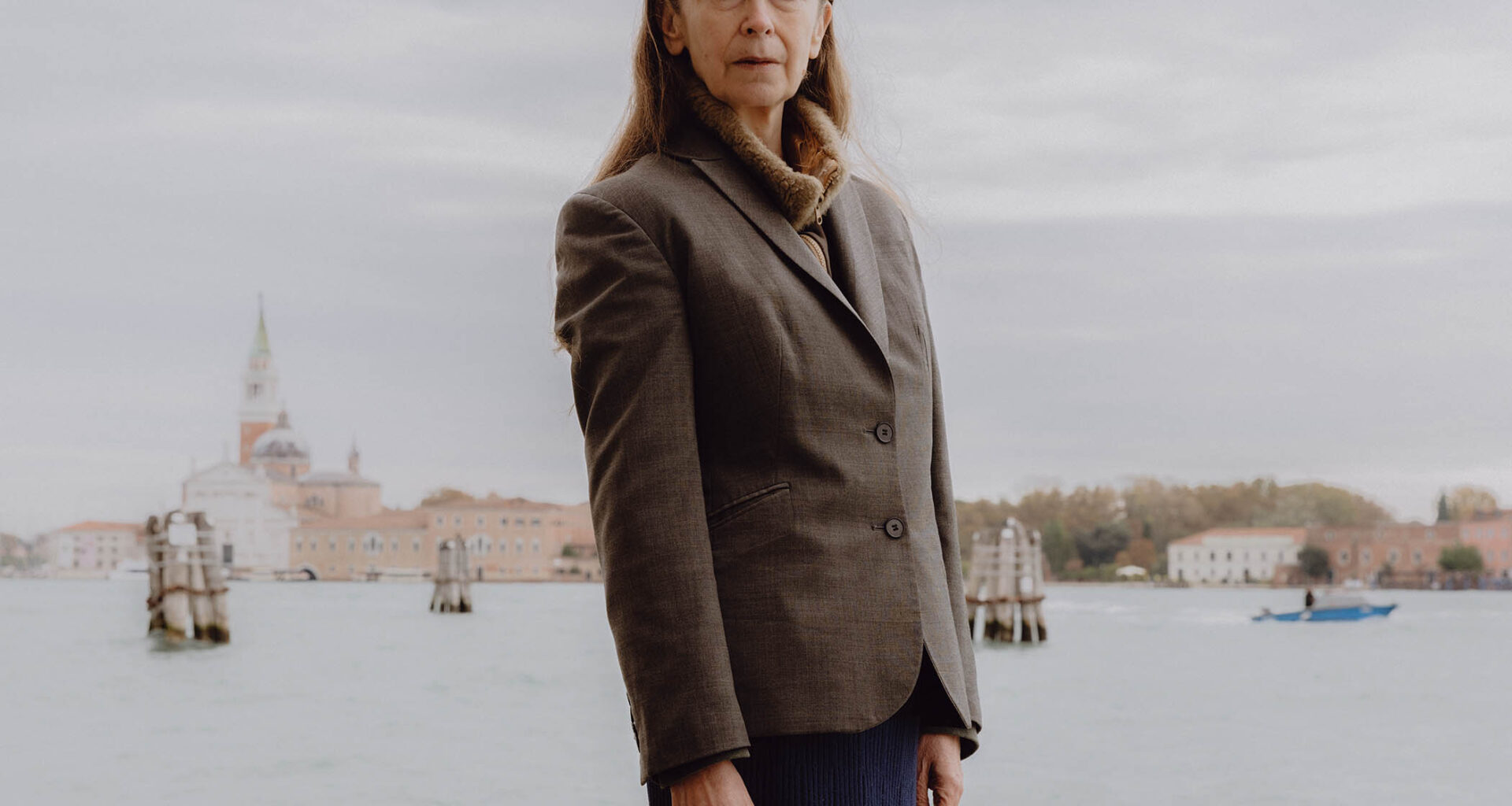
Portraits by Matteo de Mayda for The Observer
Chiaroscuro – meaning light/dark – is the technique used by artists to better define their subject. Leonardo da Vinci and Caravaggio were big on it: think heavy shading, plenty of drama. Now the artist and writer Celia Paul is using that method to help me see her more clearly. We begin our walk in Venice in the dark passage, Calle Lunga San Barnaba, where she lived briefly, and will end up at her old, light-filled studio in Dorsoduro in front of an expanse of water and below a bright November sky.
Except there’s just one problem: we’ve got to get from the dark to the light. “I have no sense of direction at all,” says Paul, looking at me plaintively, her otherworldly eyes the colour of the lagoon.
When Paul first arrived here for a residency three years ago, Chiara, a young woman who works at Victoria Miro, Paul’s gallery, drew her a map on a piece of paper. “I stuck to it completely because I knew I would get lost otherwise,” she says. “People think getting lost in Venice is one of the most exciting things, but it’s a terrifying prospect for me.”
We are here now because Paul, who is highly unusual in being a great painter and a great writer, has a new book out this month, Objects of Desire: An Artist in Venice, based on her diaries from that sojourn. It coincides with an exhibition of extraordinary paintings at Victoria Miro’s Venice outpost.
For now we stay rooted, craning our necks as she points to the green shutters of the apartment at the top of the building, her home for seven weeks in 2023 during her residency. The clanging of a street sweeper’s trolley is our nudge to get moving.
As we walk, Paul says she came here overburdened with grief, to contemplate the loss of the two loves of her life: her husband, the philosopher Steven Kupfer, who died of cancer during the Covid pandemic in 2021; and Lucian Freud, her lover from 1978-1988 and the father of her child, the artist Frank Paul. Freud died in 2011.
For Paul it wasn’t easy being in this city of labyrinthine passages, which she describes in the book as a “collective brain” holding memory and loss. Although she would come to Venice with Kupfer each November for her birthday (she turned 67 this week), being here by herself was different: “Loneliness almost knocks me out,” she writes.
Rather like Proust’s character Marcel in In Search of Lost Time, who came to Venice after the death of his lover Albertine, she says she thought the city might ease her melancholy. “He came with his mother. And by the end he was cured of grief. And I felt, I want to be cured from grief,” says Paul, who read all of Proust aged 19.
It wasn’t just Venice, I suggest. Didn’t Marcel’s flings with other women help? “Yes, he realised that, actually, your lover is replaceable,” she says, as we squeeze past tourists. “He didn’t want to go back to Paris with his mother on the train, because he was having such a wonderful time with all these new lovers.” Not her experience? “No, no, that’s the last thing I want,” she says. “What I wanted was to feel that I could be alone. Which is always what I’ve sort of wanted. I wanted to feel liberated, so that I wasn’t haunted by all the ghosts of my past. Except I didn’t, I felt chained.”
Her Venetian apartment, criss-crossed with beams on the floor and ceiling “like a spider’s web”, with a little altana, a terrace at the back, was a far cry from her studio opposite the British Museum, her home and place of work for almost 40 years. Freud bought the London flat for her when she was 18 and had just left the Slade (they met at the art school, he a teacher, she a student). It was very much her space. Her husband, Steven, who lived in Kentish Town in northwest London, didn’t have a key and she would work there each day from 6am to dusk.
Paul survived in Venice by forging another routine. I point to a bar and ask her if she had been; she says she was too nervous to venture out. She painted every day, picked up eggs, pre-made salad and wine from the supermarket but hardly ate, so intense was the period of working.
We come to a bridge and then Fondamenta della Toletta, a small square with a fountain where, in the book, she describes watching a man drinking the cool water. Then here, she says, pointing to a spot by a bridge, a woman would set up a stall and play the tune to the Beatles’ Yesterday by rubbing the rims of wine glasses. It’s off season so today they’re another pair of her ghosts.
She knew when she arrived that she wanted to make work that spoke to “the moodiest of the Venetian Old Masters”. On her first day in the studio she opened a book featuring La Tempesta, by the influential painter Giorgione. The artist’s mysterious work shows a woman breastfeeding her baby on the undulating banks of a canal under the gaze of a soldier on the other side of the water, clearly aroused from the state of his breeches. Two suggestive stone pillars stand between them. There is a lightning bolt. A snake. The most popular theory is that it’s the Garden of Eden. It’s deeply sexual.
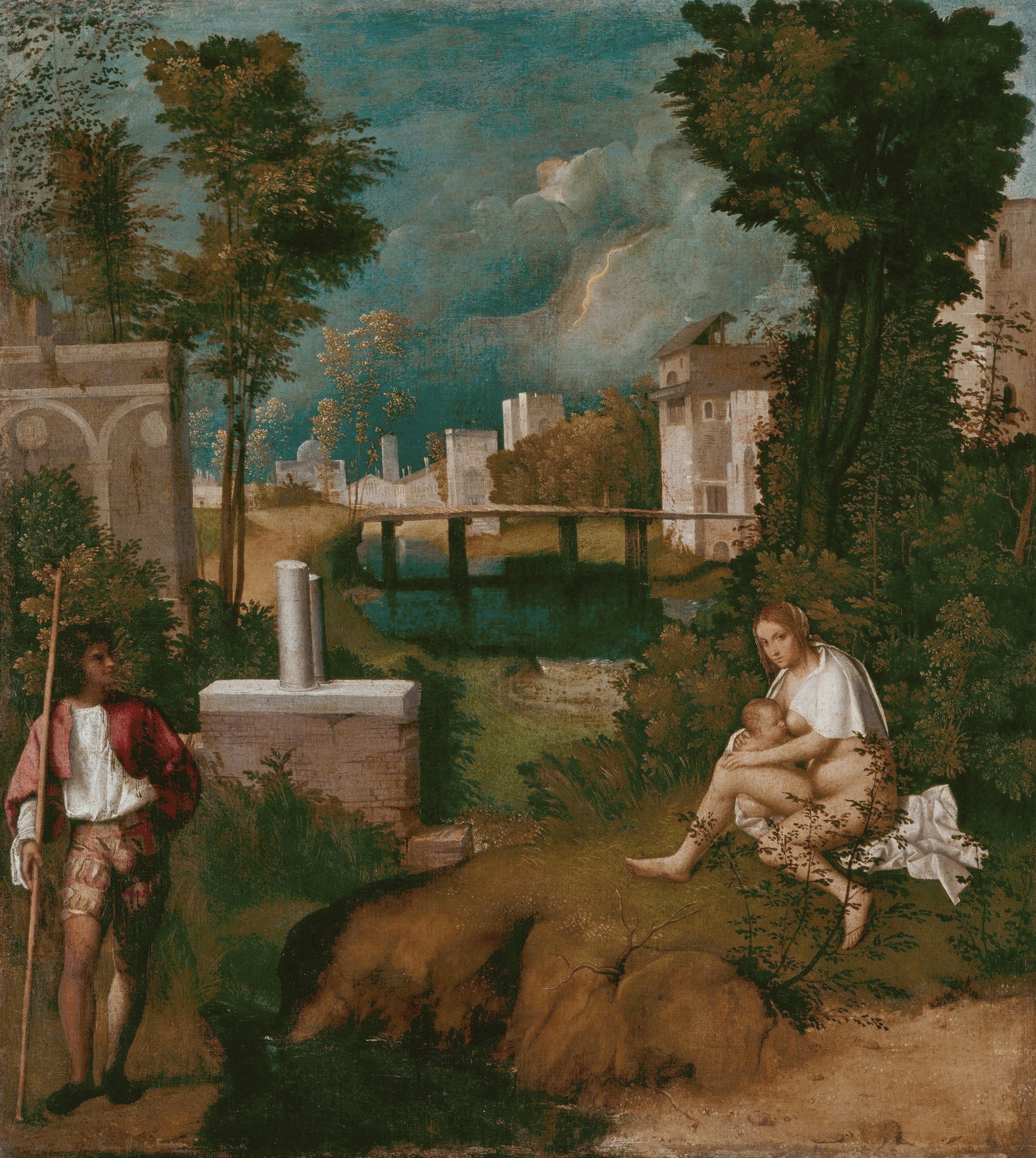
La Tempesta by Giorgione, c.1508
She knew immediately what she wanted to do. In her painted response, That Obscure Object of Desire, she focuses entirely on the woman. “I ignored the man, but put in these two pillars, which are kind of phallic symbols, and I felt they were a bit like Lucian and Steven,” she says.
“And I was breastfeeding, [it was] the young me. I felt that it was important to leave the man out, because I’ve lost both the loves of my life; they’re both dead. So there’s this feeling of an absent male.”
In fact La Tempesta had been part of Paul’s life for a very long time. It was much discussed when she was at the Slade and Freud’s work Painter and Model (1986-87) echoes its composition and shows Paul, who modelled for him, clothed and holding a paintbrush, standing at the edge of the frame alongside a naked male model sprawled on a leather Chesterfield.
“It was a painting that was very important to Lucian,” she says. “The composition of the painter and model. Exploring the power dynamic between male and female.”
Not that Freud discussed this interpretation with her. “He never wanted to explain his motives at all,” she says of his art. “In fact, he really disliked that kind of interpretation.”
Did he mind you interpreting his work? “I think he would have felt threatened by my interpretation of his painting,” she says.
‘They haven’t been able to see beyond, to my heart. To be seen as a muse is deeply frustrating, and I feel appropriated by it’‘They haven’t been able to see beyond, to my heart. To be seen as a muse is deeply frustrating, and I feel appropriated by it’
We duck down by Liceo Marco Polo, a secondary school, to avoid the crowds. We’re not yet lost. “I empathise with Lucian,” she says. “It is a difficult experience when another artist puts their interpretations on to you.”
Paul feels she has been deeply misunderstood over the years. Many critics have found it impossible to concede that “the muse” she is so often reduced to can also be an important painter. No matter that she was always painting during her time with Freud.
“I feel I have, on occasion, been appropriated for someone else’s agenda,” she says. “They haven’t been able to see beyond, to my heart, which has been frustrating. To be seen as the muse is deeply frustrating, and I feel appropriated by it.”
Her books, Self-Portrait, Letters to Gwen John and now Objects of Desire, are responses to people getting her wrong, she says. But it’s a constant battle. She wrote a critique of William Feaver’s biography of Lucian Freud in the LRB and the Times responded with a story headlined: “Celia Paul: Tearful secret of artist Lucian Freud’s young muse.” “There’s a kind of this entrenched patriarchy,” she says.
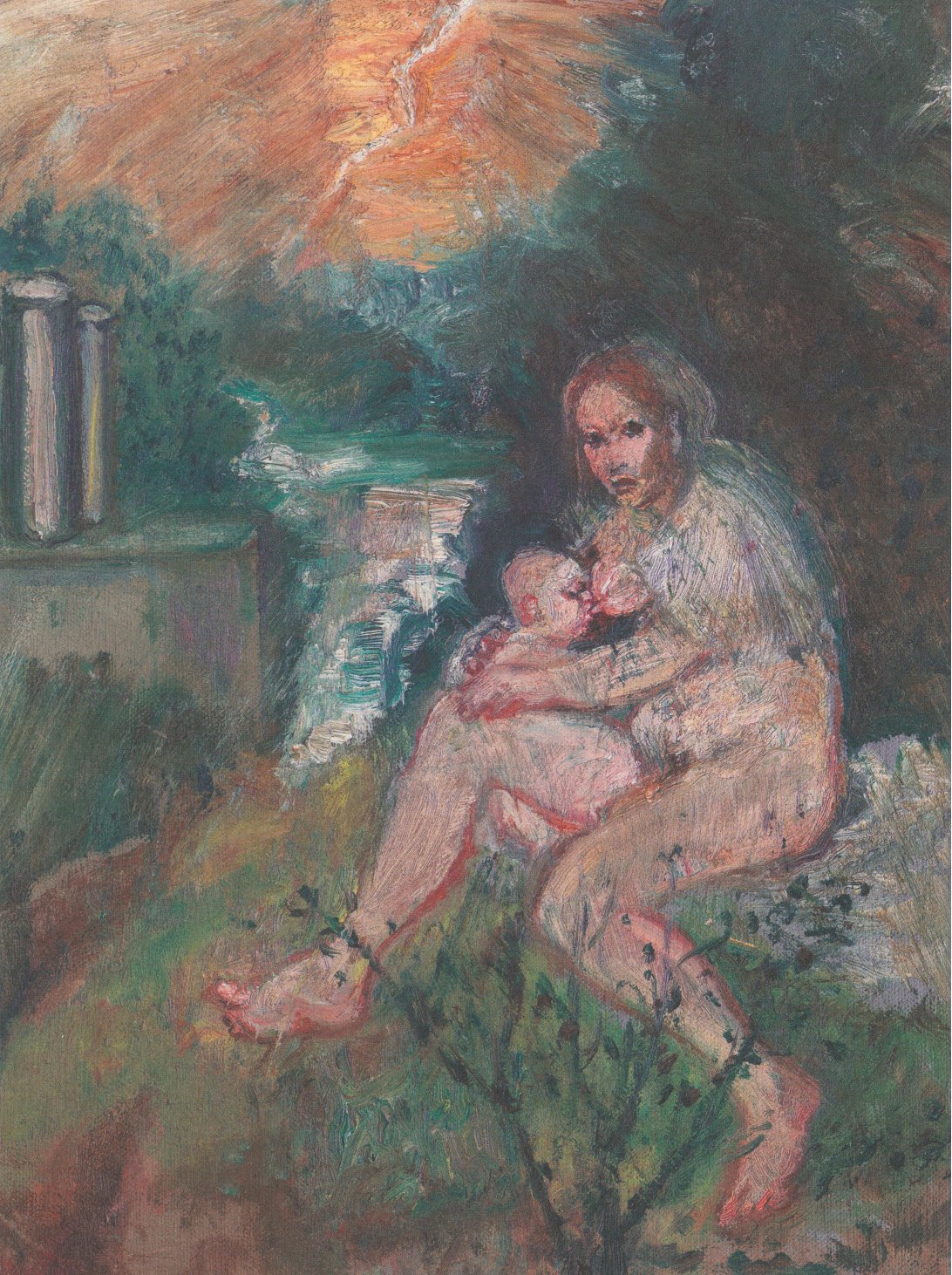
That Obscure Object of Desire by Celia Paul
It’s difficult, I say, because Freud is so much a part of you. It’s hard not to talk about him when speaking about your work. She nods. “I think he is obviously one of the leading characters in my life. And I’ve got a child, his son, and his grandchildren, and I’m very close to the Freud daughters, particularly Bella and Esther.” Recently Paul was a guest on Bella’s podcast, Fashion Neurosis. “And obviously, falling in love with him when I was 18, and… and somehow feeling so deeply connected to him through art.
“I still think about his paintings in a way that relates to mine, unlike any other contemporary painting,” she says.
We walk on to Fondamenta delle Zattere, a promenade on the canal: here comes the sky!
We discuss whether a melancholy place such as Venice in fact lifts the spirits. “Absolutely. I mean, there’s nothing more lonely-making than being in some very noisy party. The most melancholy sound of all is the ice-cream van.”
And, in a timely fashion, here’s Gelateria Nico, where we had planned to stop. Coffee? “I’ve had three very strong coffees already,” she says. Instead we take in the view from the vaporetto stop.
I’ve wondered how she chooses when to write or paint. When not in Venice, she writes in the tiny kitchen in Bloomsbury on a very small laptop; she doesn’t do cut and paste or attachments and types with one finger.
“A painting comes from here, the stomach area,” says Paul, pointing to her tummy. “I write if I’m in love. And I write if I’m grieving. Writing is a bit like unravelling. It’s a journey on the ground. Whereas if you paint you see everything at once, and it’s not a way to sort out something that is too problematic.”
So writing is better therapy. “Oh, yes, very much so. ‘Why am I so unhappy?’ It is a way of seeing.”
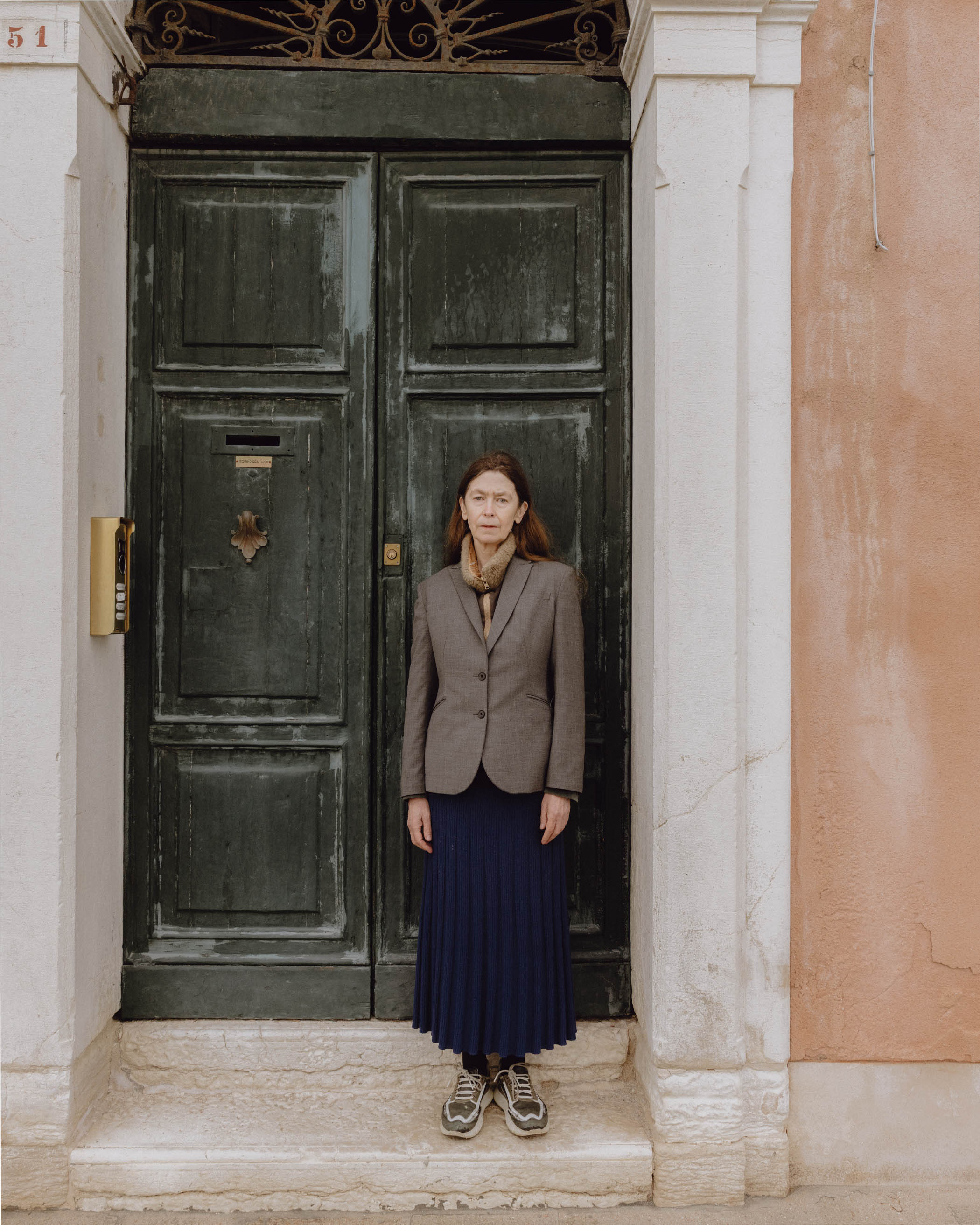
Paul’s fear of travel is a product of childhood trauma, she says. Born in India to missionary parents, this serious child became seriously ill at the age of five, forcing the family’s return to England. Her father went on to become the Bishop of Bradford. But before that, “we had to stay in this very grim house that belonged to an elderly woman connected to the church missionary society. India’s so full of light, and then this terribly oppressive house was bleak,” she says. “I think people who have lost their first home from early on want to stay in one place, because it’s like a bomb has dropped on your life.”
We are now outside the Pensione Calcina, where the art critic and writer John Ruskin took a room in 1876–1877 while working on The Stones of Venice. “It’s also where Annie Ernaux stayed when she wrote Simple Passion,” says Paul. Ernaux’s book charted an all-consuming love affair.
We look out over the canal to Le Zitelle (“the Spinsters”), a church which was part of a complex that gave shelter to young women. It’s now a luxury hotel. The tide is changing.
Her exhibition at the Gladstone Gallery in New York this spring received rave reviews. “One didn’t even mention Lucian,” she concedes. Her new work, the paintings inspired by Giorgione, seascapes, self-portraits, speak for themselves. Her recent recognition as one of our greatest living painters has coincided with a new demand for works by older female artists.
At her opening at Victoria Miro the previous night, Paul, priestess-like in a long, pale pink silk tunic designed by her niece, Alice Archer, explained to the room of friends, family, a Venetian aristocrat and a sleeping baby, how Venice had healed her.
She told how, back in England and driving through the countryside, she had said to herself: “Ah, I am home.
“And then I suddenly realised, actually, I am home myself,” she said, her eyes welling up.
When she returned to London from Venice she was changed. She painted some of her strongest self-portraits. She created a new home. Kupfer had left her his house in Kentish Town. It was held up by books, and she cleared it and had it restored. Now she finally has a place where she can host her son, his wife and her grandchildren. It’s a refuge from the queues for the Bayeux tapestry exhibition currently thwarting the calm of her Great Russell Street studio.
“I realise that’s part of why I’m starting to feel how wonderful it is to be on my own, because I don’t need to compromise at all. I can do exactly what I want when I want,” she says.
She has plans for a new version of her painting Colony of Ghosts, which depicted the all-male School of London painters. Instead, in contrast, she will paint her four sisters, who often sit for her: “four men versus four women”, she says.
We made it. We have arrived at the turquoise door of her former studio where we meet Matteo, The Observer’s photographer. He can’t contain his excitement: he’s just seen a dolphin. It’s famously made its home in this part of the canal but it’s his first sighting. “There are lots of fish here, he knows where the best restaurants are,” Matteo jokes. Then, Paul sees it too, its spine riding a wave. Her face lights up.
Celia Paul’s new book, Objects of Desire: An Artist in Venice, is published by Jonathan Cape and New York Review Books. Subscribers get 20% off at The Observer Shop. Celia Paul: Objects of Desire, an exhibition of new paintings, is at Victoria Miro Venice until 12 December
Paintings courtesy of the artist and Victoria Miro, Gallerie dell’Accademia, Venice