
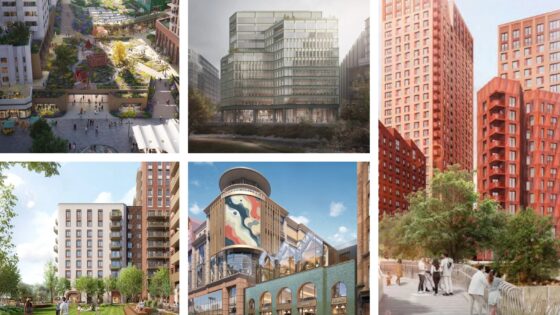
In a half-yearly trading update published last week (13 November), the UK’s largest commercial property developer said it would pause spending on most new office schemes and delay residential schemes in London and Manchester to ‘pursue viability’.
Landsec said the ‘high-risk’ environment for office development meant there was ‘little upside’ in selling buildings to fund new office development over the next year and a half. Instead, it said it would concentrate on completing its pipeline of offices.
Those schemes include the ongoing Buckley Grey Yeoman-designed retrofit of the 29-storey Portland House in Westminster. Landsec said that following the project’s completion, its ‘committed development exposure will come down to [£200 million]’.
Landsec’s report said this would allow it to focus on The Republic office building in Mayfield, Manchester, designed by Morris + Company, which is under construction, plus a handful of smaller retail projects including a food hall at Trinity shopping centre in Leeds.
‘New supply is constrained with build cost inflation and higher interest rates limiting development viability,’ Landsec said, ‘so as new projects are being deferred and the fit-out costs businesses face on relocating have risen sharply, rents for our high quality assets are rising.’
Residential projects appeared worse affected by economic conditions.
Landsec said it did not envisage start dates ‘before 2028 in any event’ for Studio Egret West and shedkm’s plans for 879 homes at Mayfield – the masterplan’s first residential phase – or GRID with Heatherwick Studio’s 1,800-home masterplan for Camden’s former O2 Centre.
The developer’s chief executive, Mark Allan, said in a statement accompanying the trading update: ‘We have continued to deliver on our strategic objectives over the past six months, strengthening our positioning for a higher inflation, higher rate environment.
‘In a more uncertain world, the characteristics of our earnings matter. We own scarce, prime real assets where customer demand is concentrating. Those assets are already generating strong rental growth, with significant further income growth embedded in our portfolio.’
The decision to delay new projects comes just weeks after Landsec paused a 1,700-home regeneration scheme in Lewisham, south-east London, masterplanned by Studio Egret West, after the council called for more affordable units.
The masterplan for the £1.5 billion mixed-use regeneration of Lewisham Shopping Centre gained planning permission a year ago. Studio Egret West worked on the scheme with Archio, Stirling Prize-winner Mae and Studio MULTI.
Studio Egret West director Lucas Lawrence told the AJ: ‘Complex, large-scale regeneration schemes often require flexibility and, while this pause is disappointing, the spatial, social, and environmental groundwork we have laid creates a resilient foundation for future development should the situation change.’
Lawrence added that the practice’s plans for transforming Lewisham town centre, which included a tower rising to 35 storeys, remained ‘as relevant as ever’.
But Mae founder director Alex Ely, writing on LinkedIn (see full post below), described the situation as symptomatic of a ‘broken system’, which was failing to deliver housing in the capital.
Landsec pointed in its statement to ‘higher interest rates, increased construction costs and more complex regulations’, which were curtailing development, particularly in London.
But, in relation to the Lewisham scheme, it added that Lewisham Council had been unwilling to support its move to unlock more land without a ‘significant increase in affordable housing’.
The FSTE-100 firm, which began the planning process five years ago, said: ‘This position, combined with the exceptionally challenging economic conditions, means that we no longer see a sufficiently certain route to delivery and have taken the difficult decision to de-prioritise the redevelopment of Lewisham Shopping Centre to focus on other residential projects.’
2018 predictions: Will the profession continue to be marginalised?