
From the opening flashback to the Battle of Hastings, in which Nikolaj Coster-Waldau’s William of Normandy bellows “Harold!” at his opponent, it was clear that the new BBC epic King & Conqueror was going to take a slightly — how shall we say? — imaginative look at history.
As Coster-Waldau told The Times before the show aired: “Obviously, this is a drama … There are a lot of liberties taken in terms of the story and the accuracy. But I think in broad strokes we aim to be as engaging and precise as we could be…hopefully you can enjoy it as a bit of fiction based on real history.”
So how disappointed should we be? Can we forget about the detail and enjoy an eight-part drama that aims to capture the spirit of events? With the help of Dr Katherine Harvey, a specialist in medieval history and an honorary research fellow at Birkbeck, University of London, here’s our breakdown of some of the show’s biggest moments.
Did Harold Godwinson save William’s life when he travelled to Edward the Confessor’s coronation?
Edward’s coronation in 1043 is a good place to start, as things got bloody. In the drama William and Harold are fully grown men and both present for the ceremony. But William, who was 14 at the time, did not attend — Harold, who was about 23, did. En route, Harold saves William’s life from bandits. There is no evidence of this, though it works as a dramatic conceit that ties the two men’s fates, and offers a hefty dose of dramatic irony given everything we know about what happened at Hastings 23 years later. England and Normandy experienced complex power plays prior to 1066, and King & Conqueror has a habit of personalising big stories with a hefty dose of fiction. Also hovering in the background is the memory of Alfred the Great, who united England towards the end of the 9th century. He was never referred to as Alfred the Great in his lifetime, though, as he is (many times) in the drama. That happened only in the 13th century, according to most historians.
• Read more TV reviews, guides about what to watch and interviews
Was Edward the Confessor a babbling religious zealot?
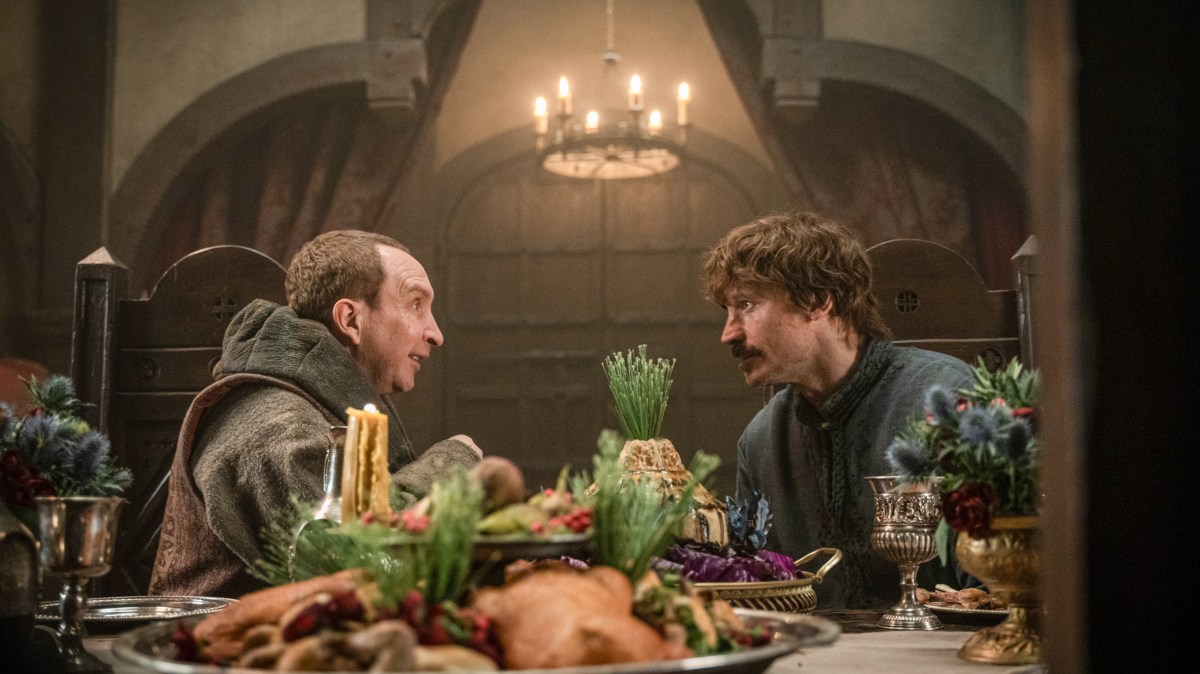
Edward was certainly a man of deep faith, but in the drama (where he is played by Eddie Marsan) he claims to hear God’s voice and clings to a holy relic — a finger kept in a box. No historical accounts mention this, although there are legends of miracles surrounding him.
Harvey tells me: “I think it is fair to say that he was a very pious man — to the extent that, after his death, he was said to be a saint. But they overdo it a bit.” Also, because so many people’s names were similar, Edward’s wife’s name has been changed. In reality she was Edith, not Gunhild (that was the name of her sister).
Edward was said to be a reasonably strapping man, fond of hunting and fairly competent as a king. He did not have an aversion to sex either, as suggested in the drama — because while he and his wife did not have children, it is believed that they did at least try. Harvey says: “The whole question of Edward’s sex life is an interesting one. I don’t think that anyone suggested he was celibate during his lifetime, although obviously his lack of children was a source of concern. But after he died the idea that he and Edith decided to have a chaste marriage quickly became an important part of his claim to sainthood. That story may well have been encouraged by the widowed Edith, to stop people blaming her for their childlessness.”

Juliet Stevenson as Emma of Normandy
LILJA JONS
Did Edward beat his mother, Emma of Normandy, to death with his crown?
Er, no. Wily and powerfully manipulative as Emma of Normandy (played by Juliet Stevenson) is, her son was not so riled by her bullying and plotting that he bludgeoned her to death. He did, however, exile her because he felt she had never wholeheartedly supported him. “But,” Harvey notes, “only to Winchester, and when she died he had her buried as a queen next to her second husband, Cnut.” The idea that Edward died while having sex with his wife is also not supported by the historical record. “According to Edward’s biographer, he died after a short illness, surrounded by nobles and his grieving queen,” she says. “Plus, the Bayeux Tapestry shows her sitting at the foot of Edward’s deathbed.”
• King & Conqueror review — historical tosh, but this 1066 is still entertaining
Did William and Harold have a bath together?
Er, once again, no. The scenes involving Harold and William prior to their encounter on the Hastings battlefield are confected, and that includes the sequence in which they share a bath as well as a set-piece in which they fight on Whitsun. Harold is thought to have visited William in Normandy around 1064, and sworn an oath of fealty to William — but baths and swordfights were probably not on the agenda. Still, there is a glimmer of truth in some of this, Harvey notes: “Communal bathing was fairly common in the Middle Ages. A bit like bed-sharing — and, like bed-sharing, it wasn’t necessarily sexual. So, although this didn’t happen, it’s maybe not quite as implausible as it seems.”

James Norton as King Harold and Indy Lewis as Margaret
BBC/CBS STUDIOS/LILJA JONS
Did Harold marry to cement alliances?
It is true that Harold had children with a woman called Edith the Fair (played by Emily Beecham), but there is no evidence that they were married. Harvey says: “Such informal unions, known as ‘Danish marriages’, were quite common, even though the church didn’t approve. This Edith was probably a very wealthy landowner, with connections to various Anglo-Scandinavian lords in Harold’s earldom. So although the drama makes it look like a love match, this relationship was a useful one for Harold.”
Harold is also shown marrying Earl Morcar’s sister, Margaret, to cement alliances with the Mercians, which is broadly what happened — though she was actually yet another Edith: Edith of Mercia (changed in the drama to avoid confusion). The fate of Harold’s lawful wife after the Battle of Hastings is not known, but Edith the Fair is thought to have lived until about 1086. It is said that her brothers took her from London to Chester for protection after the battle, but the record doesn’t give any indication of what happened to her after that.
Did Harold kill his brother Earl Tostig at the Battle of Stamford Bridge?
In the drama Harold’s beloved brother Tostig (Luther Ford) is driven to distraction by the death of his wife, Judith, during childbirth. He is also furious that Harold handed over the earldom of Northumbria to Morcar, joined forces with the fearsome Viking king Harald Hardrada and was killed by Harold at the Battle of Stamford Bridge — an accidental blow after Tostig saved his brother’s life.
While Tostig did lose his life at Stamford Bridge, there is no suggestion that the events depicted happened. In addition, Tostig’s wife did not die at this point — she was still alive at the time of his death and later remarried. There is also no evidence that Harold ordered the death of his wayward older brother, Sweyn (Elliot Cowan), whom he is shown to have cheated out of the Wessex earldom, kick-starting the steady destruction of the Godwinson family. The real Sweyn was dead before Harold became Earl.
Was the appearance of a mystery comet in the skies unsettling?
This detail is true. As depicted in the Bayeux Tapestry and supported by modern-day astronomers, Halley’s Comet did appear in the skies of England and France, though it was spotted in April 1066, six months before the Battle of Hastings, and interpreted as a potentially devastating omen. In the drama William exploited it as a sign that God was on his side and that the arrow that killed Harold at Hastings had a divine origin. This may well be correct, according to Dr Harvey: “Medieval people took astronomy seriously. It was considered a proper science, and the position of the planets was thought to have a direct impact on life on Earth. So they were keen on predicting and trying to interpret the meaning of all sorts of astronomical phenomena — comets, eclipses. William may well have interpreted the comet in this way.”
Did Earl Morcar really sit out the Battle of Hastings?
The scenes in which Morcar fought against Harald Hardrada, alongside Mercian forces led by his brother Edwin ahead of the main clash at Stamford Bridge, are broadly true. Morcar and Edwin’s forces were not present at Hastings, which may have been decisive — though it is not known if Harold labelled Morcar a “coward”, as depicted in the drama. Some historians believe Morcar and his men were still too battle-weary after fighting Hardrada to join Harold. Others suggest more venal motives. So this is broadly accurate. After the Norman victory at Hastings, the brothers submitted to the new King William, but later rebelled, unsuccessfully. What the drama also broadly gets right is the folly of Harold launching his forces on William so quickly after the Normans landed their ships when he could have mustered more men; what also rings true is the way he was riled, as the drama makes clear, by William’s ravaging of villages on England’s southern coast.
Did Harold and William bellow each other’s names at Hastings before engaging in one-to-one combat?
There is no evidence for this, though the dramatic scene in which the two fight it out makes for a good climactic scene. The sequence in which William plunges an arrow into the eye of Harold’s corpse to suggest that he was killed by a bolt from the heavens also uses heavy dramatic licence. But there is a whiff of truth about William’s motives. The Bayeux Tapestry (most likely commissioned by William’s half-brother Odo) is keen to suggest that this is how Harold died, and the story was convenient Norman propaganda. Nobody really knows who or what killed Harold, but early accounts of the battle do not support the death-by-arrow theory. Some historians even believe Harold was slain on the morning of a battle that ended around dusk. One thing that is correct is Harold’s prediction, early in the whole saga: “If William becomes king, he will tear England apart.”
Dr Katherine Harvey is the author of The Fires of Lust: Sex in the Middle Ages (Reaktion 2021); all episodes of King & Conqueror are available on iPlayer