
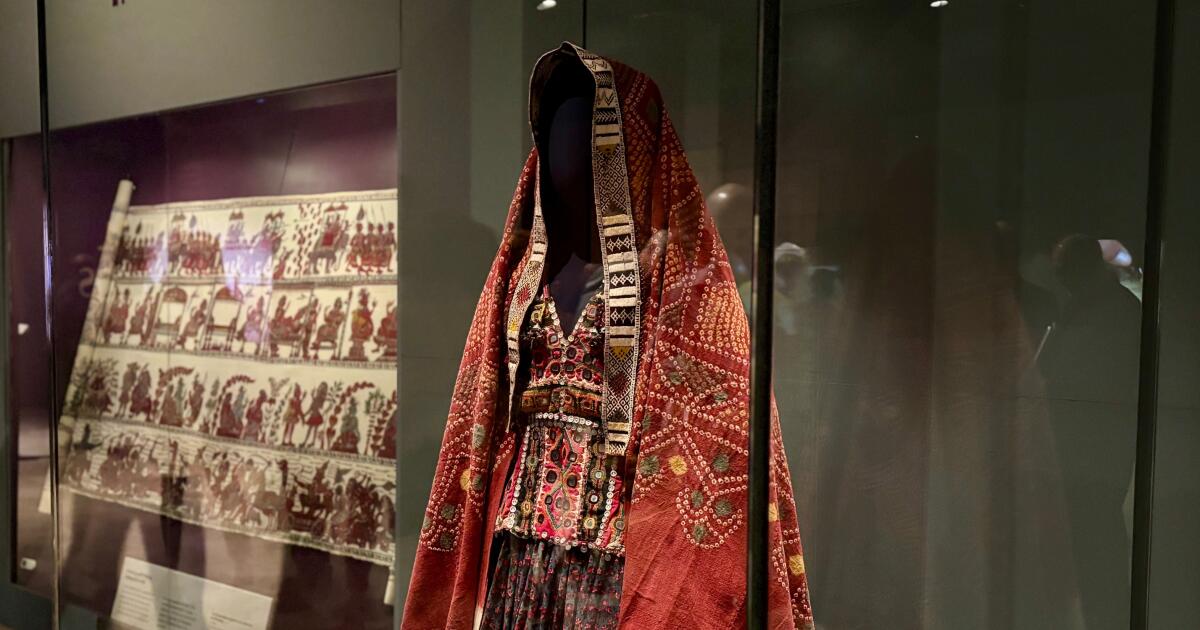
Cotton is a familiar textile that almost everyone wears, but before the 1800’s the common cloth was actually a luxury. At the time, Europe depended primarily on wool and linen for clothing while China dominated the silk industry. India was the main exporter of cotton cloth, but it wasn’t just any cotton. Painted and printed cotton cloth, known as Indian chintz, became what some historians regard as the first global fashion trend.
Bowers Museum latest exhibition, “Global Threads: India’s Textile Revolution” now open through April 5, 2026, traces the story of Indian chintz and how the textile changed the industry and the way people dress around the world.
Produced and circulated by the Royal Ontario Museum and curated by Dr. Sarah Fee, “Global Threads” features over 80 pieces spanning four continents and explores nearly 1,000 years of textile mastery.
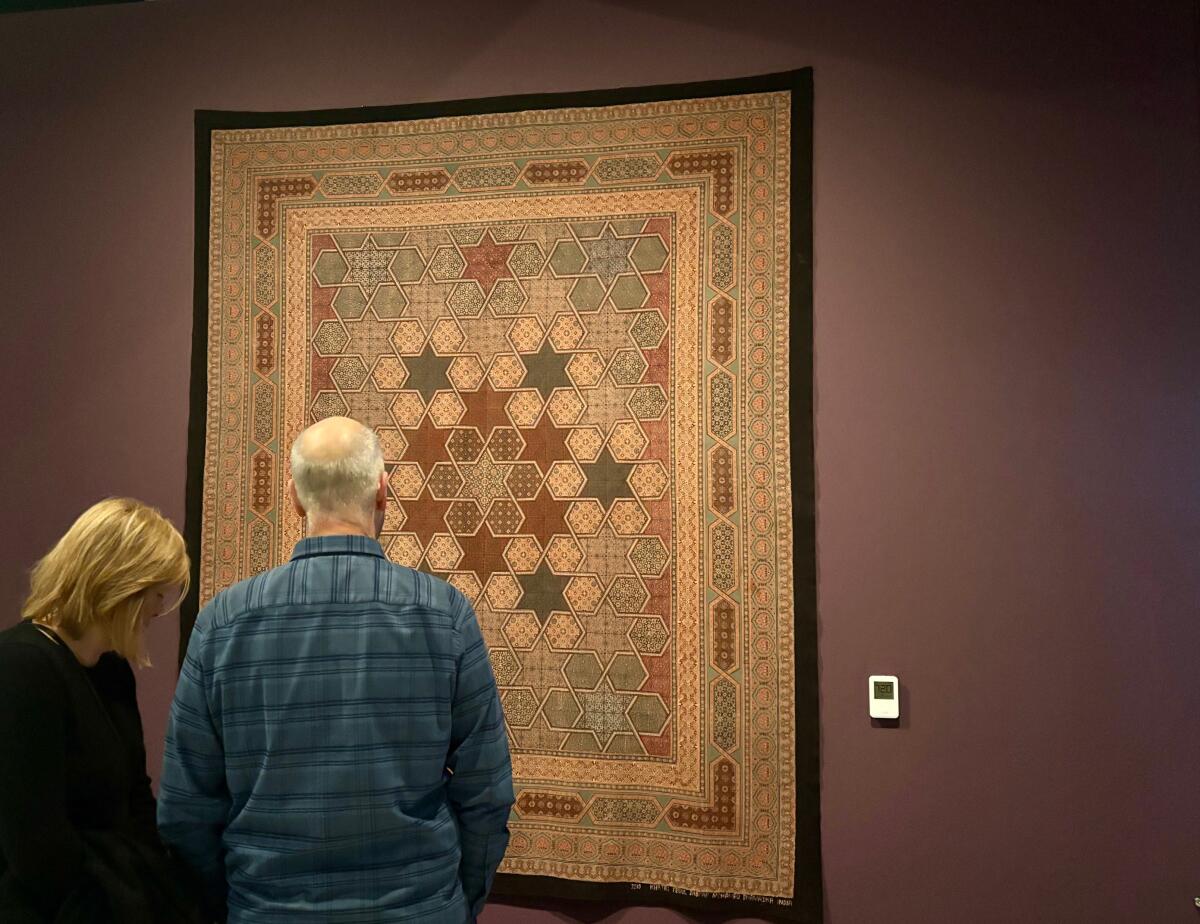
Patrons view Global Threads” at Bowers Museum, an exhibition that explores over 1,000 years of textile mastery.
(Sarah Mosqueda)
“The cloth that we call Indian chintz is an ancient art, it is an art that entranced and revolutionize the world,” said Fee. “And it is also an art that is undergoing an exciting contemporary phase.”
Fee is the curator of Eastern hemisphere textiles & fashion at the Royal Ontario Museum, associate professor in the department of art history at the University of Toronto and considered a leading scholar of global textile histories. Earlier this month she gave a lecture to Bowers members on the exhibit and the history of Indian chintz.
“Everything you see in the exhibition are the Indian originals and they are cotton cloth that was washed or printed using natural dyes, and as you see the designs go far beyond florals,” said Fee.
Examples of the use of Indian chintz within the exhibit range from palace-size palampores to 13th-century archaeological fragments and modern couture. The exhibition highlights Indian artisans who perfected cotton weaving and natural dyeing techniques, while following the journey of the richly colored fabrics from Indian to markets across Asia, Africa, Europe and the Americas.
Fee pointed out that in the West, Indian chintz is often mistakenly compared to calico, which is actually an imitation of it.
“Western imitation masked Indian chintz, it has also diminished and cheapened it,” said Fee. “You may know the expression, ‘chintzy’ to mean something cheap or shoddy and that is something recent that comes out of these industrial imitations.”
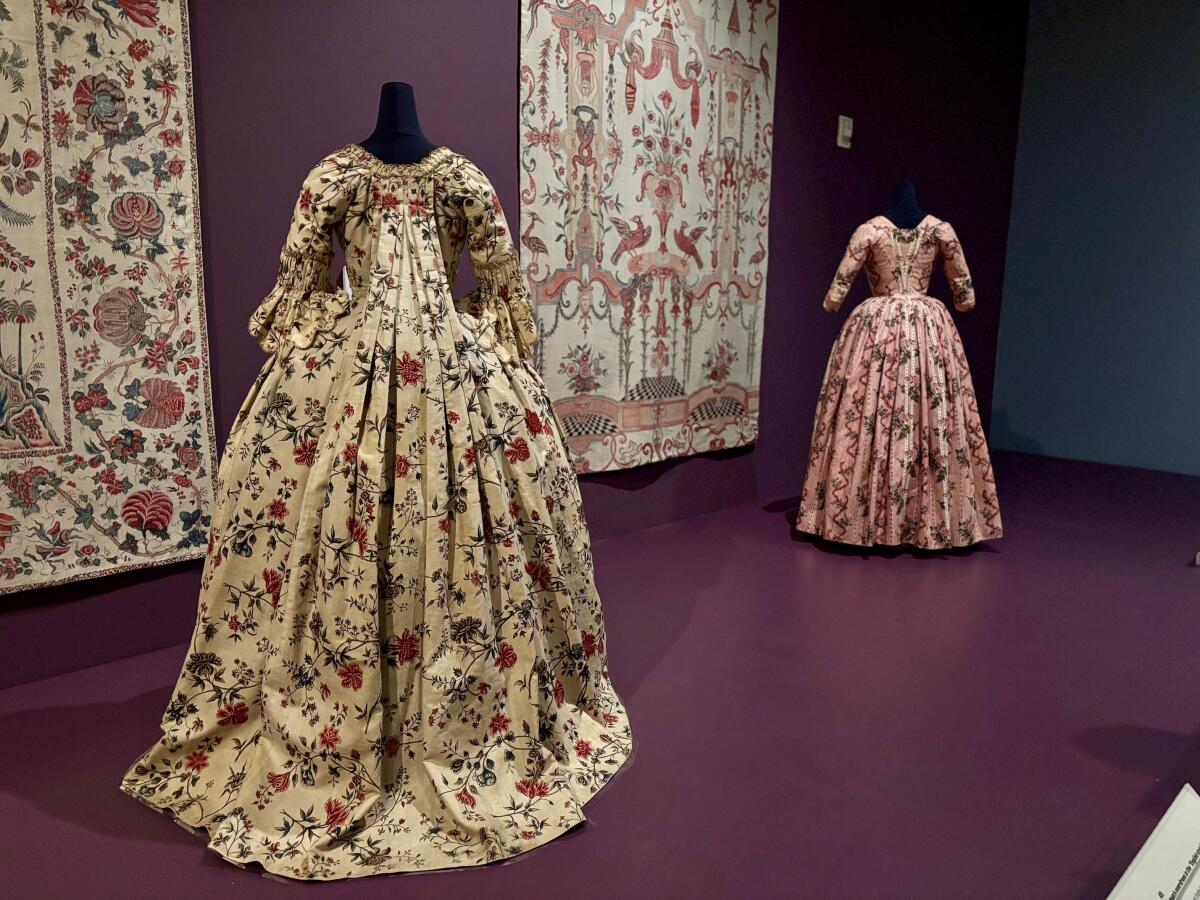
Bowers Museum presents “Global Threads: India’s Textile Revolution.” The exhibition reveals the story of Indian chintz, global fashion trend from the 17th century.
(Sarah Mosqueda)
True Indian chintz is hand-spun from thousands of meters of the finest thread and colored using natural dyes and techniques developed over thousands of years.
“Industrial imitations from the West from the 19th century have really erased India’s deep history and artistry and ‘Global Threads’ attempts to recapture it,” said Fee.
The chemical ingenuity of Indian artisans made it possible to dye cotton that naturally resists dyes and allowed the colors to remain vibrant, even over multiple washings. Block prints on display in the exhibition from the 13th century remain brilliantly colored to this day.
“Some of these pieces are 600 years old, but you can see how still vibrant and vital the design and color is, hence why it was such a popular fabric,” said Fee.
“Global Threads” is also part of the inspiration for the theme of Bowers Museum’s annual gala, reimagined as the Bowers Bash. The new model for the signature fundraiser will celebrate South East Asian art and culture as the Bowers Bollywood Bash on March 21, 2026. From 5 p.m. to 1 a.m., guests can enjoy Bollywood-inspired music, dance, fashion and fine dining. Tickets include a three-course gourmet Indian fusion meal by Mumbai-born chef Ali Loukzada as well as a full Chaat station with dessert, and more provided by Chef Manindder Tej. The Bowers Bollywood Bash will also be the capstone fundraiser for Bowers Museum’s 90th Anniversary year in 2026.
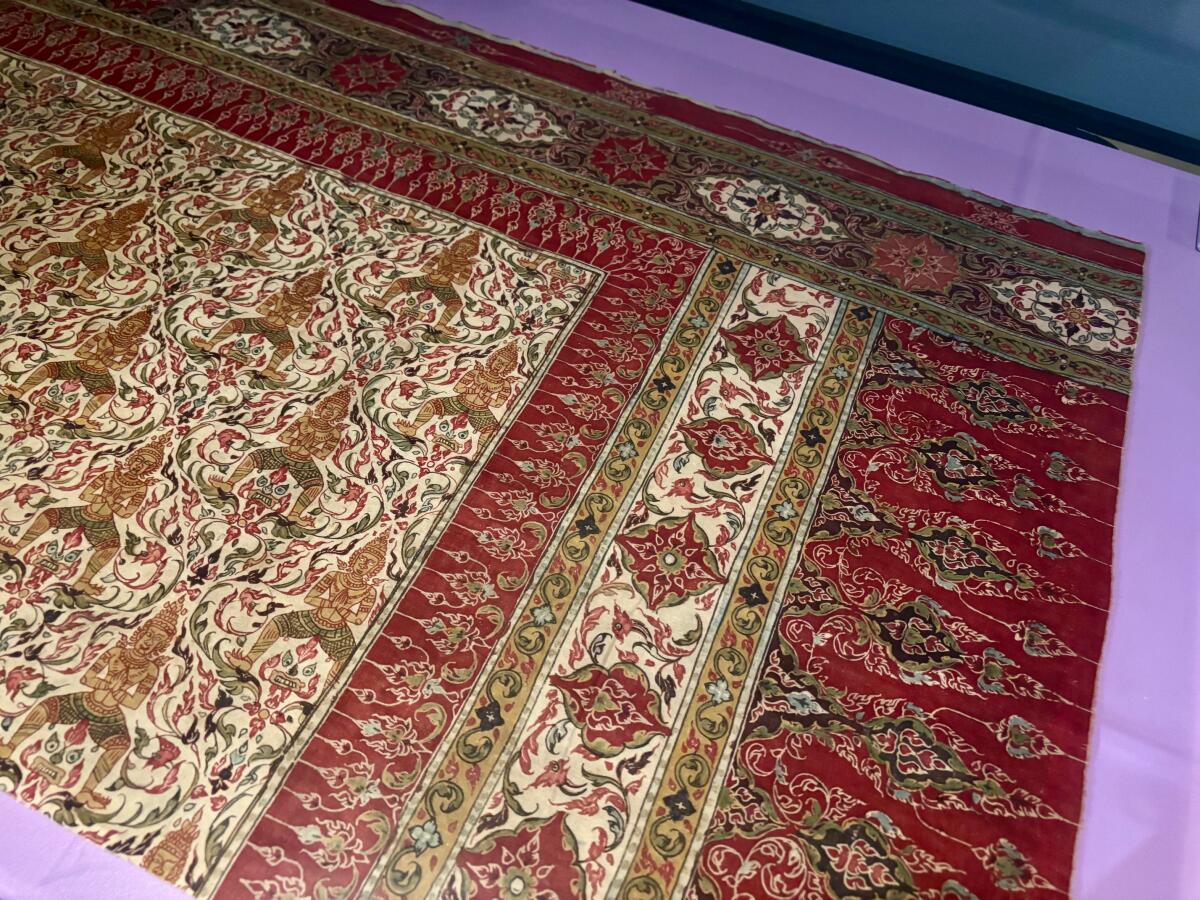
A fragment of textile from the late 1700’s colored with natural dyes that remain vibrant to this day.
(Sarah Mosqueda)
Like any good fashion trend, Indian chintz has cycled in and out of favor, and today it is experiencing a renaissance with a revitalization of the practice evident in India, particularly in the last 15 years. The work of six contemporary Indian artisans is featured in “Global Threads.”
“There are so many talented contemporary artists today that for the exhibition, we had a hard time choosing,” said Fee. “We went with six and we chose them because of their innovations and the new directions they are taking art, but also because they make natural dyes the forefront of their practice.”
The exhibition also includes video interviews with the six artists, which Fee says is an important thread.
“I encourage everyone to take the time to watch the artist interviews so you an hear these artists speak in their own words, about their journey and their creations.”
“Global Threads: India’s Textile Revolution” is on view through April 5, 2026 at Bowers Museum, 2002 N. Main Street in Santa Ana. Hours are 10 a.m. to 4 p.m. Tuesday through Sunday. For details on the Bowers Bollywood Bash go to bowers.org.