
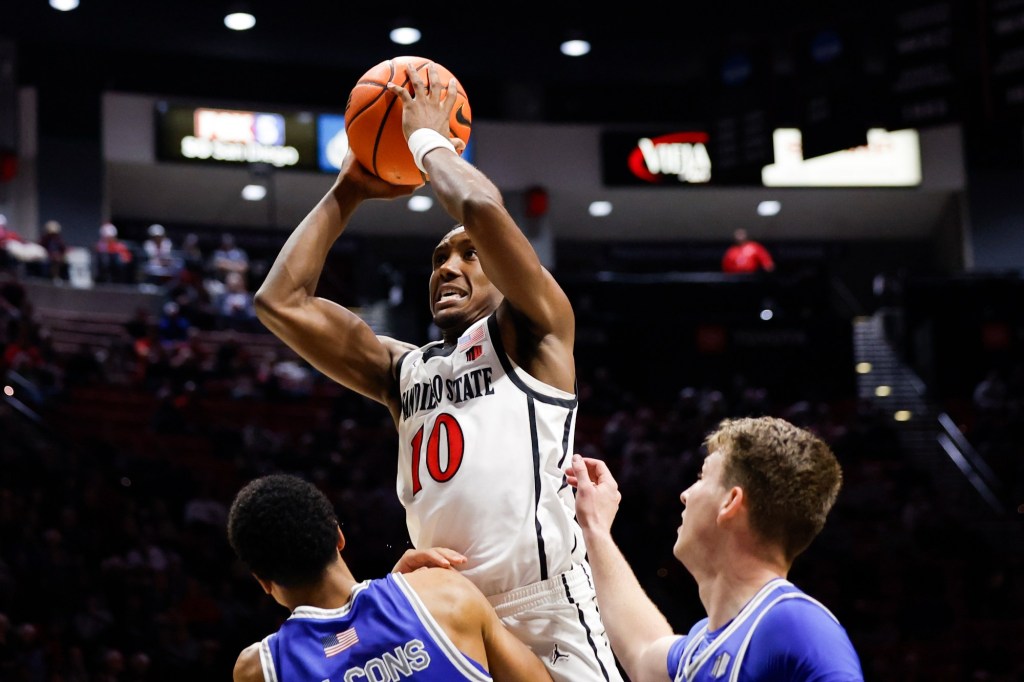
Three thoughts on San Diego State’s 81-58 win against Air Force at Viejas Arena on Wednesday night:
1. The Hibachi
Junior guard BJ Davis and his teammates are too young to know Vinnie “The Microwave” Johnson, the former Detroit Pistons sixth man who became legendary for heating up quickly off the bench of their 1989 and 1990 NBA championship teams.
“Haven’t heard of him,” Davis said. “Shame on me.”
But they do know who “The Hibachi” is.
That’s the moniker bestowed on Davis by assistant coach JayDee Luster for having similar qualities, borrowing an old nickname for Gilbert Arenas. Wednesday marked Davis’ seventh straight double-figure scoring effort off SDSU’s bench, a stretch in which he’s averaged 16.3 points per game while shooting 54.2% on 3s and making 36 of 38 free throws.
Against Air Force, he had just two points on 1 of 6 shooting at the half but it was only a matter of time before the coals began to glow. Second-half line: 15 minutes, 17 points, 5 of 5 shooting (4 of 4 from 3), four assists, no turnovers, plus-19 while on the floor. He had 11 consecutive points over 4½ minutes that essentially put the game away.
We’re one game into the Mountain West season, and the Sixth Man of the Year might already be decided.
“That’s been the role I’ve been playing this year,” Davis said. “Just embraced it. Just trying to provide that spark, that energy, trying to come in and guard and get my teammates involved and create my own shot as well.”
It wasn’t what he had in mind after starting all 31 games last season and averaging 9.0 points. But Reese Dixon-Waters returned from a season-ending foot injury, and Miles Byrd returned from the NBA draft, pushing the 6-foot-2 guard from Modesto Christian High School to the bench.
“It was on my mind at first, in the beginning of the season,” Davis admitted, “but I had conversations with my people and they make sure I’m grounded and focused on the bigger picture, which is winning. … However much time I get is what I get. I have to do what I can to help the team win with what I’m given.”
Usually when your leading scorer – Davis is now averaging 13.3 points per game – comes off the bench, that’s a pretty strong case that maybe he shouldn’t. But the more the Hibachi heats up, the more it solidifies his role as a super sub who plays starter’s minutes. Wednesday night, he played a team-high 27 minutes, four more than anyone else.
“Sometimes your best five players aren’t starting, and BJ is one of our best five players right now,” Dutcher said. “He’s accepted the role, obviously, because he’s playing great in it. In the back of his mind, does he want to start? I’m sure he does. But he’s too important and too valuable to us in the role he’s playing right now.”
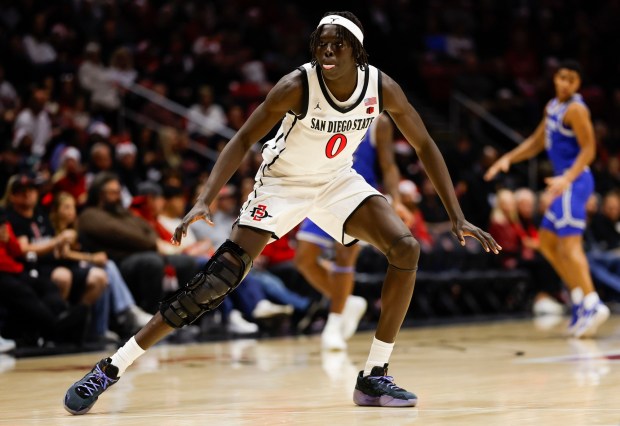 SDSU forward Magoon Gwath has 12 points and four rebounds against Air Force on Wednesday night. (Meg McLaughlin / The San Diego Union-Tribune)
2. Mental block
Maybe the worst thing Magoon Gwath could have done was post 20 points on 5 of 5 shooting, seven rebounds and three blocks his first game back, seven months after knee surgery.
Expectations soared, both internally and externally. Pressure mounted. Urgency ensued.
“It’s going to take a while,” Dutcher said. “And I told him that: ‘Magoon, as ready as you feel when you come back, there’s going to be a process to do this, to get your timing back, to get your confidence back. I know in your mind, you feel you’re ready to go. This is going to take time.’”
And it has. Over the next five games, the reigning Mountain West freshman and defensive player of the year averaged a pedestrian 7.4 points, 4.2 rebounds and 1.4 blocks while shooting 42.9%.
The 7-footer took another step forward Wednesday, though, with 12 points on 5 of 7 shooting to go with four rebounds, three drawn fouls and two blocks in 21 minutes. Gwath is certainly not a finished product and he’s playing limited minutes in short spurts, but there were glimpses of what, hopefully, is to come.
Gwath is still wearing a bulky knee brace (that he says is far lighter than it looks) and will continue to for most, if not all, of the season. Asked if the recovery is more physical or mental, he said:
“You could say it’s a little mixture of both. … Obviously, coming back from injury there’s a little mental block. I’m still overcoming it. From when I first got on the court until now, there’s a huge difference with trusting my movement – planting hard on the leg or making hard cuts off it, really pushing, and knowing my knee is good and not trying to protect it.”
Dutcher has seen that, too.
“You want to go fully on that leg that they’ve told you to do nothing on for (seven) months,” he said. “Don’t put weight on it, don’t jump off it, don’t do this and that, we’ll rehab it. Then you come back and play, and they tell you to jump off it at full speed. So there is a mental block.
“I like the progress he’s making, but I don’t think we’ve seen anywhere near the Magoon Gwath as the year progresses.”
The question now becomes, when?
“Not sure,” Gwath said. “I’m just going to keep working until I get there.”
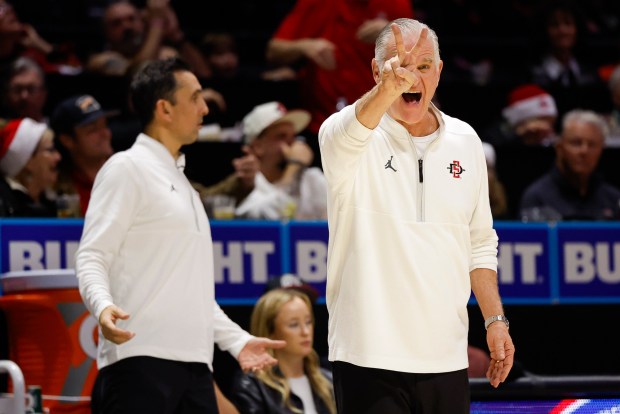 SDSU coach Brian Dutcher yells to players during their game against Air Force at Viejas Arena on Wednesday. (Meg McLaughlin / The San Diego Union-Tribune)
3. Playing games
Entering Wednesday night, only one of the other 364 Division I teams had played fewer games than SDSU’s eight: 2-5 Florida A&M. Texas Southern (1-7) had also played eight. Everyone else had played nine, 10, 11, 12, 13, 14, even 16 games.
It’s a quirk in this season’s schedule, partly from the availability of home “buy” games, partly from playing three in three days at the Players Era Festival in Las Vegas and, knowing from past experience with the Maui Invitational, that it’s prudent to provide ample rest afterward.
Over the previous 20 days, it meant two games.
But that changes this week, with three games in six days.
Dutcher can’t wait.
“The thing I like best is now we’re playing games,” he said. “I’m so tired of practice, they’re so tired of practice. All we’re doing is practicing, and it’s just grating on everybody. They’re tired of hearing us. I’m tired of watching them in practice some days.
“This team needs to play games now. I think we’ve played darned near the fewest games of any team in the country. We’ve gotten better through practice, but practice is tedious and we were ready to move on beyond practice at this point.”
Normally, they would be in the midst of another long break, with a school moratorium on sporting events during final exams. In the previous two seasons, that’s been 10 days.
The Air Force game was originally slotted for Saturday, creating a 10-day break, but then SDSU was invited to play Saturday’s neutral-court game in Phoenix against No. 1-ranked Arizona — an opportunity too good to pass up. So they got special permission to move the Mountain West opener to Wednesday, during finals week.
That also removed one nonconference game that ordinarily would have slotted in the previous two weeks, creating the endless stretch of two games in 20 days. They opted to play their final nonconference game, against the Division III Whittier Poets, on Monday afternoon to shorten the break before their Dec. 30 conference game at San Jose State while still allowing players to go home for Christmas.
There was also a nine-day break before playing Troy, when the Aztecs looked rusty and found themselves in a 14-2 hole that they ultimately couldn’t overcome in two overtimes. There was a six-day break before the 40-point loss against No. 2 Michigan.
It’s one reason, possibly, for the perceptible lack of rhythm and consistency, both on a team and individual level.
“We played today, we play Saturday, we play Monday,” Dutcher said after the Air Force victory. “We’ll take a couple days off for Christmas, we’ll come back and we’ll be in the Mountain West grind with two games per week. We don’t have a bye week until February.”
This season, that might be a good thing.