
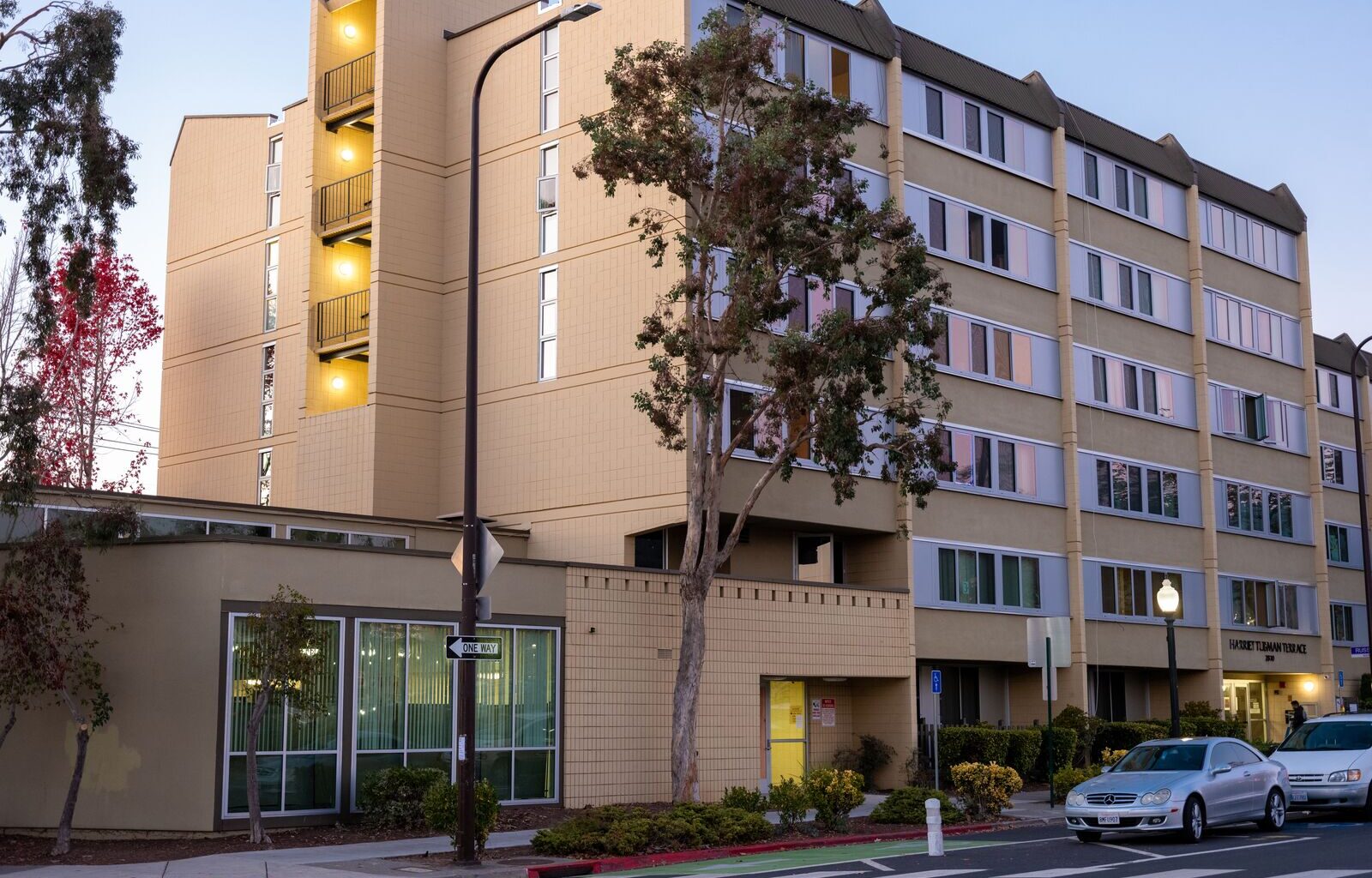
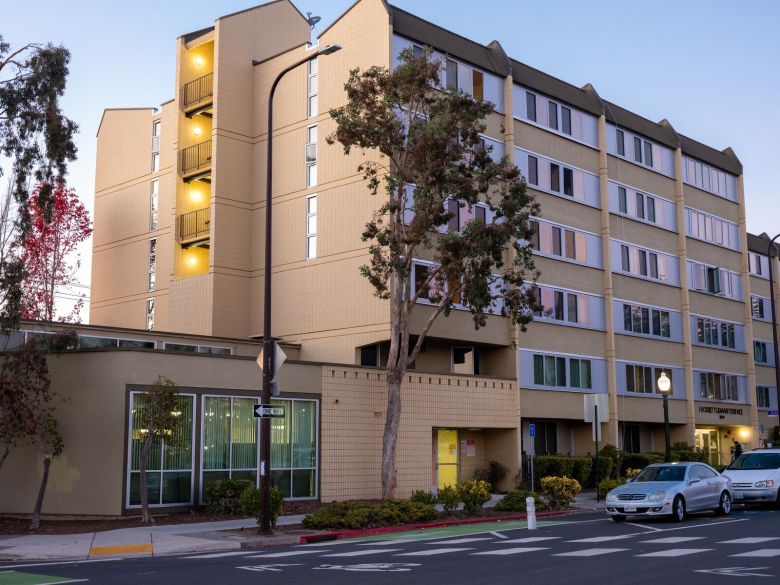
 Harriet Tubman Terrace, an affordable housing complex for seniors in South Berkeley. Credit: Ximena Natera, Berkeleyside/Catchlight
Local affordable housing nonprofits are facing hundreds of thousands of dollars in new city fees because of a little-noticed provision in a ballot measure approved by Berkeley voters last year.
The city’s Rent Stabilization Board agreed at a meeting Thursday to give those organizations more time to pay new annual rental registration fees imposed under Measure BB, which match the fees Berkeley charges to for-profit landlords. Nonprofit leaders warn the additional costs will be difficult to bear for organizations that already run on slim margins, and could force affordable housing providers — which typically can’t raise tenants’ rents, whether because of their mission or legal restrictions — to cut back on other expenses such as building maintenance.
“It might mean that those organizations are not able to continue to manage or hold on to those properties, and that would be a horrible situation for the whole community,” said the Rev. Sophia DeWitt, chief program officer at East Bay Housing Organizations. “It becomes a financial and fiscal sustainability issue.”
The measure, which was initially developed by members of the rent board and backed by pro-tenant groups, passed with 56% of the vote in 2024, defeating a rival measure brought by landlords. Measure BB made an array of changes that broadly strengthened tenant protections, such as limiting the circumstances landlords could use to justify evictions and codifying tenants’ rights to organize and bargain with property owners.
The measure also brought tenants in subsidized housing fully under the jurisdiction of the rent board, including those who live in dedicated affordable buildings or rent with vouchers from the federal Section 8 program.
Rent Board Chair Soli Alpert said the change was motivated by recent circumstances in which “tenants were facing really bad situations” in affordable buildings, but couldn’t appeal to the board for help because their properties weren’t in its domain. He pointed as an example to an incident in which dozens of tenants at the Strawberry Creek Lodge senior housing complex received eviction notices.
“We really saw a need to make sure that these tenants have access to services,” Alpert said.
The change means that affordable housing providers must pay as much as $344 per unit each year in registration fees to the rent board. Those organizations previously didn’t have to pay anything, or in some cases paid a discounted rate.
Alpert said the board has been advised by its attorneys that it can no longer offer discounts to nonprofits.
“Legally, we can’t charge a different fee for a different person,” he said. “It has to be based on the services we’re providing.”
DeWitt, whose organization advocates on behalf of the nonprofits that build and manage affordable housing, said the cost increase came as a surprise to her and other housing organizations.
The Berkeley nonprofit Resources for Community Development (RCD) estimated its annual registration fees would increase by more than $100,000 as a result of the change, from $16,500 in the 2024 fiscal year to $133,500 per year going forward. DeWitt said that increase is “pretty representative” of what several local organizations expect.
New fees weren’t widely discussed in run-up to vote on Measure BB
Supporters of Measure BB discussed extending tenant protections to residents in affordable homes during the campaign, citing the Strawberry Creek Lodge eviction notices in a Berkeleyside op-ed and writing that the change would create “protections from nonsense evictions” for low-income renters. However the new fees for affordable housing groups weren’t mentioned in their argument, nor were they widely discussed during the campaign — the costs didn’t come up in either a nonpartisan summary of the measure prepared by the city attorney’s office or arguments from opponents of the measure.
Officials from RCD, East Bay Housing Organizations and two other affordable housing providers wrote a letter to the City Council this fall raising concerns about the fees; providers have also been discussing the increase with the rent board.
At its meeting Thursday night, the board voted unanimously to extend the deadline for providers to pay the fees, from Jan. 2 to March 31. It was the second extension the board has granted for the fees, which were initially due last summer.
“It’s impossible for our properties to simply absorb those costs,” RCD Policy Manager Courtney Pal told the rent board. “As a nonprofit provider serving the most vulnerable, we obviously can’t just raise rents, and so we need to explore other resources to fund these new fees — and this extension will really give us the opportunity to do just that.”
Alpert suggested the nonprofits and City Council should work together to come up with the money to pay for the fees, such as by having the city contribute part of the cost from its general fund. He and rent board Executive Director DéSeana Williams sent a letter to the council last month asking that its members identify “city or external funding” to that end.
But using city money to pay for the fees could be a tough sell at a time when Berkeley faces a structural budget deficit of more than $20 million, and officials are looking for ways to cut costs and raise revenues. Asked about the board’s suggestion, Councilmember Terry Taplin said, “I don’t see how that’s going to be possible.”
Taplin contends the fee hike will add to the many difficulties affordable housing organizations already face.
“Our nonprofit affordable housing providers are our primary partners in the creation of affordable housing, and these are projects that are very difficult to finance,” he said. “We risk undermining our own efforts when things like that happen.”
Alpert said the rent board is committed to working with nonprofit housing providers to help address concerns about the roll-out of the fees.
“We don’t want to make it difficult for them,” he said. But, Alpert added, “These tenants deserve services, and the services need to be paid for.”
Related stories
Berkeley ballot measures BB and CC: Voters to decide overhaul of rent rules
October 18, 2024Oct. 19, 2024, 2:36 p.m.
South Berkeley seniors live with lack of heat, shoddy repairs under new management
March 7, 2023Sept. 5, 2023, 12:21 p.m.

Opinion: Don’t be misled on housing — vote yes on Measure BB, no on Measure CC
October 14, 2024Oct. 17, 2024, 1:23 p.m.
“*” indicates required fields