

Since 2018, transboundary flows have been unprecedentedly worse. Failures at the treatment plants on both sides of the border combined with intense rainstorms have led to a record 100 billion gallons of untreated wastewater spilling into the river.
The sewage spills also occur at other times, when aging infrastructure breaks down or as construction takes place in Tijuana. Now the once seasonal river flows throughout the year.
Rapid growth in the Tijuana River Valley is driving the environmental and public health threats.
In the last 100 years, the region’s population has grown from 1,000 to nearly 2.2 million, supporting $80 billion in cross-border commerce annually, according to some estimates.
Economic policies such as the North American Free Trade Agreement, or NAFTA, have reshaped the U.S.-Mexico borderlands, generating billions of dollars of revenue that have benefited the U.S. economy and transformed the labor market in Mexico. Just south of the border in Tijuana, factories known as maquiladoras have cropped up to feed consumer demands for goods.
At its simplest, the sewage crisis is a math problem.
Tijuana produces roughly 70 million gallons of wastewater each day. Treatment plants on both sides of the border combined are able to process about two-thirds of that amount — when the infrastructure is working. Meanwhile Tijuana continues to grow. Estimates predict the city will produce over 40% more wastewater by 2050.
South Bay residents have grown accustomed, albeit indignant, to contaminated waters in their community. The beaches of the Tijuana Slough, an area near the mouth of the river, have now been closed for nearly all of the last 1,400 days.
Like many people, Andrew Cobarrubia, a Chula Vista resident, has been fishing off the Imperial Beach Pier since he was 12 years old. But he doesn’t eat his catch anymore.
“The fish are contaminated … so we just throw them back.”
Dollars and sense
Scientists are trying to understand the scope of the contamination so they can evaluate what the health impacts could be. Both goals seem more urgent to define than ever.
“Our community has been saying it for years, and they were ignored,” Kimberly Dickson said.
The county’s water quality test results usually arrive late, after residents have been exposed, Matthew Dickson said, adding that a warning system that notifies residents immediately when a transboundary spill has occurred could give them a chance to reduce their exposure.
A couple years ago, the Dicksons got sick from E. coli after walking their dog on the beach in Coronado. When they arrived, there were no signs up warning of any contamination, Matthew Dickson said. But the next day when they were sick, they saw the tests results online and the warning had gone up.
The couple has also begun working with the U.S. Navy on more precise testing to understand what contaminants specifically are causing illness. They are now testing for what organisms are present in patients’ fecal matter, the Dicksons said.
Support crucial reporting on Tijuana River pollution impacts.
Give $10
Some researchers have themselves fallen ill trying to gather data.
SDSU public health researcher Paula Stigler Granados spent months in the river running tests, clad in protective clothing and a respirator. Several of her students were getting sick with gastrointestinal and respiratory illnesses, rashes and headaches, and more, she said. Then she came down with an antibiotic resistant E. coli, which is something that she had been finding in her tests. It seemed she had recovered, but she fell ill again.
“It was wild how sick I got so fast,” Granados said. “I ended up again with this infection that went to my kidneys, and I was in the hospital. Within five days after I started to get symptoms, I was in full blown sepsis, and I had to spend a week in the hospital.”
She lost a kidney. She says she can’t say for sure that the river contamination led to her infection, but it seems likely:
“Was it the river? Was it not the river? I haven’t been sick like that ever. … There’s no reason why I would have any sort of antibiotic resistant infection in my body.”
Decades of advocacy have yielded promises from the federal government, which owns the international wastewater treatment plant just north of the border, to do something to address the sewage crisis. But the pollution has long outpaced infrastructure solutions.

In early December, activists gathered in Imperial Beach to ask the California Coastal Commission to demand that the Trump administration create permanent funding structures not only for the buildout of wastewater infrastructure, but for its future upkeep.
Other solutions that have been floated include diverting the river so that more of the water can be treated.
But those proposals are on wish lists — not anywhere close to being realized. Some have been on the table for a long time.
While they wait, some South Bay residents have found a new ally in the attorneys and law firms building personal injury cases against the federal government and Veolia, the international company running the wastewater treatment plant on the border.
Attorney Jim Frantz says that he has close to 2,000 clients they’re working with in the case. His firm has been calculating the financial damages for loss in property value as well as for health damages it has yet to calculate. He says that for one person with serious, permanent health issues, damages could run in the millions of dollars.
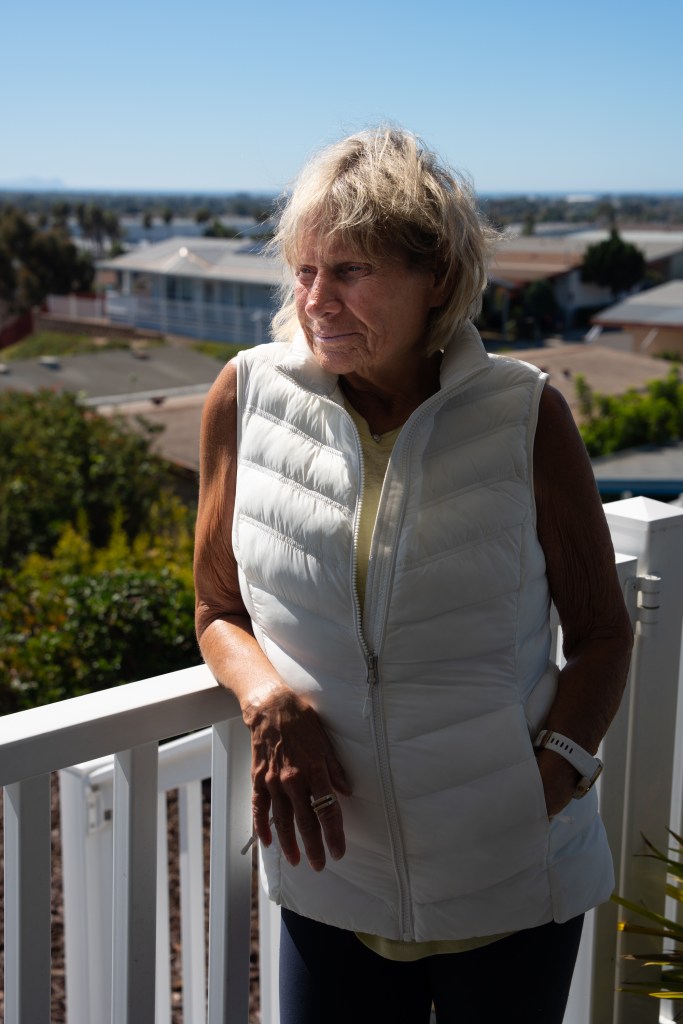 Alana Shapley, who joined the Frantz Law Group lawsuit, stands on her balcony overlooking the Tijuana River Valley on Oct. 17, 2025. Since moving to the area Shapley has suffered asthma, headaches, nausea and also contracted an autoimmune disease which caused her hair loss. (Philip Salata/inewsource)
“There has to be some real teeth on the accountability side of things,” Frantz said.
For many of the residents inewsource interviewed, money is beside the issue. Some told inewsource that if it would help solve the problem, they would put that money back toward a solution.
“The only thing that brings us together is the attorney, and that’s for monetary value,” said Magee, who joined the Frantz lawsuit.
Magee said he wants to see the end of the pollution causing residents’ health concerns.
“The best medicine is preventive medicine, and what they’re waiting on is this devastation to happen — that doesn’t make dollars nor sense.”