
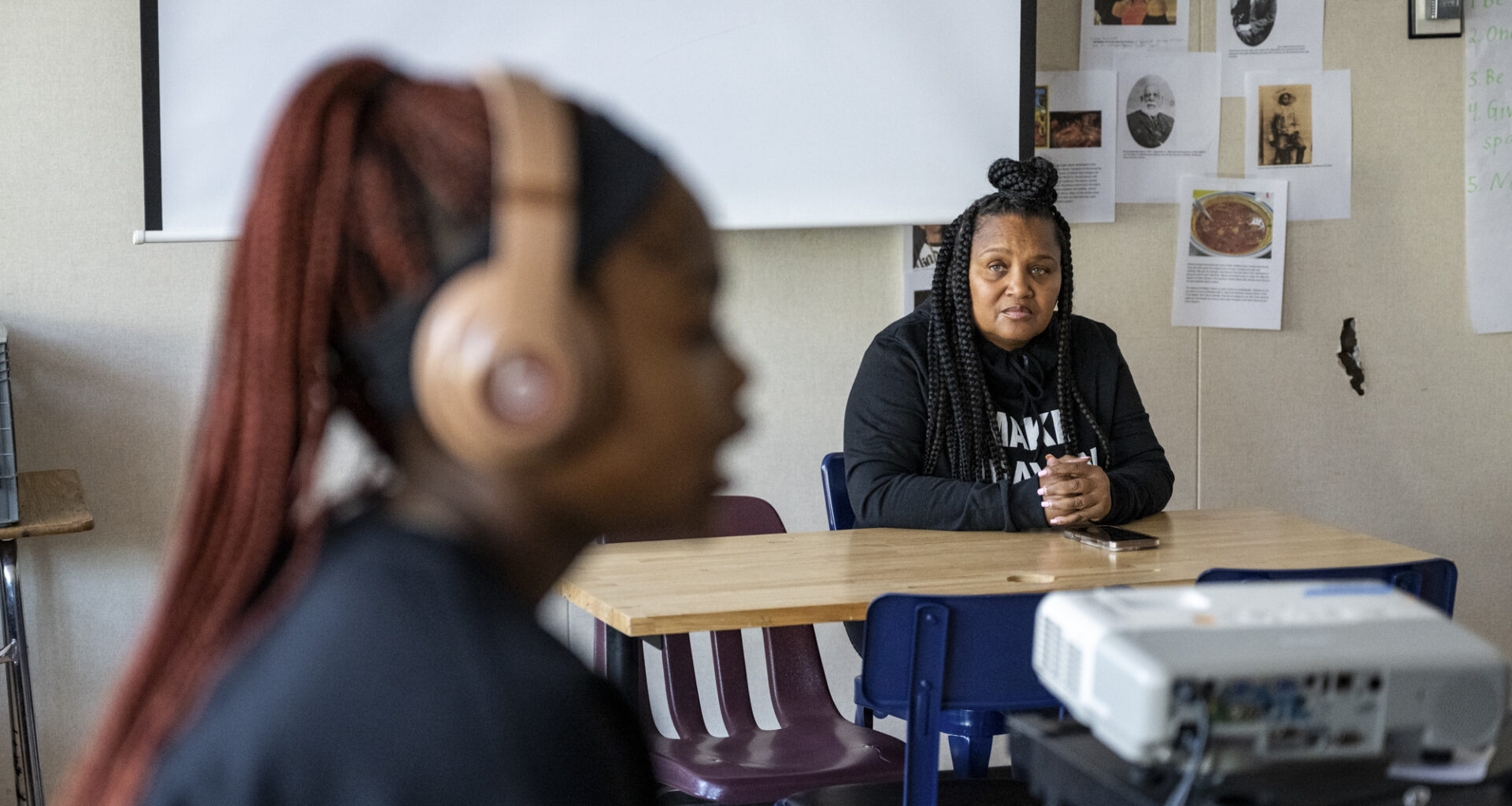
Today, Saffold asks 15-year-old sophomore Kay’Lonnie Jackson to talk about a conflict she’d just worked through. Jackson and two other girls in the group had been clashing over some gossip all week, and that morning they’d finally put it to rest.
“Our beef was over some he-say she-say stuff, and both of us was in the wrong for listening and dragging on the beef,” Kay’Lonnie said. “So as a young lady, I went up to her and addressed myself where I was wrong, and she addressed herself where she was wrong and we apologized to each other.”
This is Saffold’s goal: to teach students the skills to defuse arguments and think before they react to provocation. Progress is hard won. In this case, Saffold had met with the girls several times over three days to mediate the dispute before they eventually ended it themselves.
“Y’all was driving me crazy this week,” she said. “I felt like I wasn’t getting nowhere. So for you guys to call me today and y’all pretty much fixed it on y’all own, it just made me super proud. It let me know that you guys are listening to what I’m saying.”
When Saffold dispenses advice, it comes from someone who’s been there: She was once a student at Castlemont — and a self-described hothead who got into her share of fights and ended up in continuation school.
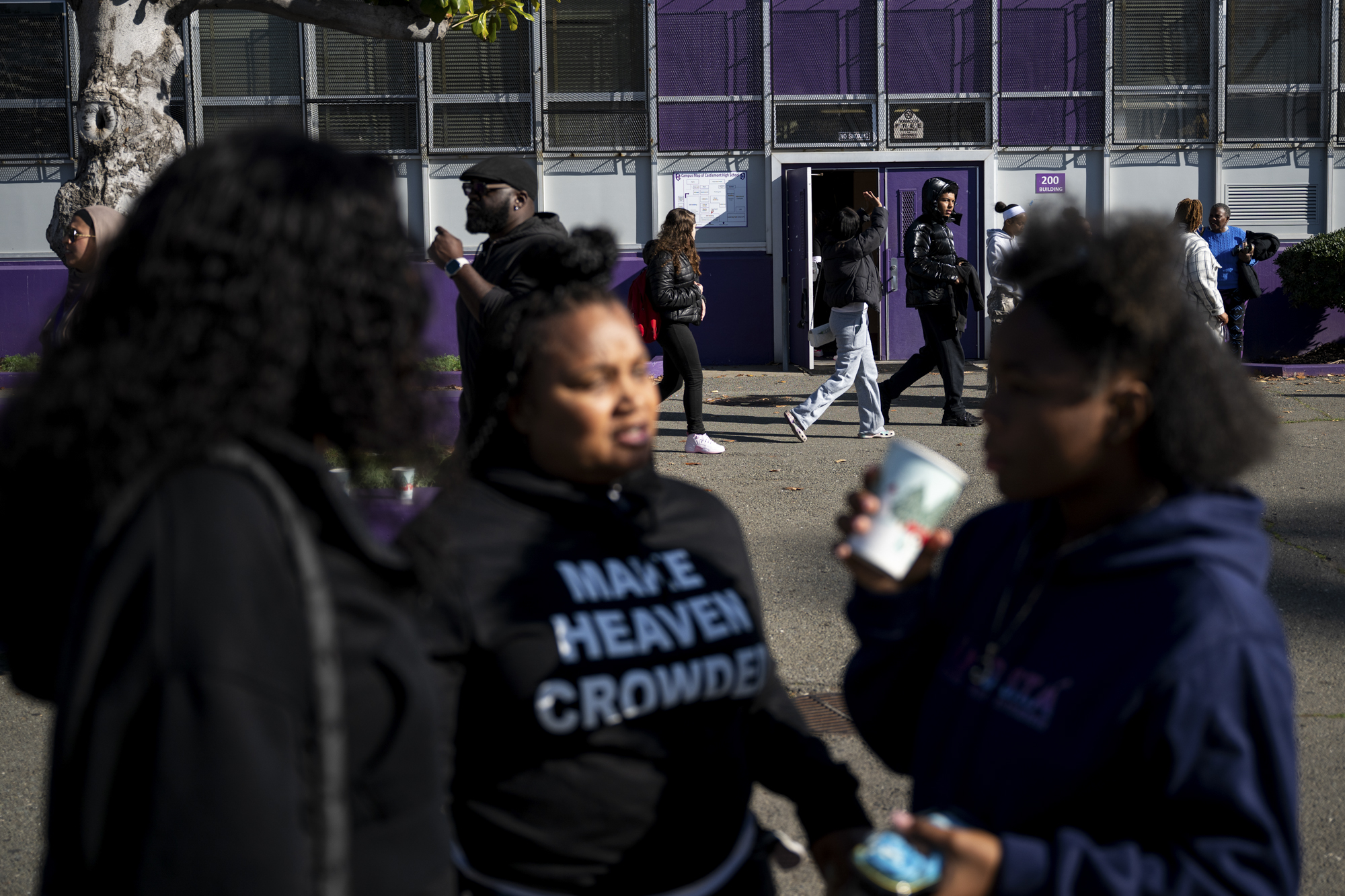 Phelisha Saffold (center), a school-based violence interrupter, talks with students during lunch at Castlemont High School in Oakland on Dec. 5, 2025. (Beth LaBerge/KQED)
Things have changed since her high school days. She recognizes the rumor mill that drives conflict, but technology has supercharged it. There’s social media, with its ability to broadcast a slight campus-wide in a second, and the way smartphones have turned students into amateur PIs. “They’ll record a conversation and take it to another student and say, ‘I got proof that this has been said,’” she explains.
Still, Saffold knows this community because it’s hers. She grew up in East Oakland, “so nine times out of ten if something is going on, I might know your mother, your grandmother, your uncle, your cousin,” she said.
In this work, which is as important as the training violence interrupters receive.
“They use that credibility, they use that experience, to gain trust with the individuals that they’re working with,” said David Muhammad, executive director of the National Institute for Criminal Justice Reform, which works to reduce violence and incarceration. “They serve as an example for these young people.”
Saffold’s connections help when she needs to involve students’ families to end a conflict — which sometimes means persuading a dad, aunt or cousin not to take things into their own hands and retaliate on behalf of their student.
Vital work at risk
Today, most large urban districts in the country have some kind of violence intervention specialists on campus, said Muhammad, who has helped lead gun violence prevention strategies in cities nationwide, including Oakland.
Here, Saffold is part of a violence prevention ecosystem developed after the district dissolved its school police department in the wake of the George Floyd protests and committed to overhauling its approach to safety. She works with the former school security officers, now called “culture keepers,” who are focused on de-escalation and trauma-informed restorative practices, along with counselors and social workers, among others.
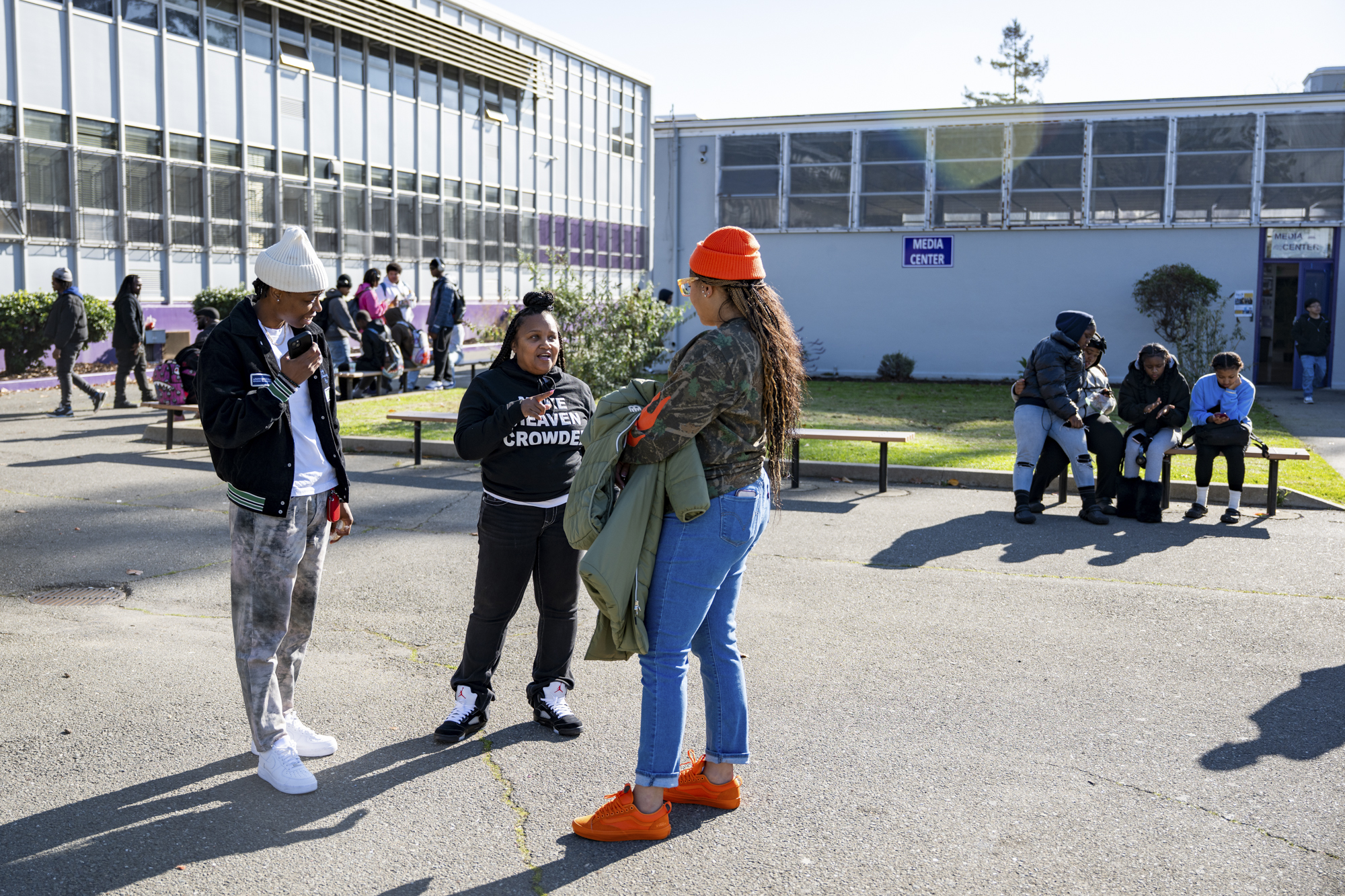 Phelisha Saffold (center), a school-based violence interrupter, talks with Tierra Rogers (left), a gender violence specialist, and Ebony Gray, a case manager, at Castlemont High School in Oakland on Dec. 5, 2025. (Beth LaBerge/KQED)
Two of her closest allies on campus are the gender-based-violence specialist, who focuses on dating violence, sexual assault and exploitation, and the life coach, something between a mentor and a case manager who works intensively with students. The trio is part of a pilot program rolled out at seven high schools across the district beginning in 2022.
These three-person School Violence Intervention and Prevention Program teams are paid for by the city’s Department of Violence Prevention using money voters allocated for improving public safety through 2014’s Measure Z. The department funds community-based organizations like Saffold’s employer, the nonprofit Youth Alive, to carry out the work.
A city-funded evaluation of the program by the Urban Institute, a nonprofit research organization, found that from its start in 2022-23 through the end of the 2023-24 school year, violence interrupters held 681 mediations. Almost 60% were proactive, while 11% were aimed at preventing retaliation. Overall, evaluators called the pilot program “promising,” though they noted that it was understaffed and underresourced.
But funding is set to sunset at the end of the school year, and the district is in no position to pick up the tab — the Oakland school board just approved a plan to cut $100 million from next year’s budget amid leadership turmoil as it looks to avoid another state takeover.
Nelson Alegria, the district’s newly minted executive director of safety, said administrators parsing data to try to streamline the program might pare away positions at some schools and staff up at others. But the program as a whole, he said, would stay largely intact.
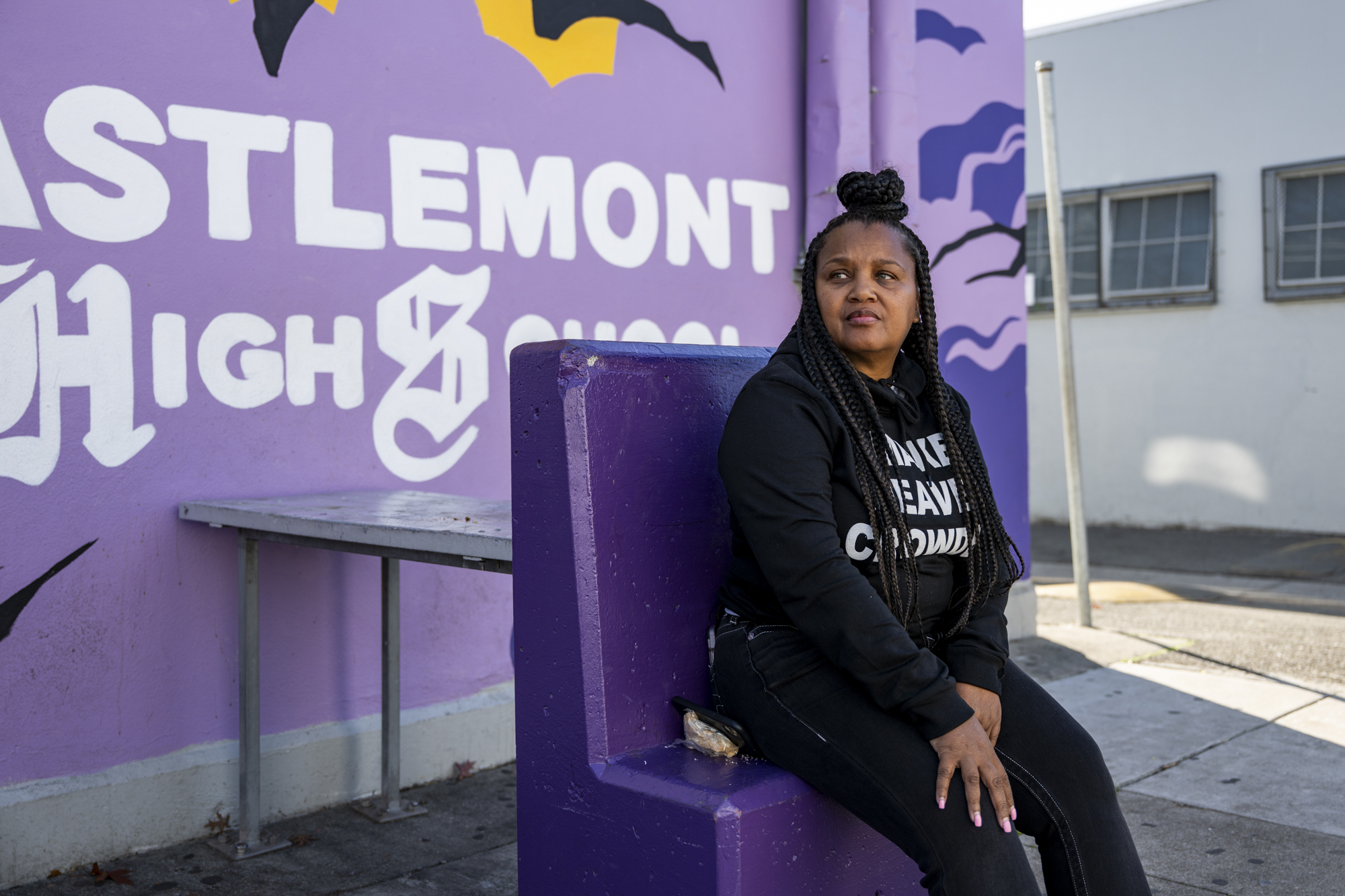 Phelisha Saffold, a school-based violence interrupter, sits at Castlemont High School in Oakland on Dec. 5, 2025. (Beth LaBerge/KQED)
“Safety is a top priority,” he said. “We want to make sure everybody understands that safety is not one of those things that we’re putting on the table to be cut.”
School board director Mike Hutchinson, who chairs the Budget and Finance Committee, has doubts.
“This is an extreme financial crisis of the likes we’ve never seen,” he said, noting that it could be a struggle for the district to fund even its core educational programming. “I’m concerned about a lot of our programs, from our culture keepers on campus to our restorative justice programs to definitely our violence interruption teams.”
Hutchinson said he plans to sit down with the head of the Department of Violence Prevention to discuss alternative funding sources, citing the Skyline High shooting as proof the district needs to double down on violence interrupters.
For Castlemont’s principal, Joseph Blasher, their work is essential. “You can’t learn if you don’t feel safe,” he said.
He credits campus violence prevention efforts for helping to boost attendance and cohort graduation rates and get families more engaged.
“I couldn’t imagine all of us just having to leave the campus. That would just be traumatizing,” Saffold said. “Not just for the students — I think for us as well, because we build these bonds.”
More than just a job
Bonding with teenagers and getting them to open up, even those Saffold has grown closest to, is a skill that takes constant upkeep.
Saffold’s is on display when she spots junior Tamiya Easley, 17, at lunch one afternoon. “You know we need to talk, right?” Saffold said. “About yesterday.”
Tamiya tries to dodge her. “What did I do yesterday?” she asks. “I didn’t even do nothing yesterday!”
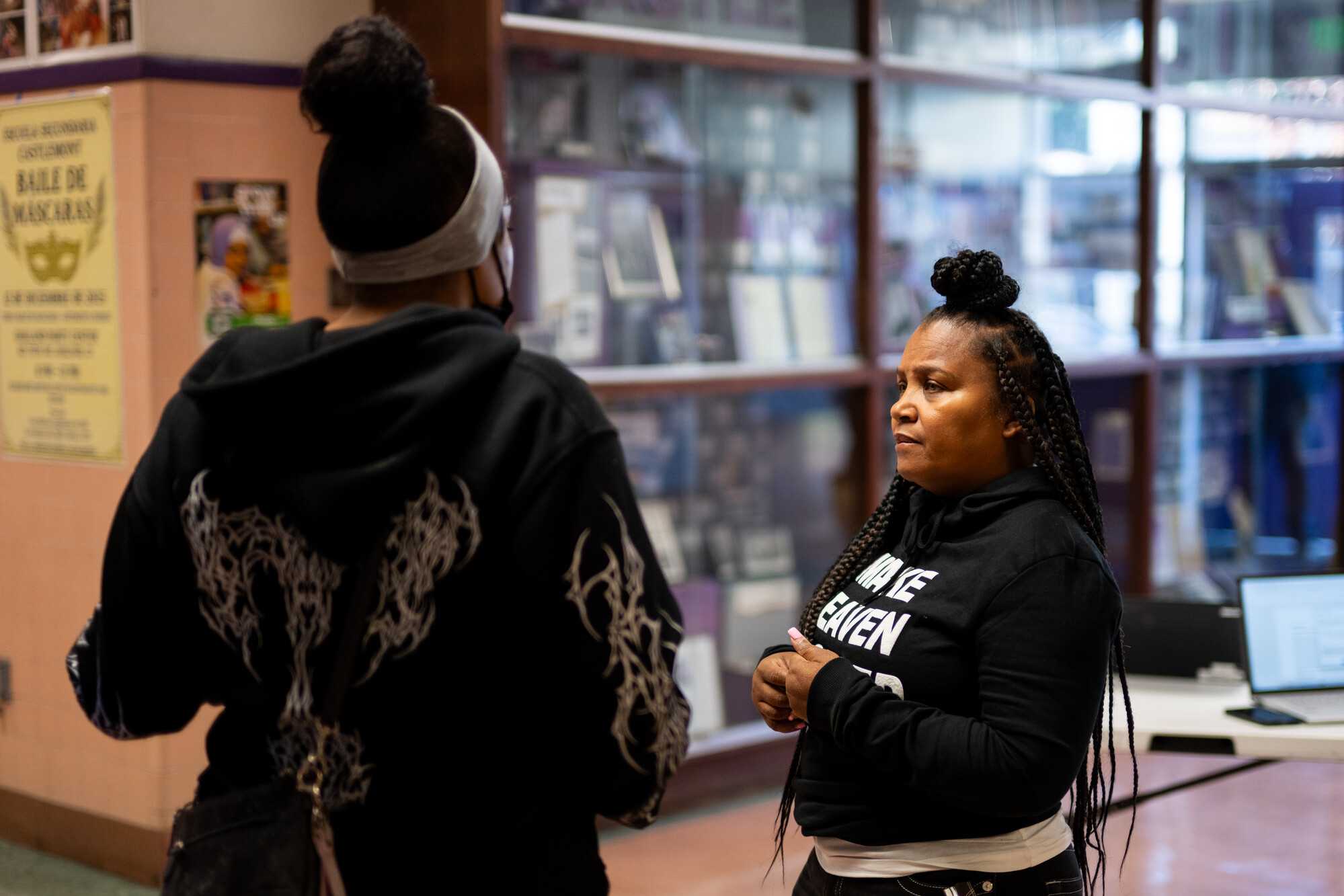 Phelisha Saffold (right), a school-based violence interrupter, talks with a student at Castlemont High School in Oakland on Dec. 5, 2025. (Beth LaBerge/KQED)
“We’re going to talk about it,” Saffold said with a laugh. She gives Tamiya a sly smile and another warm “We’ll talk about it.”
That disarms Tamiya. “Oh, when I was upstairs tripping?” she said.
“Yes, you of all people,” Saffold said with a tone that let Tamiya know she expected better.
“Mom! It’s because I don’t like disrespect.”
Tamiya explains that she heard some students had been talking about her. She got heated, and they got defensive. But she ended up apologizing, and it blew over.