
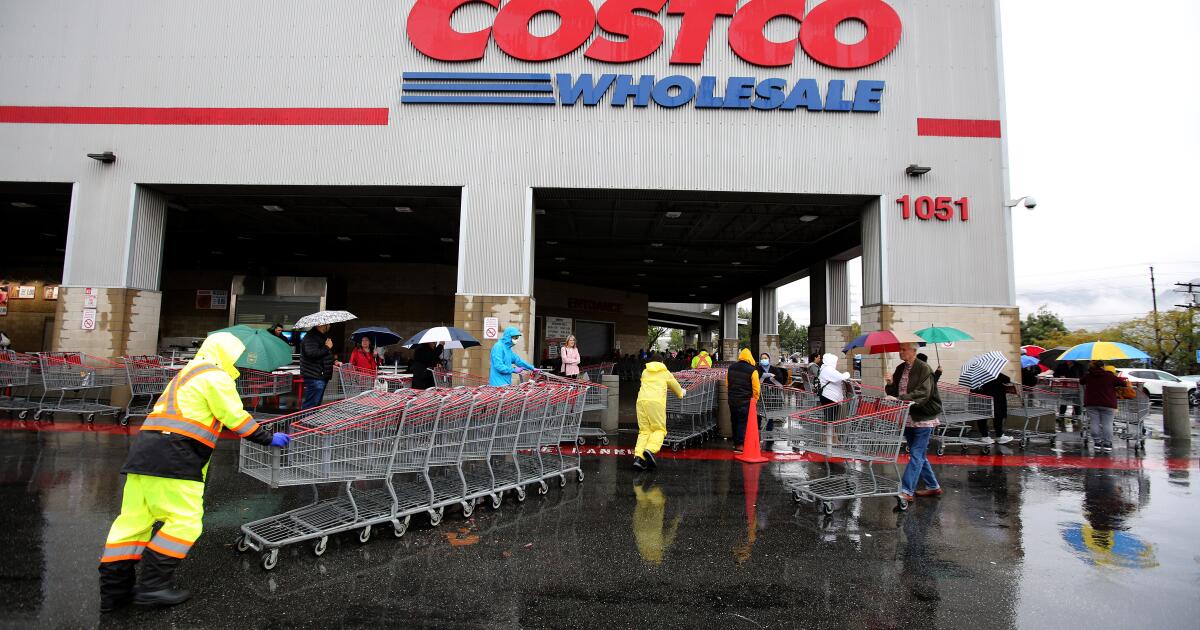
In hopes of attracting the first Costco to Brea, city leaders agreed to a 50-year sales tax rebate with a local developer if he executes a lease with the corporation.
The Brea City Council Tuesday voted to approve the agreement that gives developer Dwight Manley a year to bring a Costco to Brea to a northern parcel of a 34-acre property he is in the process of acquiring.
The agreement will rebate Manley 100% of the sales tax revenue generated by a future Costco in the first two years alone. Over the course of the 50-year agreement, the city would collect 42.5% of the sales tax.
“Costco does not enter into agreements with cities,” Manley told the council. “It’s up to the property owner. They’ve had property owners do this in many instances where cities participated because they wanted a Costco.”
Manley, who owns properties in downtown Brea and elsewhere throughout the city, claimed that four months of negotiations between Hines, the real estate investment firm that currently owns the property, and Costco hit a wall. Other bidders, he said, are interested in developing an Amazon warehouse or high-density housing on the site.
Last month, Manley sent an application to the Community Development Department suggesting a sales tax rebate agreement be considered in the quest for a Costco.
The council considered terms that would see Brea collect about $50 million in sales tax while reimbursing Manley $83.5 million.
“This is the skinniest developer deal I’ve ever heard of,” Manley said of the agreement.
Both Manley and the city are eyeing the Beckman Coulter headquarters at 200 South Kraemer St. as a potential location of a future Costco.
The property site is also near the bucolic Country Hills Estates neighborhood where homes sell for upward of $1 million.
Residents turned out for the meeting to oppose the rebate agreement as the first step toward bringing a Costco near their neighborhood.
“It’s time to put citizens first and just say no,” said Mark Strom, a longtime Brea resident. “Costco stores belong in large commercial complexes, not adjacent to an already highly-congested residential area.”
David Cain, a former finance director in Fountain Valley, criticized the economics of the agreement.
“It takes 30 years for the city to get a 50-50 share on this agreement,” he said.
“The other issue that’s significant is that you’re giving away future money that you don’t even have yet,” Cain added. “If the city were to go after an additional transaction sales tax measure in the future — we have not done that here — but let’s assume we go after that additional 1%, this agreement says the developer gets 40 cents on the dollar of that additional money. That shouldn’t be in that agreement in any way, shape or form.”
Cain described the rebate agreement as the “worst sales sharing agreement” he had ever seen in his career.
City staffers noted Brea’s history of promoting development and argued that the demise of redevelopment agencies left it in need of new strategies.
Data shows Brea residents travel to neighboring cities like La Habra, Fullerton and Yorba Linda to go on Costco runs, Community Development Manager Melissa Furio told the council.
“None of those [sales] have an economic benefit to the city of Brea,” she said.
Manley said the property sale exceeds $100 million, with the full price set to be disclosed next month. He argued that he is assuming the risk and putting up all of the money.
The rebate agreement also requires 5% of his share be withheld by the city and redirected to the Brea Senior Center to fund its events, programs and services, a “public benefit” Manley said he proposed.
Councilmember Christine Marick, who ultimately voted “no” on the agreement, asked critical questions during the discussion.
“I don’t see a protection for the city,” she said. “Other uses that maybe we don’t have to subsidize in this way, we would be getting [sales tax revenue] all up front. I actually would love to have a Costco in the city of Brea. That is not a secret. I’m looking at this from a very financial perspective of what does happen if [the Costco] ceases to exist and [the rebate] is so frontloaded.”
Councilmember Steve Vargas supported splitting the sales tax revenue to court a Costco and a majority of his colleagues agreed in a 3-1 vote, with Marick dissenting and Councilmember Blair Stewart absent.
“We need sales tax money,” he said. “Of course, I’d like 100%, but with all of these large corporations going out…even getting a 40% split is better than nothing.”