
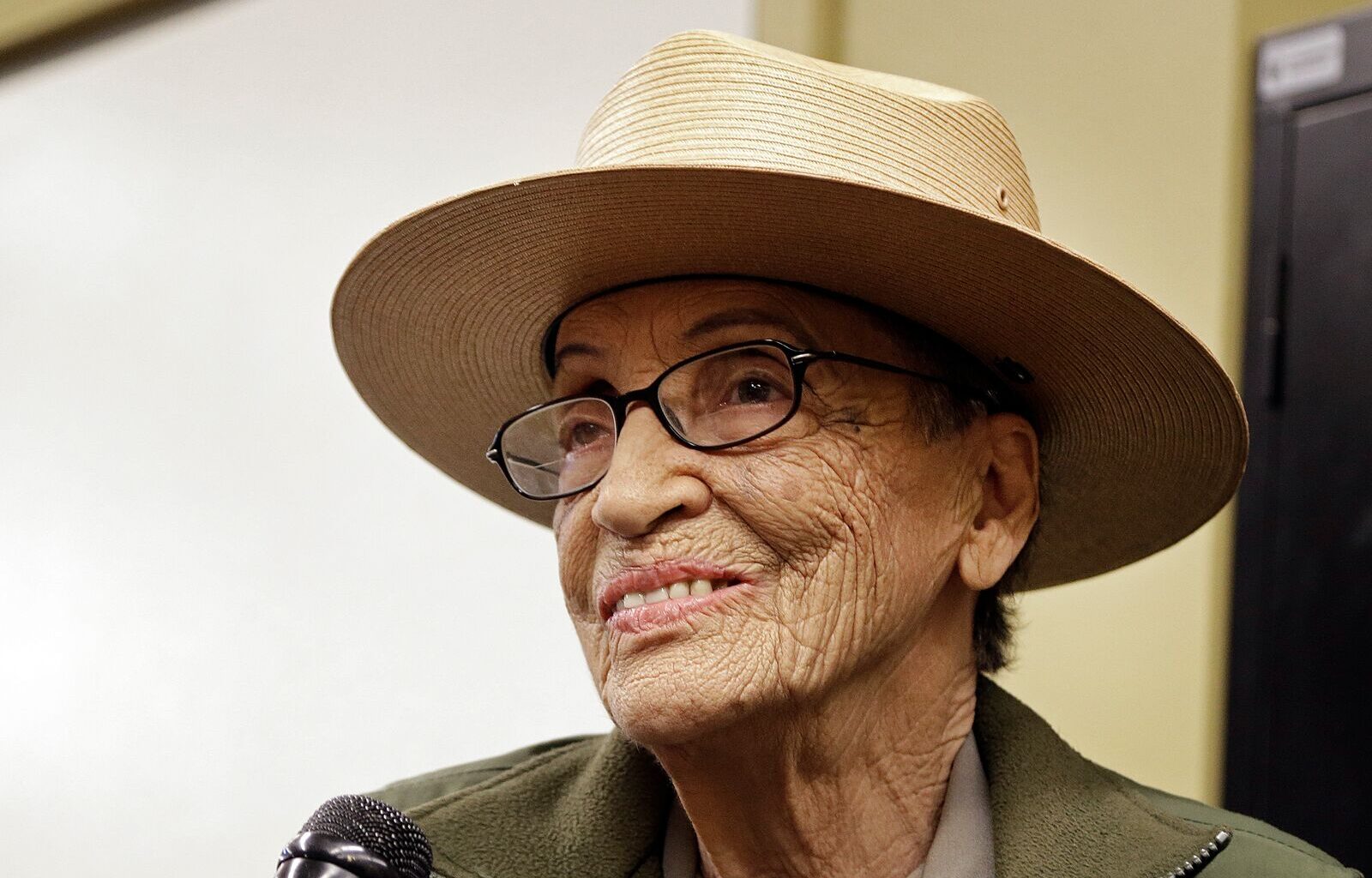
Betty Reid Soskin, who retired as the nation’s oldest park ranger, died peacefully at her home in Richmond Sunday morning, her daughter announced on Facebook. She was 104.
The post said she was with her family when she passed away. “She led a fully packed life and was ready to leave,” they wrote. A more formal obituary has since been posted.
Reid Soskin spent 15 years in the national park service, where she told visitors the stories of unsung marginalized World War II workers at the Rosie the Riveter/WWII Home Front National Historical Park in Richmond. Her service earned her a presidential coin from President Barack Obama.
She also dated Jackie Robinson, co-founded Reid’s Records in Berkeley, served as a “bag lady” (delivering cash) for the Black Panthers, and hobnobbed with the leaders of the human potential movement as a faculty wife with her second husband.
She served in a Jim Crow segregated union hall in Richmond during World War II, experienced redlining in Berkeley when she tried to build her first house, and moved to a racially hostile Walnut Creek in the 1950s. Her time sharing her lived experience as a park ranger accidentally catapulted her to fame in her 80s. In her 90s, she published a memoir recounting her many amazing experiences.
Details about a public memorial will be announced later. In lieu of flowers mourners are asked to respect their love and respect for Soskin by making donations to her namesake school, Betty Reid Soskin Middle School, where she recently celebrated her birthday with a joyous gathering among admiring children and family members who sang her the birthday song and showered her with letters and cards.
Supporters can also support an effort to finish a documentary film, titled “Sign My Name To Freedom (the same name as her memoir), about her journey to reclaim her own lost music that she had been too afraid to share. It’s scheduled to be released in 2026. Her story is also told in the film “No Time to Waste,” produced in association with the Rosie the Riveter Trust.
A clip from “Sign My Name to Freedom,” a documentary about Betty Reid Soskin’s hidden life as a singer/songwriter and a Civil Rights pioneer , and her journey to re-explore her music 60 years later.
Word of her passing spread quickly on Sunday afternoon. Within an hour of the announcement being posted, more than 300 people had paid their respects online, with the number later swelling to over 600. Among the comments:
She was a blessing to multitudes.
A great one to always remember!!
A national treasure.
Oh, such a great spirit and wonderful author, speaker, and inspiration to so many people
Hopefully we can carry on with her insistence to have the truth known.
Reid Soskin reinvented what being middle-age is all about
At her September birthday party, she said in an interview that her life really began at 50, when she could finally focus on shaping her own definition of who “Betty” really was.
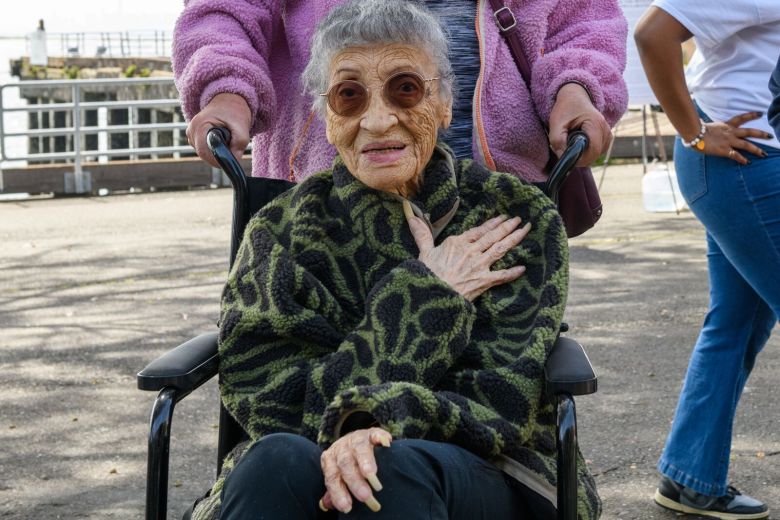 Betty Reid Soskin attended the 25-year celebration of the Rosie the Riveter park in Richmond last March. Credit: David Buechner for Richmondside
That new version of herself after 50 was many things. An established songwriter — she and her husband opened Reid’s Records, one of the first Black-owned music stores in Berkeley, in 1945. A filmmaker. An author (she even was a blogger). And a storyteller of people of all colors.
“We work to get to 50 but then we get there and we begin to wonder how long it’s going to be,” Reid Soskin said. “We never stop to realize that that is exactly what it is. We only have today.”
Put simply, she was a woman who rewrote what it means to be “middle age,” as she started her park service stint at age 84, published her book at 96 and was among Glamour magazine’s women of the year at 97, telling the magazine:
“History has been written by people who got it wrong. But the people who are always trying to get it right have prevailed. If that were not true, I would still be a slave like my great-grandmother.”
A description of her book, at the time it was published, captured the incredible breadth of what her life bore witness to:
“In Betty Reid Soskin’s 96 years of living, she has been a witness to a grand sweep of American history. When she was born in 1921, the lynching of African-Americans was a national disgrace, minstrel shows were the most popular American form of entertainment, women were looked at suspiciously by many for exercising their right to vote, and most African-Americans in the Deep South could not vote at all.
From her great-grandmother, who had been enslaved until she was in her mid-20s, Betty heard stories of slavery and the difficult times for Black Folk that immediately followed. In her lifetime, Betty has seen the nation begin to break down its race and gender biases, watched it nearly split apart in the upheavals of the Civil Rights and Black Power eras, and, finally, lived long enough to witness both the election of an African-American president and the re-emergence of a militant, racist far right.”
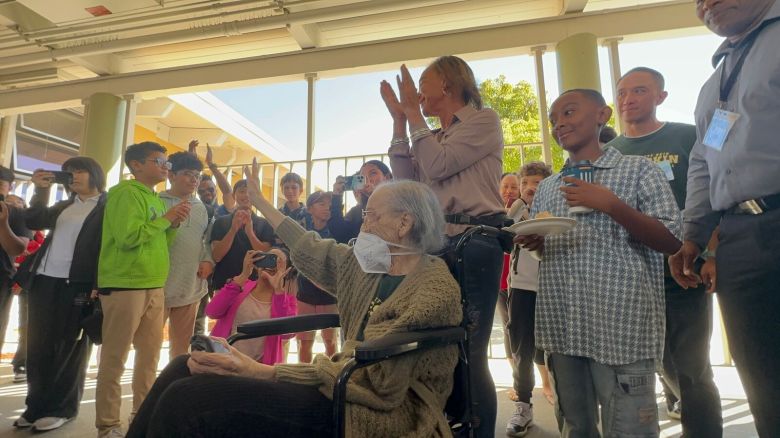 Betty Reid Soskin greeted well-wishers at her 104th birthday party at Betty Reid Soskin Elementary School in El Sobrante. Credit: Jana Kadah/Richmondside
In her own words, writing through torrents of tears
Those who miss her already might find comfort in perusing her own words, as between 2003 and 2019 she was a prolific writer, hosting the blog, “CBreaux Speaks,” with “breaux” an apparent nod to her Louisiana heritage, meaning cajun slang for “friend.”
In what appears to be her last post, on Aug. 7, 2019, written through sobbing tears, she said, details her memories of crossing the Mason-Dixon line on a 1935 train trip from the West Coast to the South at the age of 14, unaware that the imaginary line marked the very real point at which segregation practices were enforced.
The Black passengers had to be marched into a car of their own, and as the realization of what this meant sunk in, Reid Soskin experienced a life-changing shift.
“Shame and humility had been absorbed through every pore,” she wrote. “I would carry them the rest of my life after that long and awkward march of disembodied shame and inexplicable humility. This would be the moment in history when my racial identity would be forever baked into my being; where my black identity would become irrevocably fixed.”
Yet she also saw that she was part of something larger, as once everyone was together they enjoyed good food and music and warmth.
“Even at 14, I was made aware by that experience that I was part of a larger family, at least temporarily. I believe that this is what sustained me through the Sixties, that feeling of an unbreakable relatedness to that greater cause.”
“*” indicates required fields