
Over two weeks since the death of Alberto Rangel, a social worker at San Francisco General Hospital’s Ward 86, an outpatient HIV/AIDS clinic, staff and patients are left questioning what could have been done to prevent his killing.
Rangel was stabbed repeatedly by a patient who had been reported to hospital security for abusive behavior and threats made toward a doctor two weeks prior to the attack. There were plans in place to ban that patient, Wilfredo Totolero Arriechi, from the ward.
In the days following the attack, the sheriff’s department issued a statement saying that a deputy intervened “without hesitation.” The sheriff’s union subsequently issued its own statement, writing that the deputy was “close enough” to “rapidly … intervene within seconds.” The deputy, the union’s statement read, prevented a “mass-casualty stabbing.”
The statements have unsettled those on the floor during the attack. What they witnessed was decidedly different. “I’m flabbergasted that no one stopped him,” remarked a staff member at Ward 86.
Mission Local constructed a timeline of the essential hours and minutes preceding Rangel’s death. This account comes from five eyewitnesses present at Ward 86, where the attack took place, and one present at the clinic Totolero Arriechi visited earlier that day.
Thursday, Dec. 4, 8 a.m. — Wilfredo Tortolero Arriechi arrives at City Clinic
Wilfredo Tortolero Arriechi, 34, was waiting outside San Francisco City Clinic at 356 7th St, which provides free STD testing and medication. It opens at 8 a.m. A nurse, whose name has been withheld, said Tortolero Arriechi repeatedly asked to see a doctor who worked at both the clinic and Ward 86. His behavior, she noted, was “odd” and erratic.
“It was kind of psychotic talk,” she recalled. Tortolero Arriechi demanded to see the doctor to “give him something,” and threatened a lawsuit. “I will keep coming back until I find him,” he said, according to sources.
It was not the first time the nurse had seen Tortolero Arriechi there. The patient had come to the clinic several times over the prior few weeks, asking to see the same doctor, she said. Each time, she said, “The behavior was escalating.” It was “getting worse and worse,” she said. “It was ramping up.”
At the time, City Clinic did not have metal detectors, so it is unknown whether Tortolero Arriechi entered the clinic with a weapon. Since then, the clinic, along with Ward 86, has added a security guard with a metal detection wand.
8:15 a.m. — Tortolero Arriechi leaves the clinic
Staff at the clinic’s registration desk managed to calm Tortolero Arriechi long enough to convince him to leave, the nurse said. Tortolero Arriechi left within 15 minutes, she said. The nurse did not know what his plans were, or where he was going.
Basil Price, the director of security at the Department of Public Health, had been aware of Tortolero Arriechi’s fixation on the doctor for weeks. The Department of Public Health listed Tortolero Arriechi “under investigation” in a November document obtained by Mission Local.
That document outlines a security meeting among DPH leaders, the sheriff’s department and private security. Among the topics discussed: Tortolero Arriechi’s reported abusive behavior towards the doctor he would seek out at Ward 86 on Dec. 4. Tortolero Arriechi is described as having displayed “repeated angry outbursts” and “overt anger” towards the doctor.
Tortolero Arriechi sought regular care at Ward 86 and last visited on Nov. 20, sources said. His behavior had grown concerning, and doctors planned to inform him that he could no longer receive treatment at that facility. Sources at Ward 86 say they repeatedly tried to contact Tortolero Arriechi leading up to Dec. 4 to tell him he could no longer visit the clinic.
8:30 a.m. — City Clinic alerts security
Approximately 15 minutes after Tortolero Arriechi left San Francisco City Clinic, sources from Ward 86 report that Price, the director of security, received two calls: one from an unknown staff member at the clinic, and one from the doctor who he threatened.
Price made the decision to call for a sheriff’s deputy to be deployed to the ward, where the doctor was scheduled to be working, sources said. The ward does not usually have a deputy present, nor does it employ any other security personnel, metal detectors or other security measures to protect patients and staff.
Ward 86 and the other six clinics in Building 80, however, will call security when needed. Those who work in the building know when security has been called by the presence of a guard sitting near the elevator at the ground floor entrance, monitoring who goes up the elevator.
In the past, said sources from the ward, one or two deputies have been sent when a threat was made. Witnesses who spoke to Mission Local said only one deputy was seen during the morning and afternoon before and during Tortolero Arriechi’s attack. That one deputy went up to the sixth floor. No one was monitoring the traffic going up the elevator.
Tortolero Arriechi’s whereabouts for approximately five hours from 8:15 a.m. to 1 p.m. are unknown. Though if he traveled directly on foot, it would have taken approximately 36 minutes to reach the Potrero hospital from the South of Market clinic.
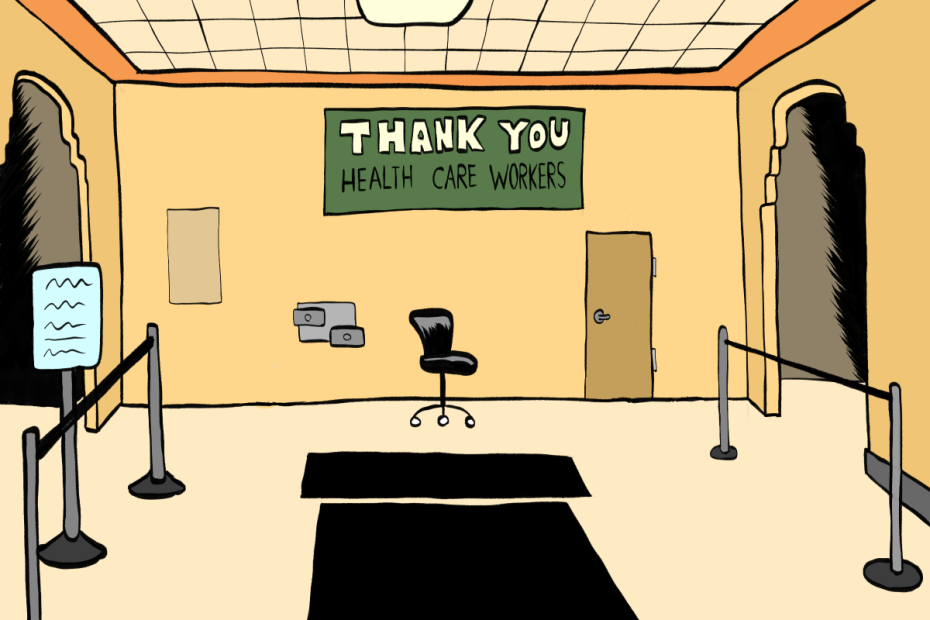 At the entrance to Building 80, staff at Ward 86 say a deputy is stationed, when called, near the elevator. On Dec. 4, when Alberto Rangel was stabbed, witnesses say the deputy was not present. Illustration by Neil Ballard.
1 p.m. — Ward 86 opens and sheriff’s deputy arrives
After Ward 86’s staffers took their lunch breaks, the clinic opened for the day and began receiving patients.
One of the ward’s nurses, Jessica Hoopengardner, began her daily duties. She checked in five patients, she said, and told them to wait in the waiting room until their appointment time.
Hoopengardner, along with another regular patient, was surprised to see a sheriff’s deputy — the ward doesn’t usually have security on site. She said she was uncomfortable with his presence.
“I just thought it was weird,” said Hoopengardner. “There’s never cops here.”
1:25 p.m. — Deputy is seen standing in the hallway, talking to a patient with a dog
Charles Adams was sitting in the waiting room of Ward 86.
He, too, was taken aback to see a sheriff’s deputy standing near the back stairway, near the pharmacy. Patients cannot enter using the stairway. The deputy was talking to a patient who had brought a small dog, he said.
The deputy’s line of sight was toward the front desk, on the opposite wall from the elevator — where Tortolero Arriechi would arrive just minutes later.
1:30 p.m. — Tortolero Arriechi arrives at Ward 86
Hoopengardner called her first patient of the day into the urgent care clinic, taking note of the sheriff’s deputy. After taking the patient to urgent care, Hoopengardner walked back to the front desk at Ward 86 to phone the doctor seeing patients that day. Urgent Care, she told the doctor, is full and can’t take any more patients for the day.
At approximately the same time, Tortolero Arriechi reportedly arrived at Building 80, walked past staff sitting at the building’s front desk, and took the elevator to Ward 86 on the sixth floor.
Sources note that if Tortolero Arriechi had been reported to security in the past and was barred from returning, they would likely have a photo of him on file.
1:33 p.m. — Sheriff’s deputy is seen standing near a dog
A photo taken by a staff member, timestamped at 1:33 p.m., pictures a man wearing boots and a dark green pant leg — the uniform of a deputy sheriff — standing near a staff member and a dog. Onlookers said the uniform belonged to the deputy.
Another eyewitness who spoke to Mission Local on the condition of anonymity said the deputy was seen “petting” the dog at this time.
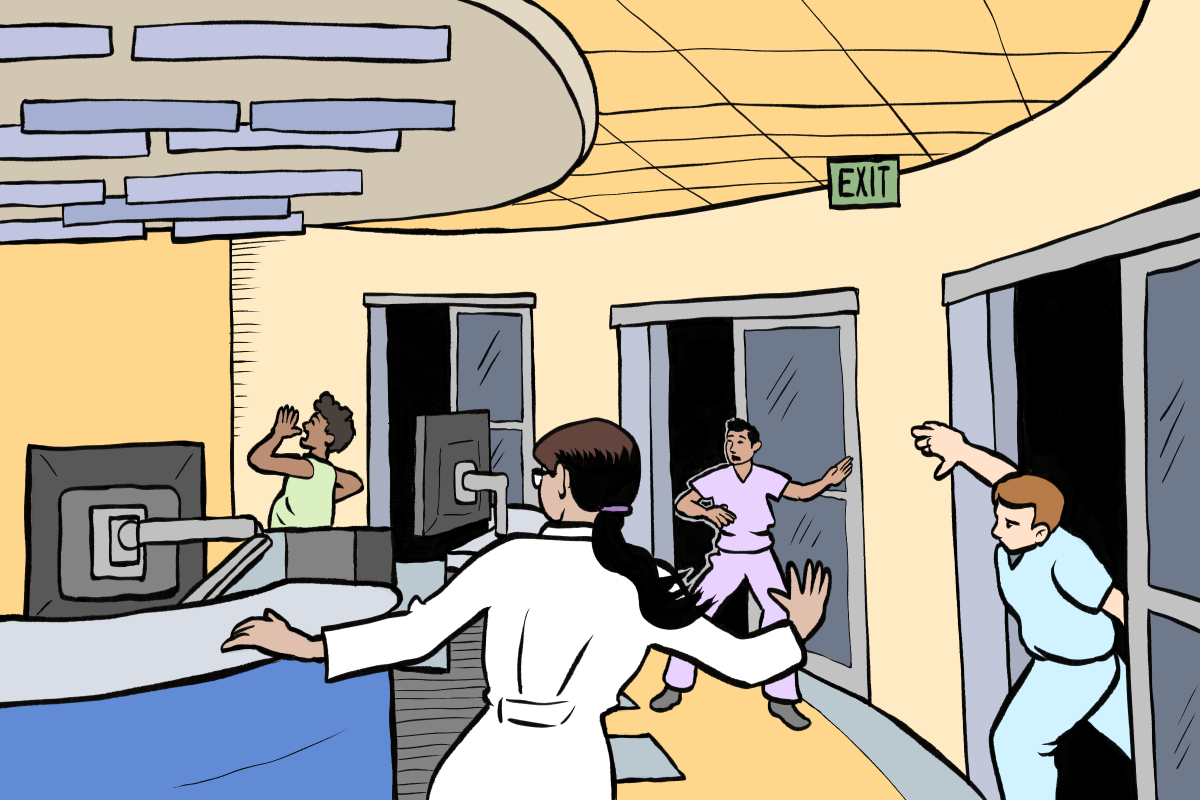
Tortolero Arriechi arrived on the Ward 86 floor. About 11 people — five staff, and a few patients, were in the room. As Tortolero Arriechi approached the reception desk, the social worker Alberto Rangel “made a bee line” for Tortolero Arriechi, speaking to him in Spanish, said sources.
Rangel began leading Tortolero Arriechi back toward the elevator. A witness nearby noted that Tortolero Arriechi “seemed calm.” Then, said the witness, “everything flipped.”
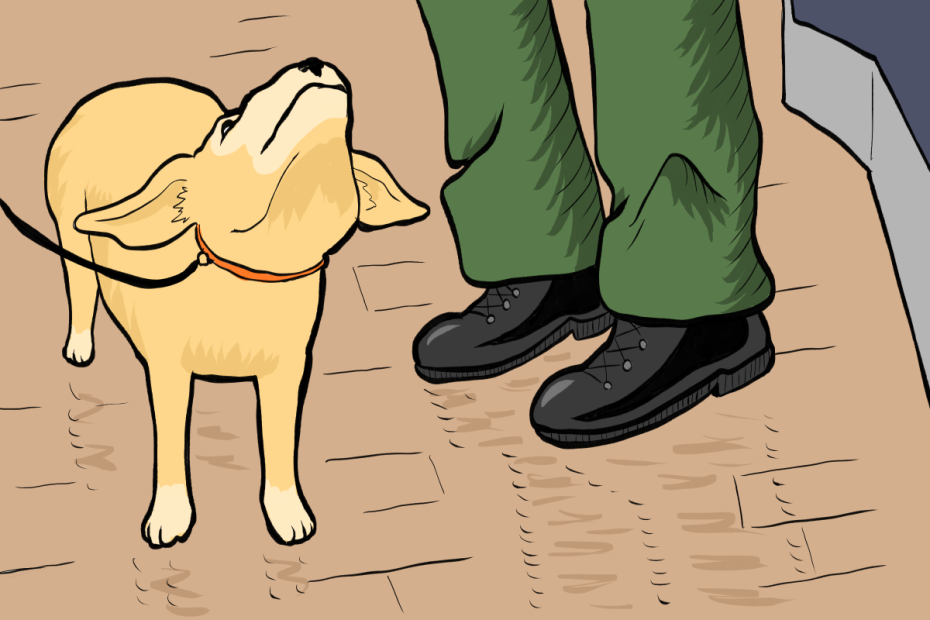 At 1:33 p.m., a staff member took a photo of a small dog near the legs of a man in a deputy’s uniform, minutes before Alberto Rangel was stabbed. Illustration by Neil Ballard.
1:39 p.m. — Alberto Rangel is attacked
Adams, who was seated in the waiting room, heard a commotion to his right — no yelling or screaming, just the sound of scuffling, he said. He looked over to see Tortolero Arriechi standing behind Rangel, stabbing him repeatedly in the neck and shoulder, before suddenly dropping a five-inch-long knife.
One witness who tried to intervene to pull the two apart said that Tortolero Arriechi was “screaming in a nonsensical way” during the attack.
Adams described seeing the sheriff’s deputy standing, frozen, as Tortolero Arriechi attacked Rangel. “He did not say a word or move toward the man that had the knife until at least 10 to 15 seconds after the man dropped the knife and put himself up against the wall,” Adams said. Adams remembered yelling “Go!” at the deputy, but did not see the deputy move until the attack had stopped.
Rangel had crumpled into a ball on the floor, said Adams. A patient in the waiting room said the same. Tortolero Arriechi stood back, with his hands in the air, recalled Adams. A group of nurses and doctors raced to Rangel and crowded around his body.
It was a “blur,” recalled a staff member. Some details given by staff and patients differ. But one detail remains the same: The intervention by the deputy and the time it took for emergency personnel to arrive were both painfully slow. The sheriff’s department, though it refused to comment on this article, has previously stood by the deputy’s actions, stating that the deputy was assigned to protect the doctor who was threatened, not to “shadow” the attacker.
Hoopengardner heard screaming and dogs barking and ran from the front desk to the hallway to see a body lying crumpled on the floor. At first, she said, she didn’t understand that it was Rangel, who was a close friend. Another nurse yelled for someone to bring oxygen, screaming, “It’s Alberto!”
Hoopengardner, in shock, ran with another nurse to a clinic room about 60 feet away, grabbed an oxygen mask and ran back. She was alarmed to see Tortolero Arriechi standing a few feet away with his shirt pulled over his head and his hands behind his neck.
Meanwhile, the nurses and staff put pressure on Rangel’s shoulder and neck to try to stop the bleeding. A staff member called 911.
At 1:39 p.m., records show the city’s emergency dispatch center received the 911 call. Within minutes, medics recorded being en route to the ward.
1:41 p.m. — Staff attempt to save Rangel’s life
Hoopengardner ran back to the clinic room to grab towels to try and stop Rangel’s profuse bleeding from his neck. Tortolero Arriechi, she said, was still standing in the same place. “There were no cops to be seen,” she said.
Then, Hoopengardner recalls she lost all concentration on Tortolero Arriechi and focused on helping her friend stay alive. Rangel’s legs were thrashing, and she knelt down to hold him down, holding an oxygen mask to his face with her free hand. Hoopengardner told him that she loved him, and urged him to stay with her.
“He was fighting this,” she said, through tears. “He wasn’t ready to go.”
Rangel lost his pulse for four minutes, she recalled. A doctor on the scene called a “Code Blue,” signaling a life-threatening emergency, and began to perform CPR.
A longtime patient sitting in the waiting room, ten feet away from the attack, remembers that “time skipped.” She saw Rangel lying in a pool of blood with doctors and nurses gathering around him, and didn’t understand who it was. “There was too much blood on his face,” she said. Once she heard that it was Rangel, she said, she screamed. “He was always so kind,” she remembered.
She remembers seeing the deputy walk slowly toward Tortolero Arriechi and pin him against a wall. He was moving “not anywhere near fast,” she recalled.
“You would think he would run, right? He didn’t,” remembered Adams. The deputy walked at a “normal pace” towards Tortolero Arriechi, and told him to put his hands behind his back. Tortolero Arriechi was already against the wall of his own volition. The deputy put the attacker’s shirt over his head and walked him to an empty room near the pharmacy, past Adams, before locking him in. After Tortolero Arriechi was apprehended, he said, “there was no sign of another deputy on the floor.”
1:44 p.m. — Staff and patients wait for ‘what felt like forever’
The rest of the patients in the ward remember being ushered into the waiting room and left in there, behind a closed door, as doctors and nurses continue to try to save Rangel’s life.
One patient recalls hearing commands and screaming outside the door of the waiting room for “what felt like forever” until she heard the sound of a paramedic’s radio, and the voices died down.
“I just thought we were hearing him die,” she said. “I assumed they weren’t coming.”
The patient did not know if the attacker had been apprehended, or how secure the patients were in the waiting room. Adams recalls hearing voices say that Rangel had flatlined. Staff and patients argued over whether to leave the door open as one of the patients said she was claustrophobic. They agreed to leave it open just a crack.
“We were all really quiet,” said a patient. “We heard everything, it was all very loud.”
1:47 p.m. — Medics arrive on scene
After about five minutes of travel time, dispatch records show medics arrived at the scene, possibly to the front entrance of the building.
1:50 p.m. — Paramedics render aid
Staff and patients report that paramedics did not arrive for at least 10 minutes after Rangel was stabbed. Hoopengardner helped transfer Rangel onto a stretcher before he was taken from Ward 86 to San Francisco General’s emergency department, 0.3 miles from Ward 86.
A patient in the waiting room sent an email, timestamped at 1:50 p.m., to her therapist
“They are screaming in hall. Staff. They just yelled that he’s breathing … We have a pulse. I don’t know who it was, was so fast,” the email read.
2:02 to 2:04 p.m. — Rangel is transported to the hospital
At the hospital, Rangel immediately underwent extensive surgery in an attempt to repair severe injuries to his neck and shoulder.
The surgery was unsuccessful, and he was put on life support, sources said. Over the next two days, friends, family, and colleagues said their goodbyes. Rangel was surrounded by family and loved ones, including his husband, when he died on Dec. 6.
2:15 p.m. — While Tortolero Arriechi is held in a room next door, patients and staff are told to stay put
Sheriff’s deputies opened the door to the waiting room and asked patients and staff if anyone had witnessed the stabbing. They took the statement of at least one of the patients as well as a staff member who reportedly recorded the incident.
Adams thought they would want to hear from all of them, but he said that once a staff member told the deputies the attack had been recorded, they stopped pulling them aside for questioning.
Patients and staff remember being told to stay inside the building, and were informed by the deputies that Tortolero Arriechi was being held in a room next door to where they waited. A patient, terrified, messaged her therapist again at 2:14 p.m.
“The police said suspect was being held in room next to me. I wanted to stay where the police took me. But they said suspect was being held in room next to us. It was Alberto who got stabbed. They stabilized him enough to move him. They have to clean blood and then we can go out back stairs,” the message read.
“I was the only one who lost it,” she recalled. “Everyone else was calm.”
“The people in the waiting room were getting very anxious,” another patient recalled. “Several clients were having mini-breakdowns, and there was one in particular who had physical or mental disabilities who was there with his mother or sister.” They started asking, he said, if they could leave, but were told to stay put.
2:40 p.m. — UCSF issues Safety Alert No. 1
UCSF issues its first safety alert, telling staff to avoid Building 80, where Rangel was attacked.
3:04 p.m. — SFPD officers arrive
According to the San Francisco Police Department, officers arrived at the building approximately one and a half hours after Rangel was attacked.
Tortolero Arriechi was arrested by the police officers, and was charged on Dec. 8 with Rangel’s murder by San Francisco District Attorney Brooke Jenkins. He is currently being held at the hospital’s locked psychiatric ward operated by the county jail.
3:40 p.m. — UCSF issues last safety alert
UCSF issued a final safety alert, this time telling staff members that they can leave Building 80 and go home for the day.
Patients and staff left the waiting room, walking down the back stairway, down six flights of stairs, said Adams. Once the door to the waiting room was finally opened, he noted a bench moved where the body had fallen. “I did not see any person of authority on the floor,” he recalled.
No one on the floor, he said, helped them leave the building and get down the stairs. They each helped a man with disabilities walk down six flights of stairs. Some, anxious to leave, Adams recalled, went through the fourth floor door to go through the elevators instead. Others were too scared to use the elevator, and continued down the back stairs, including the disabled man and his family, said Adams.
When Adams reached the lower lobby, he was expecting to see a deputy who would take his statements, but no one was there, he said.
“So much happened in such little time,” he recalled. “It was traumatic.”
Additional reporting by Eleni Balakrishnan and Lydia Chavez.