
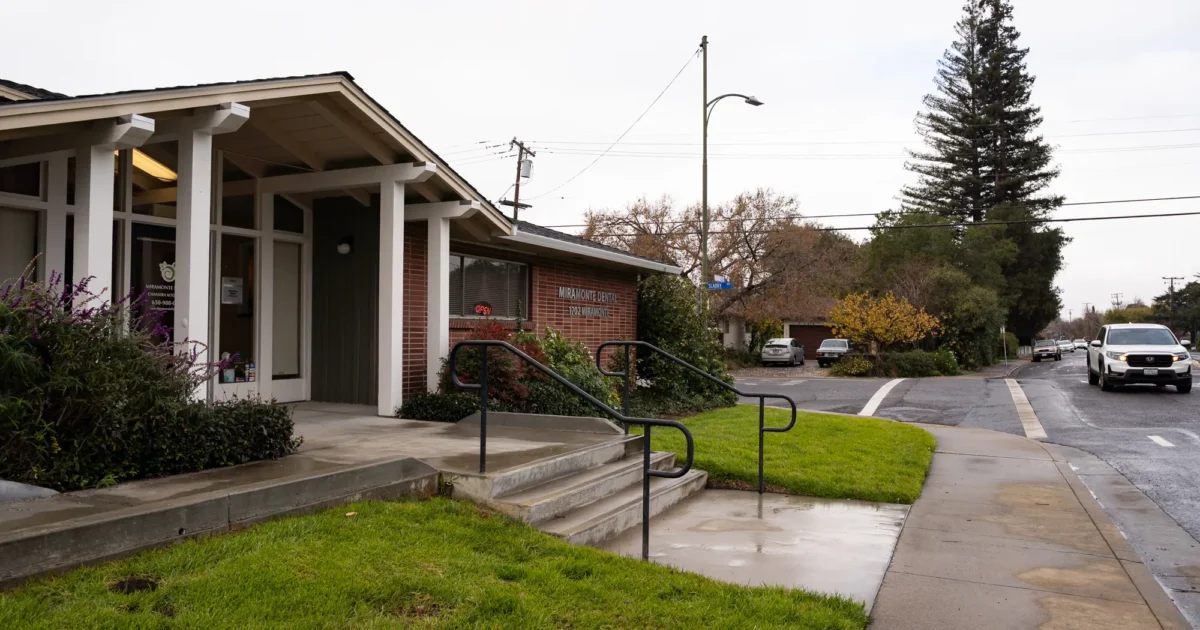
Amid objections from some community members, the Mountain View City Council has backed a plan to allow for more housing in select areas south of El Camino Real, a part of the city that is currently made up of mostly single-family homes.
In a 6-1 vote, the city council approved a motion to update land use designations and rezone certain parts of the city to support the creation of housing on existing commercial sites. Councilmember John McAlister cast the lone dissenting vote at the Dec. 16 meeting.
The rezoning of three properties in the Blossom Valley neighborhood has sparked particular opposition from people living and working in the area. Sitting at the corner of Miramonte Avenue and Cuesta Drive, 1702 and 1704 Miramonte Ave. and 777 Cuesta Drive are currently used as dental and medical offices.
Under the land use changes that the council approved, the three properties will be rezoned to allow for up to 30 residential units per acre, while still allowing for commercial uses.
The council also rezoned 1949 Grant Road, which is currently a medical facility. North of El Camino Real, the rezoned properties include the downtown Mountain View Transit Center as well as changes to 677-699 Calderon Ave., a strip mall in the Old Mountain View neighborhood with a laundromat, convenience store and restaurant.
Also rezoned were a cluster of commercial properties in North Whisman at 830, 850, 870 and 897-899 Leong Drive and 3 and 55 Fairchild Drive, which include a gas station, hotels and some vacant sites.
The changes are part of Mountain View’s implementation of its housing element, which the city council approved two years ago. The document laid out the city’s plans to meet a state mandate to facilitate the creation of roughly 11,000 new homes over an eight-year period.
Mountain View planned for the bulk of this growth to occur in North Bayshore and East Whisman. But the state also requires it to spread out some of the new housing to other parts of the city, including more affluent areas, according to the council report.
At the time, the city selected several commercial properties north and south of El Camino Real near schools, grocery stores and transit as “high-opportunity areas,” which could support more residential density and further fair housing practices. Neighborhoods south of El Camino, including Blossom Valley, are generally among the city’s more affluent areas.
“We drew a line in the sand and said, ‘We’re not going to rezone anyone’s single-family home as part of this,’” Councilmember Chris Clark said. “Obviously, that would be very unpopular.”
Despite the strategy to focus on commercial sites, the city’s plan to rezone the properties at the corner of Cuesta and Miramonte has drawn pushback. Neighbors have objected to the prospect of denser housing in an area that consists mostly of one- and two-story homes and businesses. There also are several schools and churches in the area.
While allowing for residential uses, the zoning changes do not mean that existing commercial buildings would be demolished in the short term. A developer would still need to propose a project, which would then need to go through the city’s approval process.
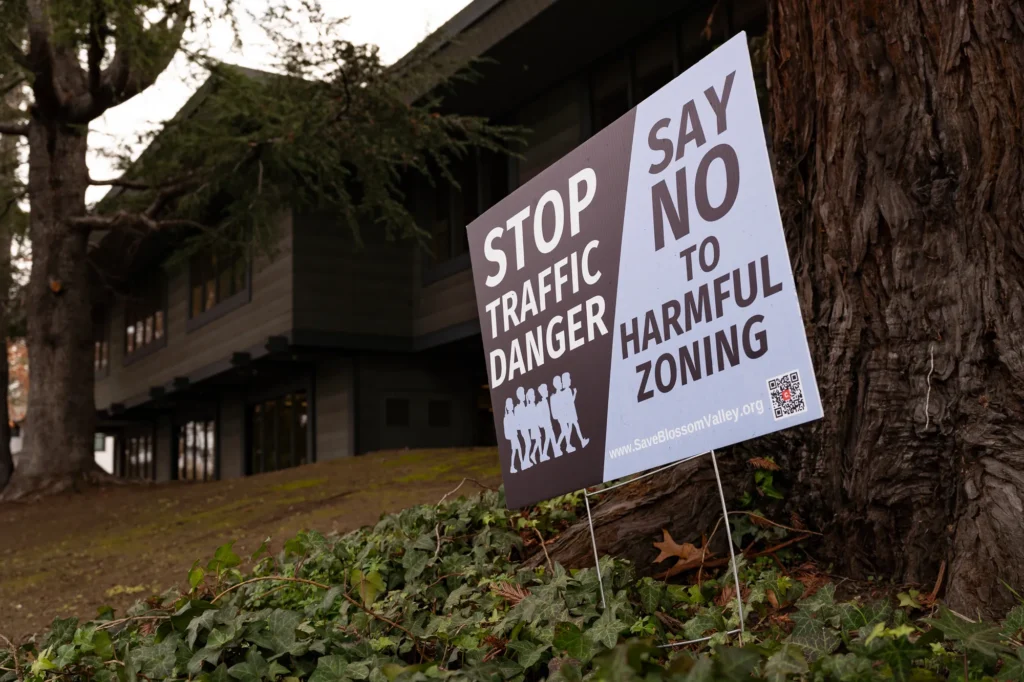 A sign opposing zoning changes outside 777 Cuesta Drive in Mountain View. Photo by Seeger Gray.
Neighbors organize in opposition
Dozens of Blossom Valley residents showed up at the council meeting with some holding signs registering their opposition to the rezoning. Public commentators described safety hazards that they say already exist at this intersection and urged the city council to select other sites.
“More housing here will create more cars and more conflict points and greater risk to the safety and health of our kids and community,” Blossom Valley resident Kristen Lenart said. Last month, Lenart and other residents launched an online petition that has gathered more than 1,100 signatures opposing the rezoning.
At the meeting, city staff proposed addressing some of the traffic challenges with short and long-term solutions, including evaluating the possibility of no left turns into or out of Sladky Avenue, which runs just north of Cuesta, and adjusting signal timings to mitigate backups at intersections.
Assistant Public Works Director Ed Arango noted that the city was also taking steps to implement street improvements along Miramonte Avenue. The city could incorporate upgrades at the Sladky intersection, either as part of the Miramonte project or separately, he said.
Public commentators however expressed skepticism about the proposed traffic solutions, describing them as a Band-Aid approach that would funnel traffic onto other streets in the neighborhood. They also expressed concerns that the land use changes would push out existing small businesses.
“I’ve invested hundreds of thousands of dollars in specialized improvements that cannot be relocated or recovered,” Lana Shukhman, one of the dentists on Miramonte Avenue, said. “These offices are not interchangeable commercial spaces. They’re longstanding health care providers that are deeply embedded in this neighborhood.”
Shukhman added that she only recently learned about the proposed zoning changes from a neighbor and not the city, a situation that several other people remarked on as well. According to city staff, mailed notices were sent out to properties within a 750 feet radius of the sites.
While the majority of public comments focused on concerns about traffic hazards and small business preservation, several speakers chimed in to express their support for the zoning changes. They noted that it could add much-needed housing in the city.
“It breaks my heart that our children aren’t going to be able to afford to live here,” Varsity Park resident Kim Ladin said. “Nurses, teachers, firefighters, the people who clean our houses, who take care of our yards, who work in the stores and the restaurants. We need to find places for them to live.”
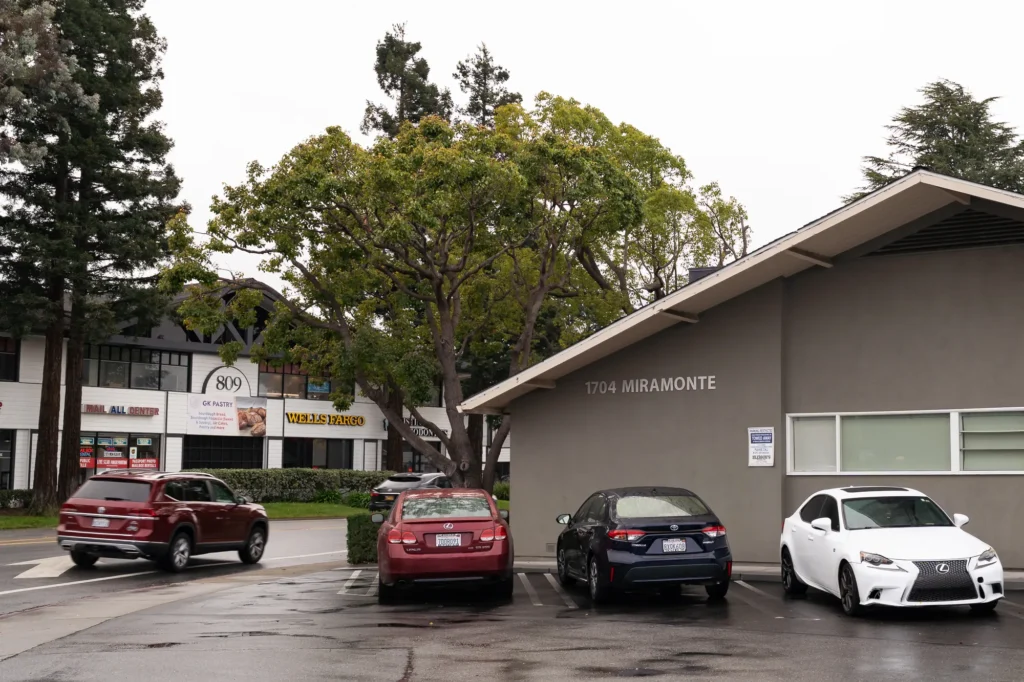 1704 Miramonte Ave. in Mountain View. Photo by Seeger Gray.
Councilmembers weigh in on rezoning
Ultimately, the city council majority voted in favor of the zoning updates, a decision that for some was tilted by information provided in a staff memo answering council members’ questions ahead of the meeting.
Councilmember Lucas Ramirez noted that state laws, specifically Assembly Bill 2011 and Senate Bill 6, could override local control and allow for residential development on some commercial sites at a minimum of 30 dwelling units per acre — the same density as the city staff recommendation.
The state laws would apply to 1702 Miramonte Ave. and 777 Cuesta Ave., according to Community Development Director Christian Murdock. There are certain physical characteristics of the properties that make them qualify under the laws, like the roadway widths adjacent to the sites, he said.
Several councilmembers expressed a preference for rezoning the sites to preserve more local control over design standards, given the possibility that state laws could provide a pathway for the same residential density — but with no community input.
“I want to do whatever preserves the greatest amount of authority for us to shape and impact whatever development project comes,” Clark said.
However, McAlister questioned whether developers would go through the city’s process instead of relying on AB 2011 or SB 6. He also expressed skepticism that the state would sanction the city if it did not rezone the sites south of El Camino Real.
According to Murdock, there has not been widespread adoption of AB 2011 or SB 6 by developers. He also noted that it was unlikely the city would be penalized immediately by the state if it failed to rezone the sites but added it was possible the state would take a close look at the city’s implementation of its housing element goals.
“I don’t think there would be a great case to say that the city’s been a bad actor and lead to decertification,” Murdock said, in reference to the city’s housing element. “But is it a possibility that those initial steps could begin? Yes, I think it’s a possibility.”
In the end, the council majority supported the plan to rezone all the proposed sites south of El Camino Real. But they made an exception for a few commercial sites north of El Camino Real that do not fall under AB 2011 or SB 6. The properties include a small Mexican market and taqueria, barbeque restaurant, dry cleaner and beauty salon at the corner of Leong Drive and Evandale Avenue.
“I want people to live in a walkable, bike(able) community where those resources are there, and they don’t need to go elsewhere,” Mayor Ellen Kamei said.
Councilmembers also commended the public for showing up to express their views, even if the outcome did not turn out the way that many of them wanted.
“It’s good that people are involved,” Councilmember Pat Showalter said. “Democracy should not be a spectator sport.”
This story originally appeared in the Mountain View Voice. Emily Margaretten joined the Mountain View Voice in 2023 as a reporter covering City Hall.