
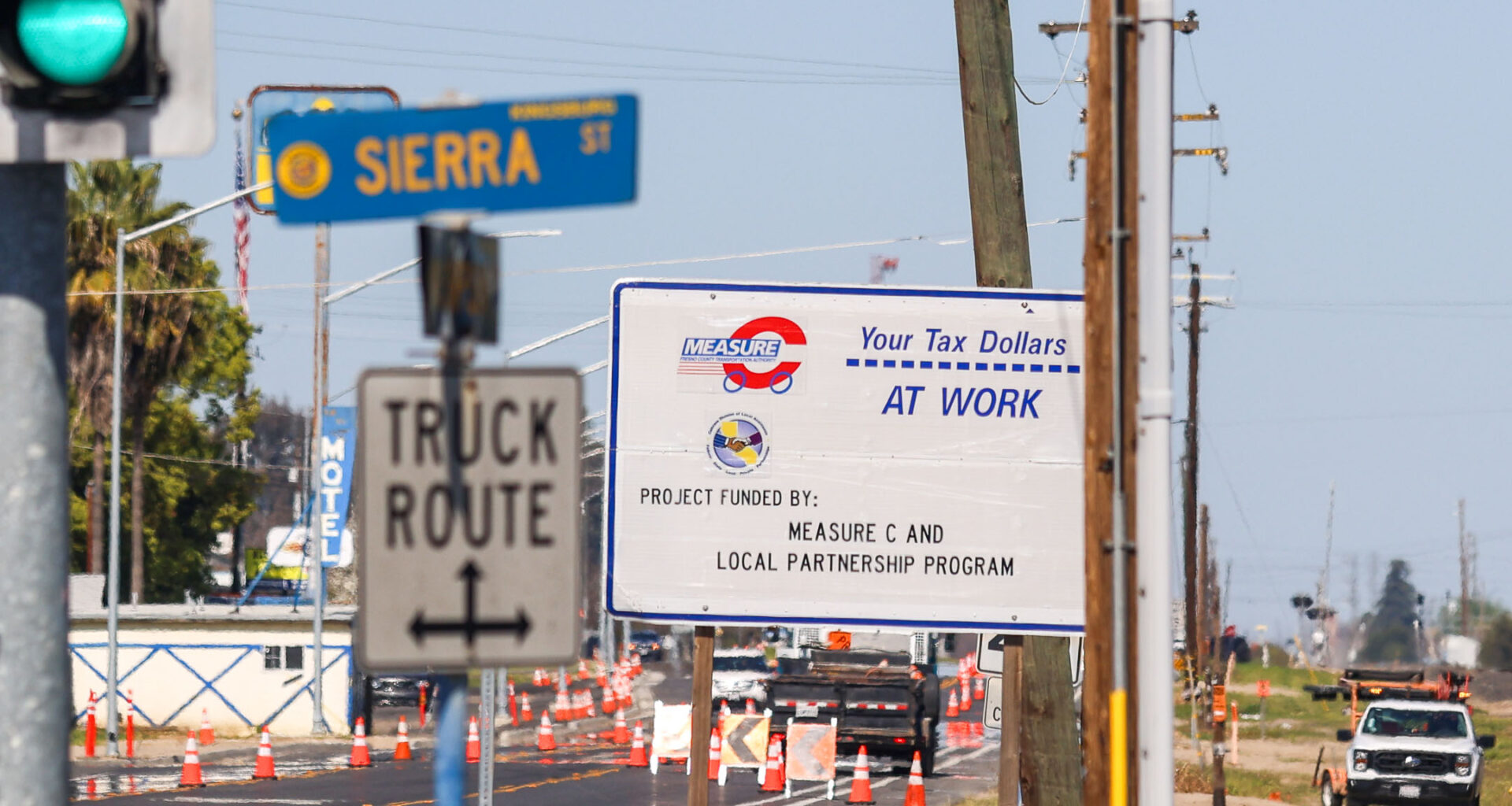
FRESNO COUNTY – With the Fresno Council of Governments Policy Board’s approval of the implementation guidelines, the fate of Measure C’s next move is now in the hands of the Fresno County Board of Supervisors.
The 16-member policy board voted 10-4, with representatives from Sanger and Huron absent, to adopt the implementation guidelines, which outline how local jurisdictions should use the tax revenue for transportation-related projects. After nearly three hours of discussion at the Dec. 18 meeting, it was Fresno Mayor Jerry Dyer who moved the vote along.
“I believe that this measure, to include the allocations as well as the implementation guidelines, although not perfect, it is good,” Dyer said. “It’s a good measure, and I think that we should be supporting it today.”
Political considerations
Voting fell along similar lines as when the board approved the allocation plan, with Fresno County Supervisor Garry Bredefeld and the mayors of Kingsburg, Reedley and Selma opposing the guidelines.
In his final comments, Dyer said the measure does not provide 100% of everything he would like to see for Fresno, just as he was sure it didn’t for Parlier, Mendota, Orange Cove, Reedley or any other city. The failed 2022 Measure C renewal effort, which Fresno played a big role in, also didn’t have everything the city would have liked, he said.
“It’s just like when I work with our city council, and all of you work with your city council, I can guarantee you don’t get everything you want. I know I don’t,” Dyer said. “And so we have to find ways to find middle ground to compromise for the good of the city, and the same holds true, I believe, for this body.”
Moving to approve the guidelines, Dyer asked for just two specific changes and directed Fresno COG staff to work with Fresno County staff to agendize the Measure C package for consideration at the Board of Supervisors’ Jan. 6, 2026, meeting.
This will be the biggest hurdle for Measure C to make it onto the November 2026 ballot, as both Bredefeld and Supervisor Buddy Mendes have said they will not support the measure in its current form. As a government-initiated tax, the measure must get approval from the board of supervisors in order to appear on the ballot.
Once it clears the board of supervisors, Measure C will also need approval from a majority of the cities that represent a majority of the county’s total population. Considering the city of Fresno accounts for slightly more than half of the county population, the measure proposal must be approved by the Fresno City Council; however, this is less of a concern for Measure C proponents, as Dyer has stated the city of Fresno’s full support for the measure.
Guideline questions
While Fresno, Clovis and all of the cities on the west side of the county have been fully supportive of the allocation plan and implementation guidelines recommended by the Measure C Steering Committee, Fresno County itself and some cities in the county’s southeast corner have been more skeptical.
Further, although the guidelines were unanimously recommended by the steering committee, Fresno COG’s two standing committees — the Policy Advisory Committee (PAC) and the Transportation Technical Committee (TTC) — did not vote to support the recommendation, Fresno COG Executive Director Robert Phipps said.
Both committees felt the guidelines were too prescriptive, lacked consistency and accuracy and needed more time to be fully vetted, Phipps said. He also noted that the policy board would be approving the guidelines subject to legal review because the law firm advising the Measure C process, Best Best and Krieger (BBK), did not have adequate time to go through them.
BBK Partner Steven DeBaun said his legal opinion was also that the guidelines were very prescriptive and read more like a specific set of requirements that need to be met in order to access funding. His recommendation was to more clearly define the role of the guidelines and address any unclear or inconsistent elements.
By doing so, this would help protect the Fresno County Transportation Authority (FCTA), which will handle the Measure C funds and distributions to cities, from any political or legal disputes. Upon questioning from policy board members, however, DeBaun confirmed that nothing in the guidelines is illegal.
Multiple policy board members said the intent was not to be prescriptive but rather to put in place stringent guidelines so that taxpayers can be assured their money is being spent as promised. They also said they felt that many of the concerns the standing committees had with the guidelines were already being addressed through technical edits.
Some board members, including Kingsburg Mayor Brandon Pursell and Selma Mayor Scott Robertson, said they would like to take more time on the guidelines to make sure everything is being done the right way.
Dyer, on the other hand, said if he has to wait multiple months for the policy board to put forward the measure, he would go to his city council to consider moving forward with a transportation sales tax solely for Fresno.
Expansion restrictions
One of the biggest sticking points for those who have opposed the implementation guidelines, as well as the allocation proposal, has been the restrictions placed on using Measure C funds to expand existing roadways.
Beyond a few specific exceptions, local jurisdictions will not be allowed to use any Measure C funds to expand their roads until all of their roads have an average pavement condition index (PCI) of 70 and a minimum PCI of 65. Even then, jurisdictions will only be able to use 5% of their allotted funds for road expansions.
“Measure C, along with matching funds and developer fees, is the main source of funding for capacity increasing projects,” Bredefeld said. “These limits make it impossible to improve traffic flow and do not meet the needs of a growing region where most people drive to work and other destinations.”
Yet Dyer and Clovis Mayor Vong Mouanoutoua said using Measure C funds to build more roads and expand roadways is what has led to all of the county’s cities and the county-controlled roads needing serious maintenance in the first place.
“The goal of this measure is, fix all your roads, get it to (PCI) 70 … and then once we get there, we’ll use the 5% if needed,” Mouanoutoua said.
Eleven members of the public spoke in favor of the implementation guidelines and the measure as a whole, while just one, Fresno County Department of Public Works and Planning Design Division Manager Mohammad Alimi, spoke against them. Alimi reiterated concerns with the measure allocations and guidelines brought up at the last board of supervisors meeting in December.
If the Fresno County Board of Supervisors rejects the Measure C proposal, the policy board could still revise the proposal and try again. Both the board of supervisors and all 15 cities in the county must consider resolutions approving or rejecting the ballot measure before the summer.
Once the measure has been circulated among all the county’s city councils, it will go before the board of supervisors one final time for certification and will then be submitted to the Fresno County Registrar of Voters. The deadline for any measure to be submitted to the registrar’s office is Aug. 7, 2026.