
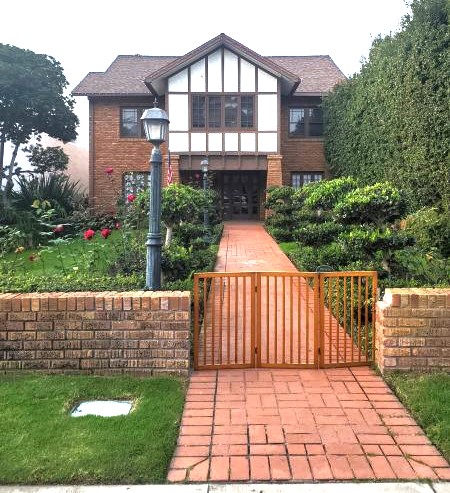
Three projects went before the La Jolla Development Permit Review Committee during its Dec. 16 meeting, with only one — a proposal for a new home on La Jolla Shores Lane — getting a vote. The other projects will return at a future meeting.
La Jolla Shores Lane
Though it was up for a preliminary review, a proposal to amend coastal development and site development permits to build a two-story, 3,189-square-foot house on a vacant lot at 9036 La Jolla Shores Lane got the committee’s support on its first hearing.
Project representative Rene Mezzo said the applicants also own an adjacent property and had looked to build an accessory dwelling unit “to link the two properties together.” But that application was withdrawn to redesign the project. The amended project before the DPR would result in a single-family house instead of an ADU.
The property is near a scenic overlook, so architect Matt Burr provided details about the house and renderings of how it would look from the public right of way. A Torrey pine tree on the property would remain.
“The interesting thing … is it shows how a view corridor can be enhanced by a carefully designed element,” said DPR trustee Angeles Leira. “I think it works very well.”
DPR Chairman Brian Will thanked the applicant team for a “thoughtful design.”
With few other questions, the board voted unanimously to recommend that the city of San Diego approve the project.
Prospect Street
A project calling for changes to a historically designated structure in La Jolla’s Village is slated to return to the committee on a future date.
The applicant team is seeking coastal development and neighborhood development permits to convert a 6,504-square-foot commercial structure at 836 Prospect St. into a 7,811-square-foot house with a subterranean garage.
Applicant representative Chandra Slaven said the project is a “historic adaptive reuse” and that the “scope is intentionally conservative to protect the historic character” of the property. She said the exterior would not be modified.
The building, known as the Sarah Beckwith House, was originally constructed in 1922 as a single-family residence but recently has contained offices, according to a city report in May.
The rear of the property, where many of the changes would take place, was renovated in the 1970s and therefore is not part of the historic designation.
“We are adding a garage to the rear,” Slaven said. There also would be “minor changes” to the landscaping “to remain consistent with the existing landscape character,” focusing more on the entry area and adding two trees.
Slaven added that because the amount of earth that would be removed “is so little,” the city determined a grading permit would not be required.
Property owner Dawn Davidson said some neighbors have been contacted about the plan and provided positive feedback.
After nearly an hour of discussion, and noting that many remaining details would not be solidified until a contractor is chosen, Will asked that the conversation be concluded and that trustees only provide requests for information the committee would like to see at the next meeting. That includes floor plans, a color-coded rendering outlining the changes, more information about frontage changes and more.
Monte Vista Avenue
Another project reviewed but not voted on would demolish a 3,290-square-foot house at 7404 Monte Vista Ave. and a 1,395-square-foot house at 7406 Monte Vista. In their place would be two new two-story, 3,752-square-foot single-family homes over basements, a new 800-square-foot ADU and a new three-vehicle carport.
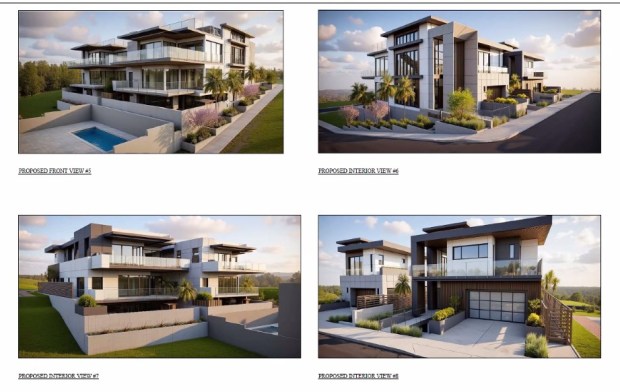 Renderings depict plans for 7404 and 7406 Monte Vista Ave. (Screenshot by Ashley Mackin-Solomon)
The proposal previously was heard in October, when DPR trustees described the design as “commercial … like an office building” and had questions about the project’s bulk and scale and whether the design fits with surrounding houses. The committee also requested improved renderings and a landscape plan.
Though that information was provided on the project’s return, Leira had additional concerns about the carport and whether it would qualify as such and therefore not contribute to the floor area ratio (the size of a development in relation to its lot). She argued that the use of support structures on two sides to hold up a balcony above the carport prevented those sides from being completely open, as required by city code to qualify as a carport.
“It’s a garage,” Leira said, arguing that its square footage should count toward the FAR. “There are walls and building on top of it … so you have a garage. You might as well call it what it is. … It’s not a carport.”
Applicant representative Michael Morton acknowledged that if the carport’s square footage were included in the FAR, the project would be larger than local zoning regulations allow. He added that the city had not yet commented on the carport design.
The applicant team agreed to return at a future meeting, hoping to have documentation from the city supporting the developer’s determination that the carport does not count toward the FAR.
Next meeting: The La Jolla Development Permit Review Committee next meets at 4 p.m. Tuesday, Jan. 13, online. The agenda will be posted 72 hours in advance at lajollacpa.org. ♦