
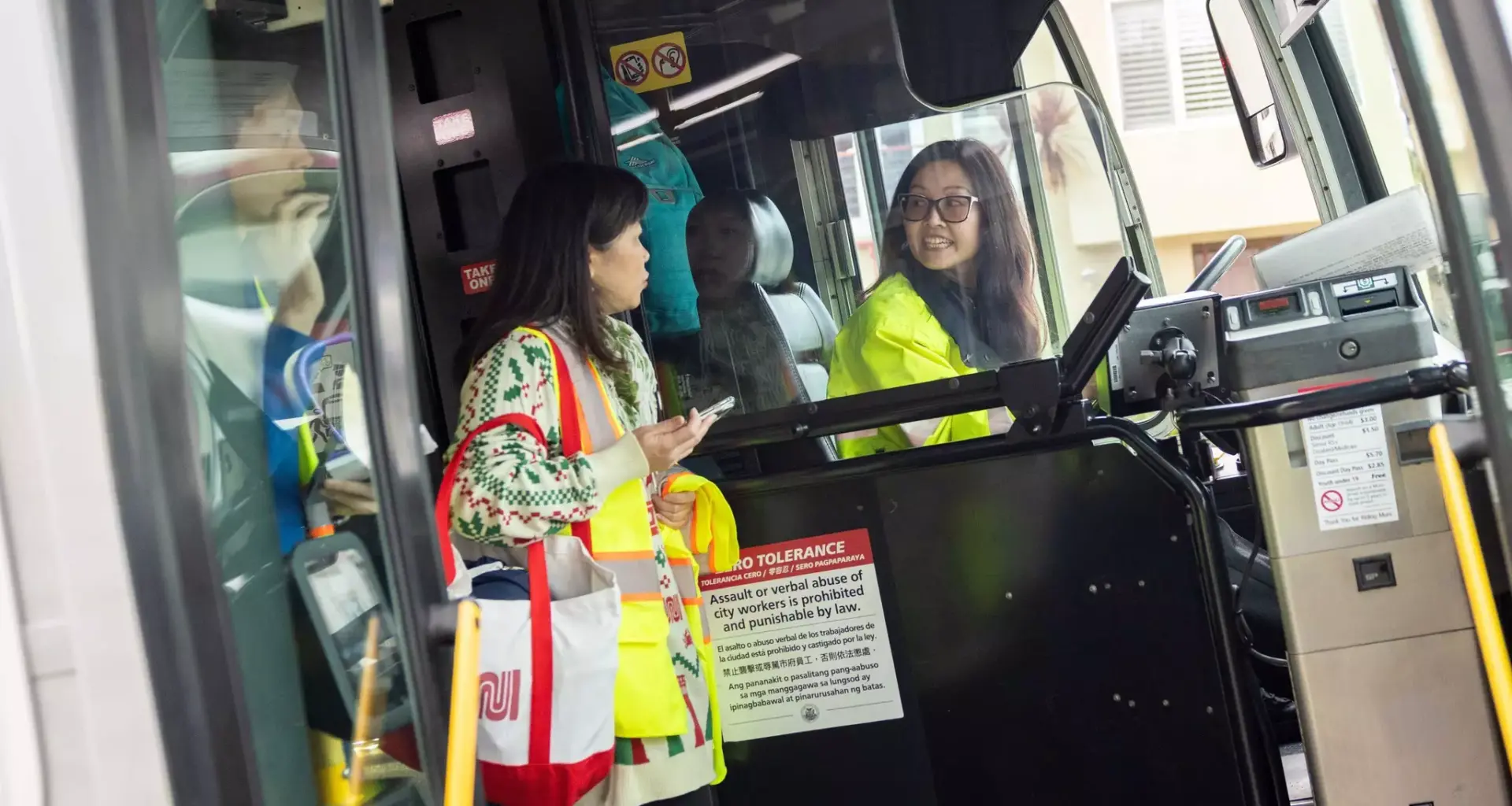
Peggy Le still can’t believe she got the job.
An immigrant from Guangdong, China, who came to San Francisco in 2005, Le, 44, spent years looking for work she enjoys. In October, she was hired by the San Francisco Municipal Transportation Agency and is in her second month of training to become a bus driver — a job she hopes to have until retirement.
“It feels like a dream,” Le told The Standard in Mandarin one afternoon while skilfully navigating San Francisco’s eastern neighborhoods on the 55 Dogpatch route. “Am I really working here?”
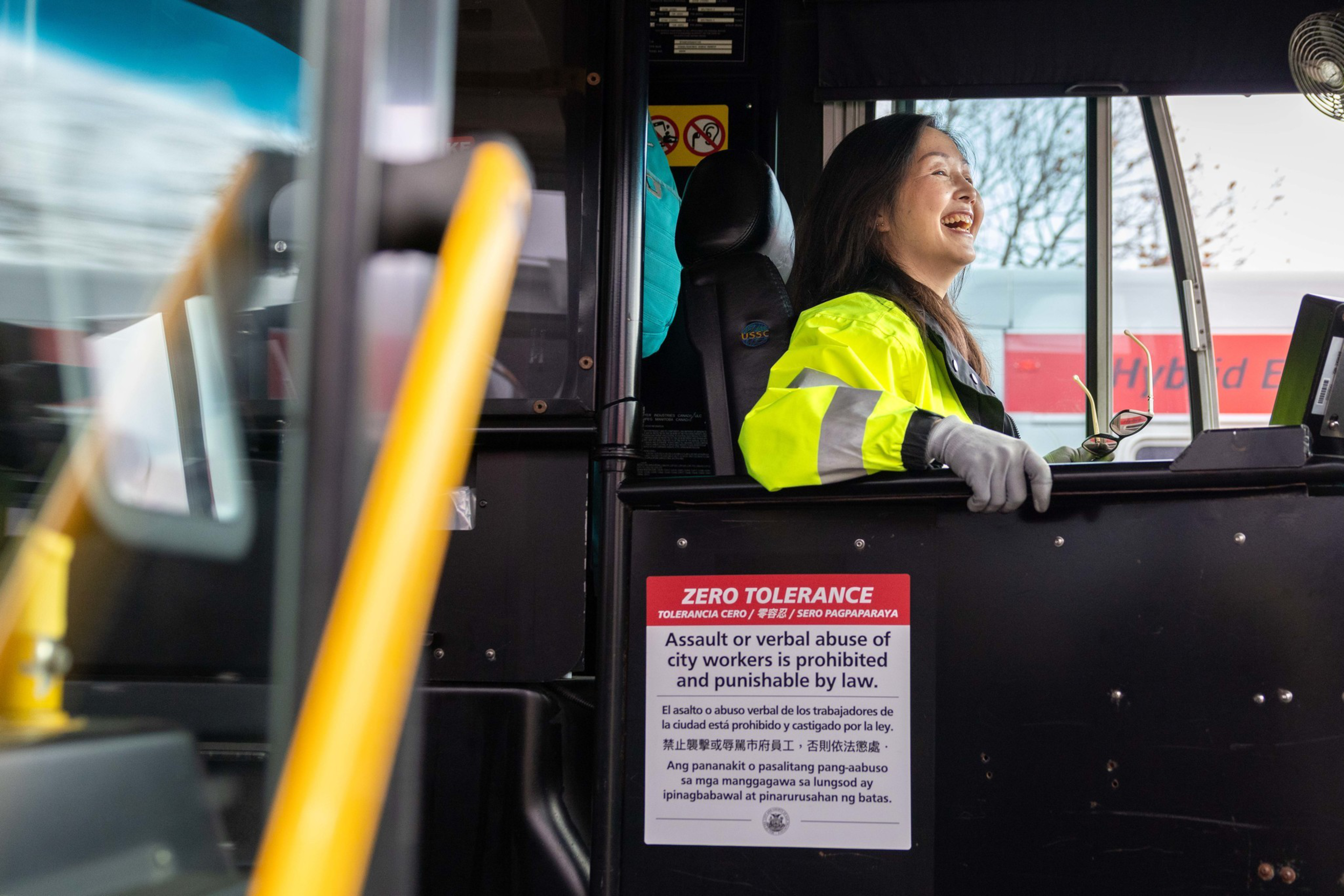 Peggy Le gets ready to start her job as a bus driver.
The job can be intimidating. It requires maneuvering a 40-foot, 30,000-pound bus on notoriously hilly and narrow streets, while dealing with the city’s complex drug and homelessness crises. Those demands would be difficult for anyone, let alone Le, who speaks English as a second language and, at 5 foot 2, can barely reach the bus pedals.
But she welcomes the challenge, especially considering the winding career path she pursued before taking the wheel.
After marrying a U.S. citizen and immigrating to San Francisco two decades ago, Le worked in the cafe at the San Francisco Zoo. After her two kids were born, she sold insurance — a job she hated — and spent a stint as a medical assistant. During the pandemic, she occasionally took gig work as an Amazon Fresh delivery driver.
Le puts up the route info.
Le’s bus in the Dogpatch neighborhood.
Le inspects the bus before driving.
Becoming a Muni driver appealed to Le because of the stability and job benefits, she said. Muni operators earn between $65,000 and $100,000 a year, according to a city job posting (opens in new tab).
“Now that I’m getting older, I want something I can do until retirement,” she said.
Inspiration came from a church friend who worked at SFMTA and encouraged Le to apply to become a Muni operator. She submitted her application in April 2024 and waited for news from the city’s human resource department, worried that she might not qualify because of her language and driving skills.
In July, she got word that she could begin training: one week of classroom exams on transportation knowledge, one week of driving tests, then on-the-road training across San Francisco before a final exam from the Department of Motor Vehicles.
“We trained at the Cow Palace: turning, backing up, all of it,” she said with a laugh. “You pass, you pass. If not, you go home. I was really lucky to pass all the tests.”
A rare one
Le is one of a handful of Asian women who operate San Francisco buses. Among the roughly 2,500 Muni operators employed by the SFMTA, about 80% are men and 20% are women. While Asian operators make up roughly 43% of the workforce, Asian women account for just 1.7%.
 Peggy Le drives on the 55 Dogpatch route.
Le brushes off the idea that she’s an anomaly. “I like driving — especially road trips,” she said. “It just felt like the best fit for me. I’ve driven myself to Canada.”
She traces her love of adventure to her Hakka (客家) roots, a group who dispersed across southern China centuries ago.
“We Hakka Chinese like to challenge ourselves,” she said.
“We’re excited to have Peggy behind the wheel and encourage people of all backgrounds to join Muni,” SFMTA spokesperson Erica Kato said. “We’re proud of her hard work to bring her abilities to our customers.”
Public safety is often on Le’s mind, especially during night shifts. It’s unnerving, she said, to haul passengers who appear mentally unstable or unhygienic. But most of the time, she’s unafraid.
“There are cameras and alarms on the bus,” she said. “I always smile at my passengers, no matter who they are.”
 Peggy Le inspects her bus.
Le has spent the last two months test-driving various routes across the city. She recalled her first nighttime test on Treasure Island while driving the 25 route, when one passenger helped guide her through the unfamiliar roads.
The narrow streets and illegally parked cars on the 57 route, which runs through San Francisco State University and the Parkmerced area, were particularly tricky.
All that driving can send her home with sore arms, but it’s no bother.
“That’s part of the job,” she said. “Driving a bus requires 100% focus every day. Every day, you treat yourself like a newcomer.”
For now, Le is focused on fulfilling the two-year driving requirement before she’s eligible to apply to operate trains — she hopes to try that next.