
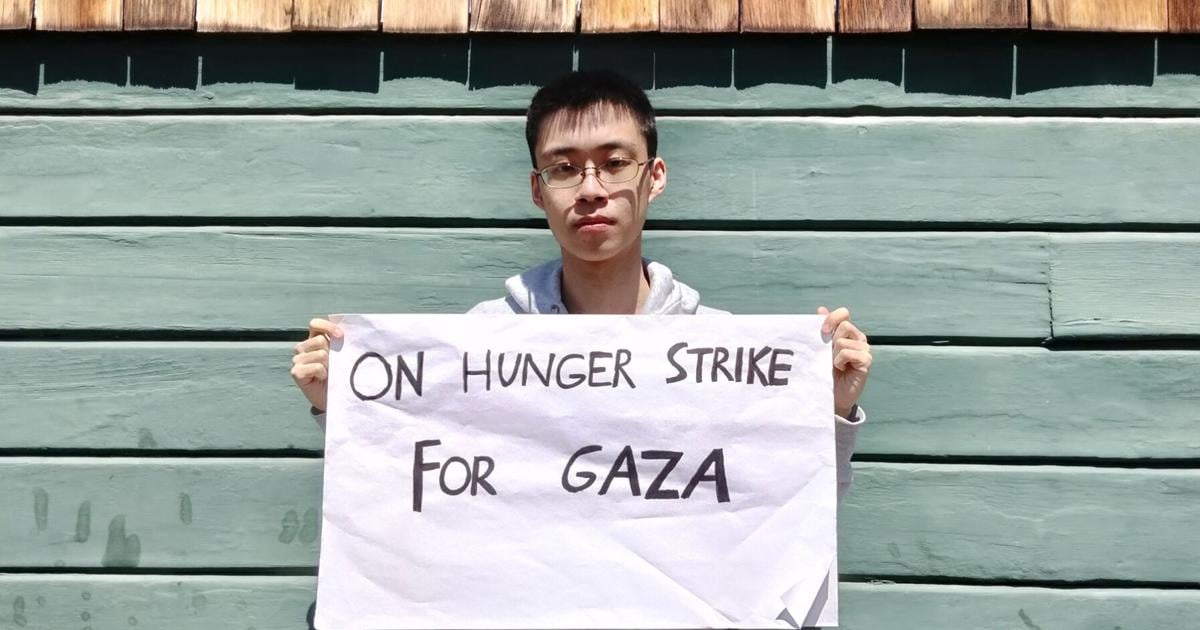
As campus comes to a quiet halt for the winter break, the debate over academic freedom following the suspension of lecturer Peyrin Kao promises to continue into the new year.
From campus to the wider Bay Area, several groups are condemning UC Berkeley or requesting meetings with campus administration after Kao was suspended earlier this month for his political remarks about Palestine in the classroom.
The Berkeley Faculty Association, or BFA, and Berkeley Initiative for Freedom of Inquiry, or BIFI, both wrote letters to campus administration of concerns over Executive Vice Chancellor and Provost Benjamin Hermalin’s interpretation of UC Regents Policy 2301. The UC systemwide policy bans “misuse of the classroom” through “political indoctrination” or by deviating from the purpose of the class.
“We are concerned that Kao is being disciplined for not engaging in advocacy per se, but because his advocacy touched on Gaza and reflected a pro-Palestinian viewpoint,” the BFA wrote. “It is hard to escape the judgment that this appears to be another instance of the ‘Palestine exception’ to free speech.”
The BFA and BIFI both took issue with Hermalin’s lack of consideration of APM – 015 in his letter. APM – 015 is a faculty policy that prohibits any “significant intrusion” unrelated to the course, with both groups arguing that the regents policy against “political indoctrination” needed to be taken into account alongside the faculty policy.
The Berkeley Division of the Academic Senate’s Committee on Academic Freedom, chaired by R. Jay Wallace, is most concerned about Hermalin’s assertion that the “visible physical toll” of Kao’s hunger strike for Palestine represented a form of advocacy, which Wallace said was a “strained” and “questionable” interpretation of the policy.
“I think we’re open to the idea that under certain circumstances, nonverbal expression could potentially violate Regents Policy 2301, but if we’re going to be interpreting it that way, I think we need much clearer guidance for faculty,” Wallace said.
Wallace emphasized that before giving any opinion on the case, the committee wanted to hear from Hermalin himself.
Campus spokesperson Dan Mogulof declined to comment, stating that per California law, campus could not discuss personnel issues. However, he shared a letter from Hermalin that did not go into the details of Kao’s case but gave an overview of how the policy is used.
In that Dec. 19 letter to leadership of the Academic Senate, Hermalin wrote that campus continually manages complaints about course content from students, parents and others. In the “rare incidents when a line has been crossed,” he wrote that the first approach has been to make them aware of the rules and not to impose discipline. He noted that repeat offenses by a single instructor are “vanishingly rare.”
“Because we do not wish, in any way, to be seen as chilling academic freedom, we rarely share these complaints with instructors, because even a simple heads up from Cal Hall can be misconstrued as pressure,” Hermalin wrote. “I would also note that when we have faced public demands to take action against faculty for their writings, social media activity, and the like, we have also pushed back.”
Beyond faculty groups, the Middle East Studies Association of North America believed Hermalin had “no reasonable evidence” to say Kao violated Regents Policy 2301 and called for campus to rescind the suspension. The San Francisco Bay Area office of the Council on American-Islamic Relations also released a statement denouncing campus’s decision to suspend Kao.
In addition, student group STEM4Palestine, which Kao helped found, has rallied support for the lecturer. The group’s letter, which calls for his reinstatement and divestment from weapons manufacturing tied to the genocide in Gaza, has garnered more than 1,400 signatures and more than 20 endorsements, including from former NFL running back Marshawn Lynch and professor and feminist philosopher Judith Butler. In September, a United Nations legal analysis found that Israel committed genocide against Palestinians during its war on Gaza.
“Something difficult about (writing the letter was) trying to describe the amount of different dynamics: the Palestine exception, crackdown on free speech … (Regents Policy) 2301’s history,” said the STEM4Palestine student who also wrote the letter. “There’s so many reasons that people should care.” The student was granted anonymity out of fear of retaliation.
Michael Ball, a computer science lecturer who signed the STEM4Palestine letter, said instructors have long been advocates for causes outside the classroom. He added that faculty are encouraged to connect courses to current events and to share interests with students.
“While it’s impossible to prove, it certainly seems most likely (Kao) was singled out because he is a lecturer with minimal protections and speaks with bravery at a time when it happens to be politically inconvenient for those in power,” Ball said in an email.
Although Kao has been suspended for the upcoming spring semester, the conversation around academic freedom and free speech will continue, as Hermalin said in his letter that he will meet with the Academic Senate’s Committee on Academic Freedom on Jan. 27, as well as the Task Force on Free Speech and Campus Climate on Feb. 20.
In an email statement, Kao had no comment on his employment plans for the upcoming year but noted that he will continue speaking out against the genocide in Gaza.
“Throughout history, students have been leaders in social justice movements, from the anti-Vietnam War protests, to the South Africa divestment campaign and the Palestine solidarity encampments,” Kao said in an email. “The strong moral clarity in their writing gives me faith that even if I’m not here, the struggle for human rights and justice in Palestine is in good hands.”