
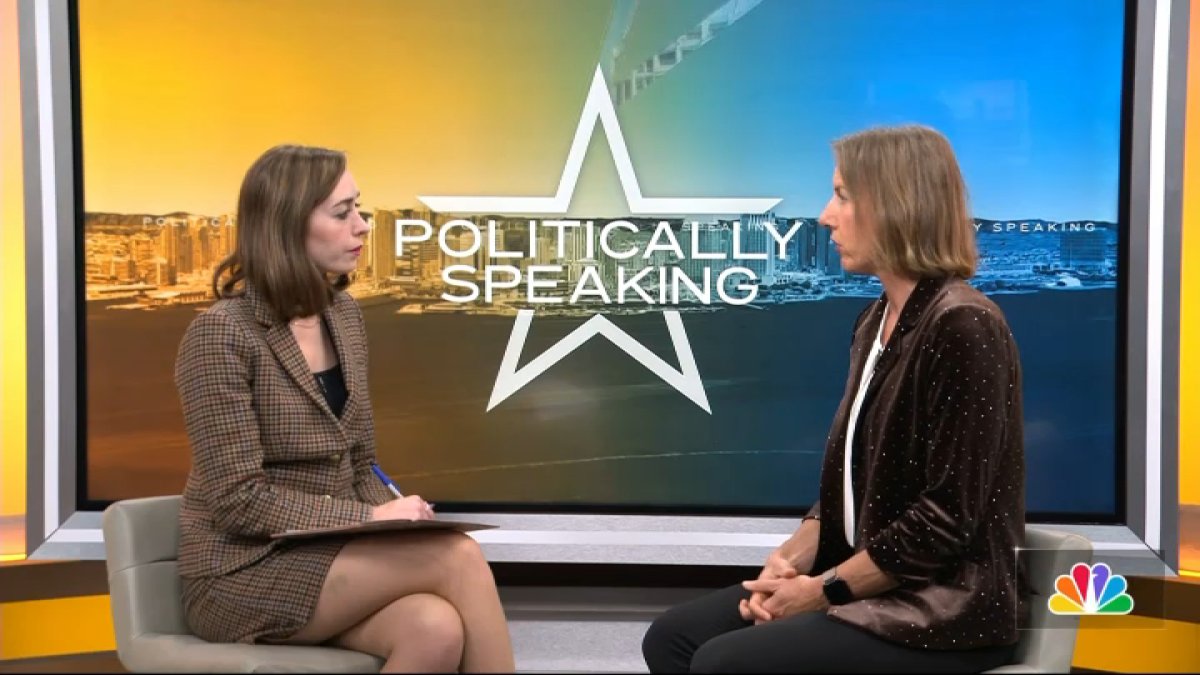
State Sen. Catherine Blakespeare joined NBC 7 Political Reporter Joey Safchik on Politically Speaking ahead of the New Year, when a slate of new laws go into effect. Blakespear, a Democrat, discusses the legislation for which she was the architect, and answers questions about why she believes California needs to rethink its approach to homelessness and housing. A transcript of the full conversation is below.
Transcript:
Safchik: A slew of new state laws go into effect at the start of the new year, some more high profile than others. And then lawmakers will get back to business, tackling issues ranging from affordability to homelessness. One of the architects of some of that new legislation, State Senator Catherine Blakespear, joins us in studio this holiday week. Thank you for carving out some time for us.
Blakespear: Well, thank you for inviting me. I’m happy to be here.
Safchik: Okay, let’s start a little retrospective. What are you most proud of in terms of legislation in 2025?
Blakespear: Well, one of the biggest bills that I worked on had to do with the End of Life Option Act, so that it was signed by the governor. And what that has to do with is medical aid and dying. So if somebody has a terminal illness and they’re within six months of death, they can take something that will allow them to peacefully go on their own terms. They don’t have to suffer at the end of their life, and they can plan their exit, essentially. So that law in California was set to expire. It had a sunset date. And what my bill did is it eliminated the sunset date. So now if people are diagnosed with a terminal illness, they’ll have the certainty of knowing that when they get near the end that that law will still be in effect for them. So I feel really grateful that the governor signed that, that we were able to pass it. And so many people have reached out saying how important it is to them that they’re able to have some control over their end of life.
Safchik: That is one of those laws that’s perhaps not as flashy, not on our radar all of the time. Why is that something you’re so passionate about?
Blakespear: Well, I’ve seen my my, the generation above me, my parents and my grandparents, struggle with those questions. And I also practice as an attorney doing estate planning. So, before I went into running for office, before I was in politics. So I had a lot of conversations with people about, their end of life and what they wanted to pass along to their heirs and how they wanted to transition. And so it was something that was really I was very aware of, as a topic that needed attention.
Safchik: Why do you want people at home to know that issues like this are something that, you’re working on day in and day out, even if they might not be hearing about them all the time?
Blakespear: Yeah, well, there are so many things. I mean, I take feedback from constituents all the time about the things that matter to them and that they want attention on. And there are a lot of groups and organizations and nonprofits. So this is something that I had a tremendous outpouring on that topic. So we had 700 people RSVP for a town hall. We had to move it, to be partially online. So there are so many people. And it was about charting your own exit. It was about this topic.
Safchik: Let’s talk about your expansion of the plastic bag ban that goes into effect on January 1st. This has been a long time coming. Why was this legislation a priority for you?
Blakespear: Yeah. So this is a really important bill. And you can already see the effects of it right now because so many grocery stores have already transitioned where they are only offering a paper bag. So no longer will you be offered paper or plastic when you buy your groceries, it’ll just be paper. Or better yet, you bring in your own reusable bag. But basically, the voters passed a plastic bag ban more than ten years ago. But there was a loophole that allowed for those thicker plastic bags to still be distributed at grocery stores because they were considered recyclable and reusable. But in reality, nowhere in California recycles them. And people were not routinely reusing them. So it’s just a huge amount of plastic waste. Plastic bag waste actually doubled, and a plastic bag has a life span of just seven minutes. And then it takes thousands of years to turn into microplastics in our environment. So for that convenience of bringing groceries home, eliminating that scourge of single use plastic in that one particular category, it was something that was really important. And so that was my most important bill. In the previous year. And it goes into effect January 1st. So you already see grocery stores that are making that transition.
Safchik: You seem excited about that. I am, I am, yeah. Do you have any other climate related legislation on the horizon?
Blakespear: Well, I just did a hearing on the Tijuana River Valley. That is really, it’s an environmental disaster and it’s centered here on our border, along our border in San Diego County. But really, it’s just a top problem in the state and also in the nation. So focusing on that, which is very local here to people who live in San Diego County. But that’s something that is fixable. You know, we know how to treat wastewater in the state of California. It’s, of course, an international issue, and it’s complex, but we can solve that. So I was glad that I was able to shine a light on that. And I also toured some of the hotspots that are down, closer to the border to see what the tier one river valley actually is looking like up close. And it’s really horrific. It smells terrible. I had to wear a mask just being there. So that’s something. And then also, I’m interested in composting. Recycling. How do we transition ourselves for the products that we’re using for our modern lifestyle? How are they able to be composted and recycled? More effectively? So I chair the Environmental Quality Committee, and I was just reappointed to do that job again next year, which I’m really grateful for. And so I expect to be working in that area too.
Safchik: On the Tijuana sewage crisis. We hear a lot from the congressional delegation on that issue. What can state lawmakers do from your perch to make a difference there?
Blakespear: Well, some of like the one, major hotspot where the sewage is flowing at a high rate and it’s aerosolized. So it’s in the air and people can’t get away from it because, you know, you cannot go in the ocean, even though people should be able to go in the ocean. But you can’t get away from the air we breathe. And so streets and roads are within local control, you know, and so the culverts that it goes through are within local control. So we would be able to at a state and local and county level to change the way that is managed, so that it’s not just an open pit of sewer that’s running through the streets in San Diego. That’s one thing. And then also there are just standards around when certain things are triggered and how it is that we’re evaluating this crisis. And ultimately it takes all of us caring about things for things to happen, because everything is pushing a rock up a hill. And so I wanted to use my position as the environmental quality chair to to really shine a light on this and say this is a top priority and we need everybody to be working on it and thinking about the solutions together.
Safchik: Should the governor declare a state of emergency there?
Blakespear: Yes. I mean, to me it seems like it should definitely be considered a state of emergency. I know there are technicalities around. Is it an ongoing situation? What’s the baseline, what’s changed? But really those are technicalities. And for people who are living with it, it is clearly an emergency.
Safchik: This has been going on for decades. Obviously we’ve seen it reach a fever pitch in the last few years. Why this attention from you now?
Blakespear: Well, because I’m the chair of this committee. You know, this was my first year being the chair. And this is my third year. I’m finishing my third year in the state Senate. So I’m able to, you know, have a role that allows me to do that.
Safchik: Has there been enough focus on this issue coming from Sacramento? I don’t know. I mean, the leadership from South County has been very strong. And we have our supervisor Paloma Aguirre who is particularly focused on this, which is great. But it’s you know, obviously it’s not solved yet. So we do need to continue to do more and better in order to solve it.
Safchik: Is there any particular action that you would like to see the statehouse take?
Blakespear: I mean, it’s not– I don’t see it as one simple thing that the state of California can do, and it is at base, it is sewage from Mexico. So they are managing their sewage differently than we manage ours. But it is crossing into our country. And so there needs to be attention.
Safchik: Are there any other bigger picture climate related issues that you would like to see? The state House tackle this year?
Blakespear: Well, I see homelessness as a climate related issue and also a humanitarian disaster. So the crisis of unsheltered street homelessness, which is basically people living in public spaces, is terrible. It’s terrible for everybody, the person who’s living like that. And then, of course, also people who are trying to use the sidewalk or the public park or, or have, you know, our hillsides that don’t have trash and are, you know, created as living spaces. I mean, we need to have managed living spaces. So one of my main focuses is to say that the waiting rooms should not be the streets. While we’re building. Everyone’s forever home. And I think there’s a certain dogma that we have adopted in California which is not serving us, which is that people deserve a permanent home. And so whether it’s permanent, supportive or its market rate, we’re going to focus our energies on providing for that to happen. But we don’t have to solve the housing crisis in order to actually solve the homelessness crisis. And that’s something that I really work really hard for, and I’ve had three summits with, you know, hundreds of people and have brought together convenings. And I’ve had legislation trying to make progress on this.
Safchik: Are you talking about shelters or interim services?
Blakespear: Exactly. Yes. So that people can have social workers to help them figure out triage their circumstance, whether it’s drug addiction or mental health or poverty or whatever the circumstances are. But we don’t have to have people just basically living completely unmanaged in encampments.
Safchik: So you feel like we haven’t invested enough in the short term.
Blakespear: Exactly. Yeah, exactly. Which is interim housing. It’s modular housing. It’s tiny homes. It’s a whole bunch of different possible solutions. Well, I was going to ask about homelessness next. So you beat me to the punch.
Safchik: But I do want to know – we’re anticipating a pretty significant loss of federal funding. How does that impact municipalities in your district?
Blakespear: Yeah. You know, there are a lot of changes from the federal government that are coming across the board, and they’re tied up in court right now, especially around homelessness. I’m particularly closely following this because I care a lot about this issue. We need people to still be able to get their section eight vouchers, which allow them to afford rent. Right? So that’s a core that is one of the most successful homeless prevention approaches that we’ve ever had. And so cutting the money that goes to section eight vouchers is going to create a further problem. But we also need to be able to fund, we need to prioritize funding places for people to go tonight. Because the idea of housing now shelter now instead of in ten years when we can build one unit of housing, you know, that’s to me that is really what the crisis is.
Safchik: So that’s contradicting the Housing First approach that the state has adopted for a pretty long time now. Why do you take that position?
Blakespear: I mean, Housing First can be interpreted a lot of different ways. So yeah, I think all the people who are living in encampments should be in an inside managed environment with a bathroom, with a pillow, with a place to put their stuff so that they can have a sleep. I mean, to me, that’s a basic human right.
Safchik: What about the people who don’t want to be?
Blakespear: I don’t feel like they should be able to live in public spaces. Like, I think public spaces need to be available for the public.
Safchik: And so do you think the state needs to take a more hardline approach there?
Blakespear: Definitely. I think there’s a right to housing and there’s an obligation to use it. And we can’t. We, of course, don’t want to criminalize poverty or criminalize homelessness. But when there is an indoor space, we should not. It should not be an option to camp in the park.
Safchik: Should people be cited?
Blakespear: I mean, we would need to have some type of consequences. Yes.
Safchik: Going back to the loss of those federal dollars, could that unravel any nominal progress that has been made?
Blakespear: I think it could be a disaster. It could force changes. It could lead to other types of partnerships and it could unlock things that have been stuck. You know, we seem collectively in California to have decided that this is somehow an unsolvable problem. So we feel like we’re stuck. And I, I am hopeful and I’m also ambitious. And I think this is not an unsolvable problem. There are we. We do. We’re the fourth largest economy in the world, California. We have unbelievable innovation. We’re able to provide social safety nets across a range of different things. We could actually do this. We just have to prioritize it. It has to be the tip of the spear. And so to me, we need to fund Prop 36, which the voters passed. We need to make sure that we have drug and alcohol treatment facilities and beds for people. And we need to provide a way for people to transition so they can bring themselves up. We don’t want to just create dependency. We want people to be able to have agency and bring themselves up, but also recognize that not everybody is going to be able to do that at every minute. There have to be places where when people are falling down the ladder, they don’t fall all the way to the ground where they’re sleeping in the dirt that they’re able to, to bounce back. And then right now, we just don’t have that.
Safchik: How do you make these changes without criminalizing poverty?
Blakespear: I mean, I think it comes if somebody says I am on the verge of homelessness or tonight I have nowhere to go, there should be a place for them to be inside, and I don’t think we have this enormous number of people who are unserved. And you see news articles in the Union-Tribune and everywhere about that specific population, people who say, I am willing to go into a shelter, congregate or individual, but there’s no bed for me. And why is that? I mean, to me, that is one of the biggest failures.
Safchik: How much power do you have from where you sit to enact these changes that you’d like to see?
Blakespear: Well, it’s limited in that I’m one of 120 legislators and there’s a governor. Right. So we have the Assembly, the Senate and the governor and all of the other agencies like Caltrans and different agencies that manage our public spaces. And of course, land use decisions, like where is housing built? Where is a shelter built? That’s up to a city. So we have more than 500 plus cities and counties in the state of California. So recognizing that it’s not, we don’t have a command and control system where somebody can make a decision. But I will say that I think leadership matters, and I think good ideas matter. And I think the public is sick of it. And the public wants to see local, state, federal, everybody say unsheltered street homelessness is something we should be tackling and we should get a functional zero. It shouldn’t just be, yeah, we’re working on it. But people are still in an encampment downtown. It should be, yes. We are. Our goal is to get a functional zero so people are not living outside in encampments.
Safchik: I want to ask about something you said. You said we collectively have decided that this issue is unsolvable. Who do you feel like has decided that?
Blakespear: I mean, I feel like I hear that reflected in so many different ways. There’s an admiring the problem that sets in. Well, it’s this level of government. We don’t have enough money. There’s no way to do it. They won’t accept housing. There’s always a description of. Of what the barriers are. And that’s why I say collectively and I don’t you know, I don’t mean that in the sense of, of, of as if that’s a final say. I just feel like I run into that all the time and, and what I want and what I try to model and what I believe is that we need to say, what can we do? And then we need to get going on doing it.
Safchik: Do you feel like as a state, we are doing the best we can on this issue?
Blakespear: Absolutely not. I think this is one of the areas we’re not doing anywhere near what our potential is, and it’s a combination of prioritizing it and also being willing to accept that it’s not going to be a gold plated five star unit for every person. But that’s okay. And I think there’s some we have all sorts of code building codes and all sorts of regulations around, set and saying people deserve permanent housing at the highest quality. And, but I think there are ways to build cheaper, faster, totally adequate housing shelter options for people to be inside.
Safchik: The state has taken a lot of heat for pouring billions of dollars into this issue over the last couple of years, and meanwhile, between 2024 and 2025, we saw a small increase in street homelessness. It sounds like you don’t think that money is always being spent wisely.
Blakespear: Yes, I mean, I just recently read a really long article and I think it was The Times of San Diego specifically about the programs that are going to be cut, under changes that are coming from prop one. So that’s all to say that there are things that are being funded with homelessness, money that are aimed at prevention, that are very valuable there, like wellness centers and schools and this kind of thing, these are valuable. But is that where homelessness dollars should be spent, or is that there should be other resources, philanthropic resources, or other types of funding streams that fund those things? Because to me, the problem is that we have become– it’s mission creep. We’ve become really distributed with all these different types of programs. And I have two counties in my district, Orange County and San Diego County. They operate completely differently when it comes to this. So I see how it is that decisions are being made. These are worthy programs. They always are. But at the end of the day, we have to prioritize. So to me, that poor soul in the rain with open wounds, that is what we should be prioritizing and recognizing that there may be other ways to fund some of these really worthy initiatives, but that they aren’t the top priority.
Safchik: Broadening out a little bit as a state lawmaker right now in the supermajority, how do you balance the state House and the state house’s efforts to push back against the Trump administration with working on this policy that some could call mundane? That’s not necessarily a bad thing, but that impacts the daily lives of Californians.
Blakespear: Yeah. I mean, we work on things. I feel like I work on things at the very biggest, top level, and some of that is really important messaging and symbolism about, like, what are California’s values? How do we feel about people being snatched off the streets without actually showing a warrant, without essentially racially profiling people and saying, you know, we’re going to federal agents to do this to the people who live in our counties. In my district, and all the way down to, you know, the reading of a bill and the specifics of what is it? What does it mean to have a secure exemption, you know, so it’s like and then and then also it’s representing my district and it’s also representing the state of California. So all of these basically there are a lot of hats that you’re always wearing at the same time as a state legislator. But that’s part of what the job is. I mean, that’s part of being an elected representative at the state House, taking my experiences in San Diego in Orange County, up to Sacramento, and, and then enacting laws and representing constituents.
Safchik: Why do you think it’s important for state legislators to take a stance when you want to stymie something that the Trump administration is doing, that you don’t feel is in line with California values?
Blakespear: Well, we have to stand up for people and we have to stand up for California. And, you know, I’m very proud of our governor. I think Governor Newsom is doing an amazing job at this, particularly about shining a light on what it is that the president is saying and doing. And you see this also in his social media, and, and it really it’s important because we need to model and show what it looks like to govern differently. And there’s a cruelty that underlies a lot of what’s coming out of the Trump administration. And I don’t believe in that. I think that’s the wrong direction for our country. And I’m concerned about the erosion of our democratic principles and also of our institutions, and a recognition that there is expertise that’s developed in topics like in public health. And, you know, we shouldn’t, we shouldn’t be just throwing all that out. So, yeah, it’s important to, to, to model these things.
Safchik: And then finally, what are your top legislative priorities looking at 2026?
Blakespear: Well, one thing that I hear a lot about in the district that I’m planning to legislate is e-bikes. So the number of kids on e-bikes, many of them actually more like motorcycles. I mean, they have a throttle that you don’t even pedal. And people at any age, some of them far under age 16, you know, 12, 13, 11 riding these things, it’s very dangerous, very dangerous for the person who’s riding it and for the public. So asking the DMV to establish guidelines around what is and isn’t an e-bike and what are the regulations for riding ones, particularly ones that are in that motorcycle type of category or moped category, because those are ones that really the local police and law enforcement, is really they they would like this handled at a level above local. And so we see a hodgepodge of different approaches. But that really is a problem. So that’s something that is particular to the district that I’m interested in working on next year. And then also care court. So that’s in the homelessness space. But it’s been very underperforming. Care Court it’s really mired in its own processes. And it served very few people. But there are people who are unable to care for themselves. And there needs to be a process where they are able to get them. They’re able to get into the pipeline to receive care, even if they can’t care for themselves. I mean, people are sick and dying in front of us, and we need a way to get them into care. So I’m planning to work on the Care Court situation. And then I think it should be repealed. Amended. Do you think it needs to be? It has potential. It needs to be strengthened. And invest it in. Yes. But it also needs to be streamlined. Just like what is the process for certain things because some of it is just overly burdensome. I’m also interested in really working on funding prop 36. That’s what the voters passed, two years ago now. And we funded it with $100 million last year. But that was, we had to really fight for that, and I really fought for that. And that’s part of, you know, creating order, having there be consequences, having people have to go into treatment, drug mandated, treatment or if there’s a felony, basically, and they decide to do diversion, then they can then you have to do the drug treatment. It’s not voluntary. And there are many examples of people who say they’re so grateful that they were forced into that because it changed their life.
Safchik: That’s quite a chunk of change. Do you feel like that’s been effective?
Blakespear: Well, it’s only been in effect for one year at 100 million. And that was– it’s somewhat effective. It’s more effective in San Diego than other counties. I’ll say that we in San Diego have embraced it a bit more. So you see, from the sheriffs, and the city attorney, the D.A., that there are positive reports. I mean, both, yeah, there are very positive reports on this, but it needs to be funded more. So I’ll be working on that next year. The other thing that I’ll just mention is that we’re in this mid stage energy transition where we’re transitioning off of fossil fuels, but we’re still heavily dependent on them for our energy. So there’s a lot around, like oil wells. And what is our approach to them as they close. So it’s not just an oil well, but it’s the refineries in California. So having some type of a transition approach where what are the assets? What’s going to happen to them? Who is responsible for them? There needs to be regulation around that. And that’s part of my role as the Environmental Quality Committee chair. That I’ll be working in that space as well.
Safchik: Well, thank you so much for all of these insights and your time this morning. We really appreciate having you here.
Blakespear: Well, thank you so much for having me. It’s been delightful.