

The City of Sacramento has completed the expansion of its Roseville Road shelter-and-service campus, adding 135 tiny homes to increase shelter capacity for people experiencing homelessness.
One hundred of the new units were built on the campus’ previously vacant northern lot. The remaining 35 tiny homes replaced travel trailers on the southern portion of the campus that were not connected to electricity. All units are now connected to power and include heating and air conditioning.
With the expansion, the Roseville Road campus includes 196 total shelter units — 100 on the north campus and 96 on the south campus.
“Our top priority is to provide people experiencing unsheltered homelessness with a safe place to go,” Mayor Kevin McCarty said. “These 100 new tiny homes at the just completed Roseville Road Campus North Expansion are a significant step in the right direction. We listened to the community and are investing in solutions with dignity; each resident will have on-site support services, heat and air conditioning, internet, hot meals, water and sanitation, and, most importantly, a space of their own.”
The Gathering Inn, an organization dedicated to housing the homeless in the Sacramento region and Placer County, will operate the northern portion of the campus, while First Step Communities, another organization that provides housing and on-site services to homeless people, will continue to operate the southern portion.
 Sacramento Mayor Kevin McCarty touts the expansion of the Roseville Road shelter campus for the unhoused Dec. 18. Douglas Carter, OBSERVER
Step Up on Second, which provides outreach to unsheltered residents in Sacramento, also will have office space on site, as will county behavioral health specialists, making the campus a hub for homeless services.
“We have long envisioned Roseville Road as a place where we can bring together multiple providers to offer comprehensive support to people experiencing homelessness,” said Brian Pedro, director of the city’s Department of Community Response. “With the expansion of the campus, and with the addition of partner organizations working on site, we are closer than ever to fully realizing that goal.”
The expansion was funded through a state Encampment Resolution Funding grant, which requires cities to target a specific priority encampment. Sacramento identified the Northern Parkway bike trail in Del Paso Heights as the focus of its proposal, said Hezekiah Allen, a program specialist with the city’s Department of Community Response.
Allen said the city has spent the past year and a half building a list of individuals experiencing homelessness along that trail and will work through that list first.
“Those individuals take priority,” Allen said.
Within that group, placements are determined by vulnerability. Allen said the city uses a regional crisis assessment tool to assess disabilities, mental health challenges and substance use disorders.
“We assess vulnerability and work through the most vulnerable first,” Allen said. “The list is effectively full. We currently have 22 people on site, and we’re moving as quickly as we can to get people off the street and inside.”
Allen said outreach teams have been working with approximately 250 additional people experiencing homelessness, and beds will be filled as they become available. Future steps will be guided by direction from department leadership.
Construction of the expanded campus took nine months to complete. The Department of Community Response received a $12.4 million Encampment Resolution Funds grant from the California Department of Housing and Community Development to purchase and construct additional tiny homes, improve campus infrastructure, expand outreach services in the surrounding community and enhance shelter and housing support. The grant also funds campus operations for two years.
City officials emphasized the tiny homes are intended as emergency shelter, not permanent housing.
When asked about the transition process, city spokesperson Tim Swanson said residents’ length of stay will vary.
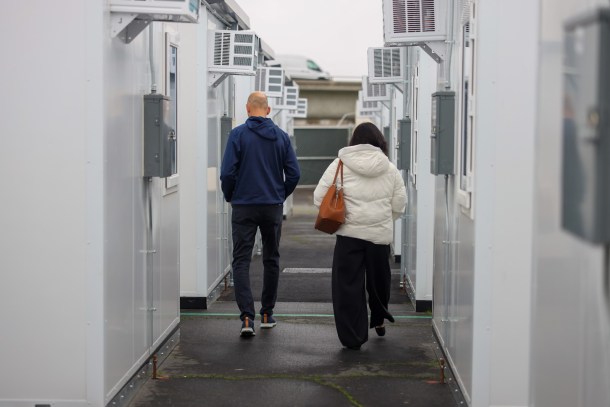 Mayor Kevin McCarty, left, tours new tiny homes alongside an assistant at the Roseville Road shelter campus for the unhoused which just added 135 new homes. Douglas Carter, OBSERVER
“This is an emergency shelter. It’s not a suitable environment to live in long term,” Swanson said. “It’s going to depend on each individual. Everyone has a different journey through this process.”
Councilmember Roger Dickinson, who represents District 2, said the Roseville Road expansion is one element of a broader range of strategies the city is using to address homelessness.
“There’s not a one-size-fits-all solution,” Dickinson said. “People are at different stages and ready for different treatment. These tiny homes are a very cost-effective way to help someone who is on the street get to a point where they’re fundamentally safe and secure and have personal space.”
Dickinson said that stability allows residents to begin addressing the issues that may have contributed to their homelessness or kept them from returning to permanent housing, including behavioral health challenges, substance use, reconnecting with family or rebuilding personal support networks.
“This serves as a very cost-effective way to allow those kinds of things to happen,” he said.
Initially opened in 2024 at a former Air National Guard facility, the Roseville Road shelter-and-service campus provides interim shelter with on-site services to support residents as they work to stabilize their lives and transition to permanent housing.
The expansion is part of the city’s broader strategy to reduce unsheltered homelessness, address encampments and expand access to interim housing paired with services and pathways to permanent housing.
Related