
When Vincent Thomas was 16, he used his boxing skills – he earned $2.50 per fight – to help support his family.
His parents, Visko and Vinca Tomas (shortened from Tomasevich), arrived from Yugoslavia in 1903. They were living in Biloxi, Mississippi, when Vincent, one of eight children, was born on April 16, 1908.
Visko got a job with the Southern Pacific Railroad in Oakland and the family moved there before World War I. In 1918, the family visited San Pedro, where Visko died at 45 after he contracted the then-rampaging Spanish flu.
That left Vinca, a diabetic, to raise a houseful of children in San Pedro. Four of them moved in with Vince’s older sister Zorka, and her husband Tom, a fisherman.
Vincent attended Fifth Street School in San Pedro, where his surname was recorded as Thomas. He and his brothers and sisters kept the new spelling.
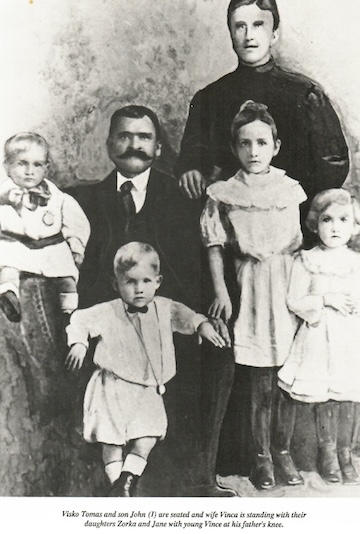
A young Vincent Thomas stands in front of his father, Visko, sitting, and mother, Vinca, standing at right in this mid-1910s photo. Also from left, son John, seated, and daughters Zorka and Jane, standing. (San Pedro Bay Historical Society)
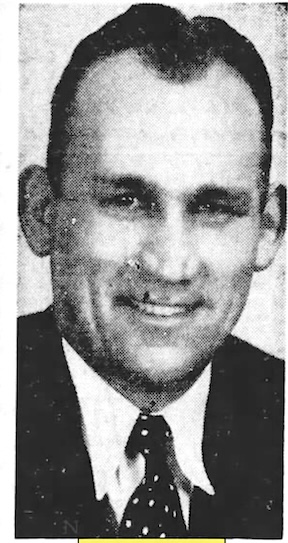
Vincent Thomas. Circa 1940. (San Pedro News Pilot file photo)
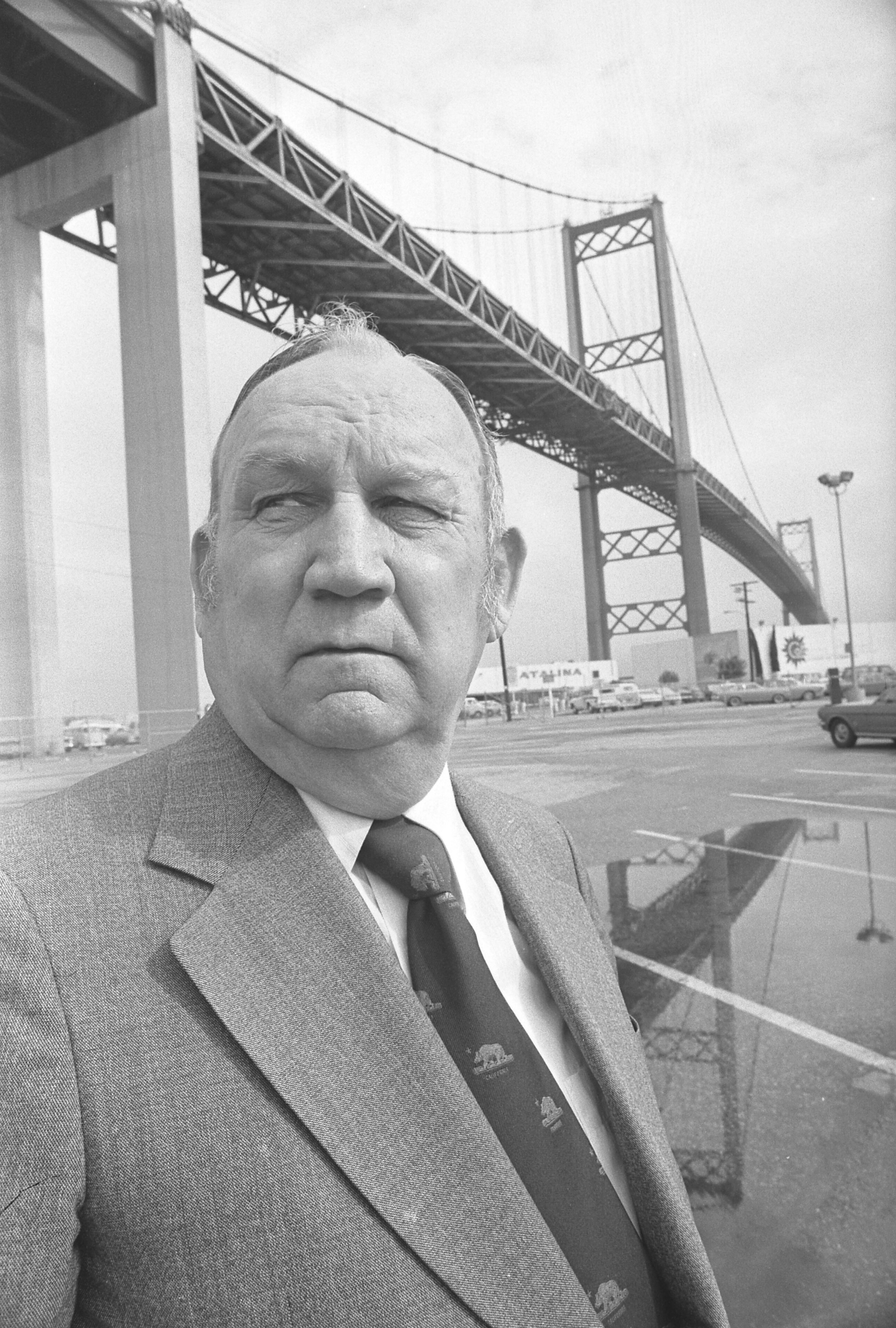
Assemblyman Vincent Thomas stands under the Vincent Thomas Bridge on Nov. 11, 1978. (UCLA Library Department of Special Collections)
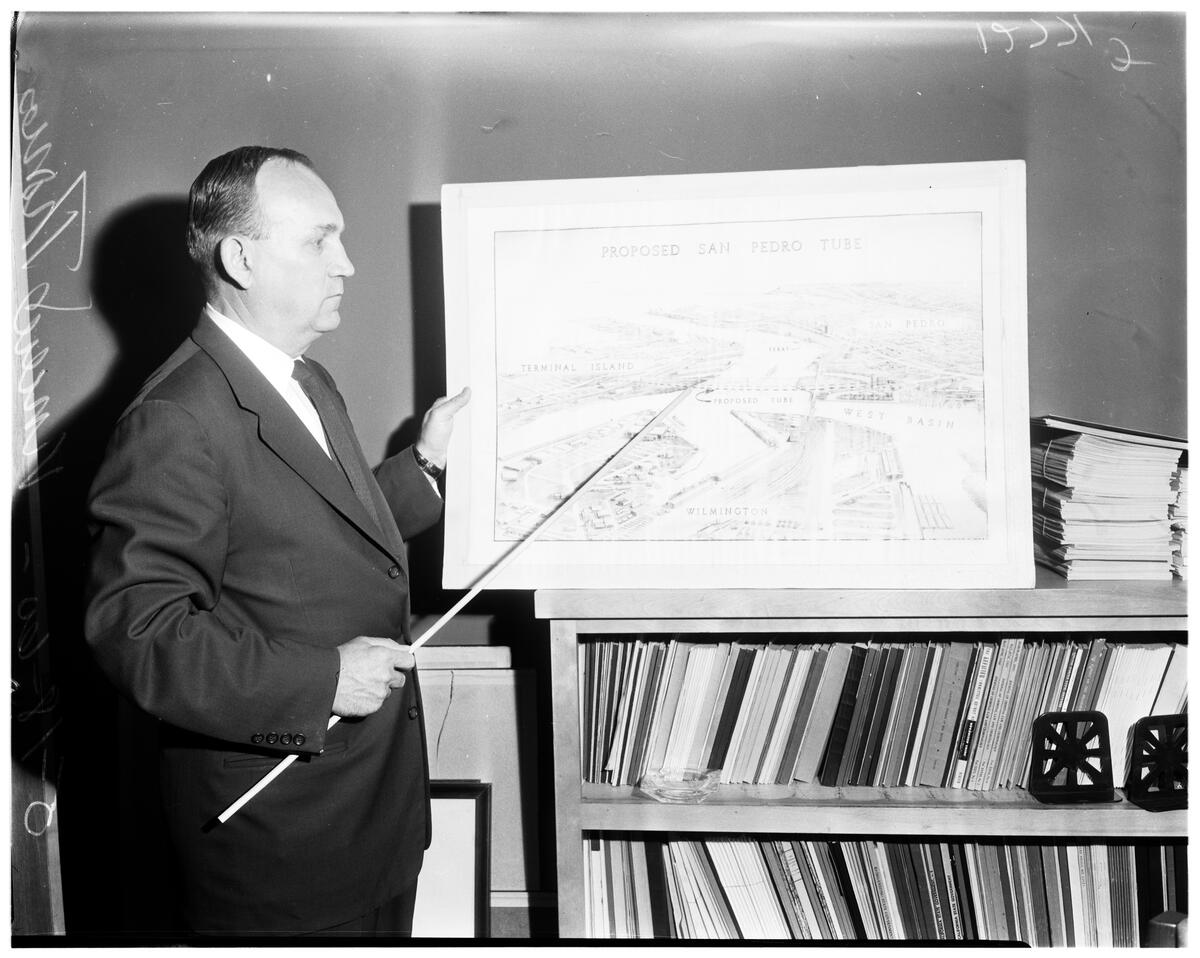
Assemblyman Vincent Thomas points out a drawing of proposed San Pedro tube between San Pedro and Terminal Island in this May 18, 1960 photo. He spearheaded the drive for underwater auto-truck tube between San Pedro and Terminal Island, and later championed the plan for a bridge project for on which construction began in 1960. (USC Digital Library)
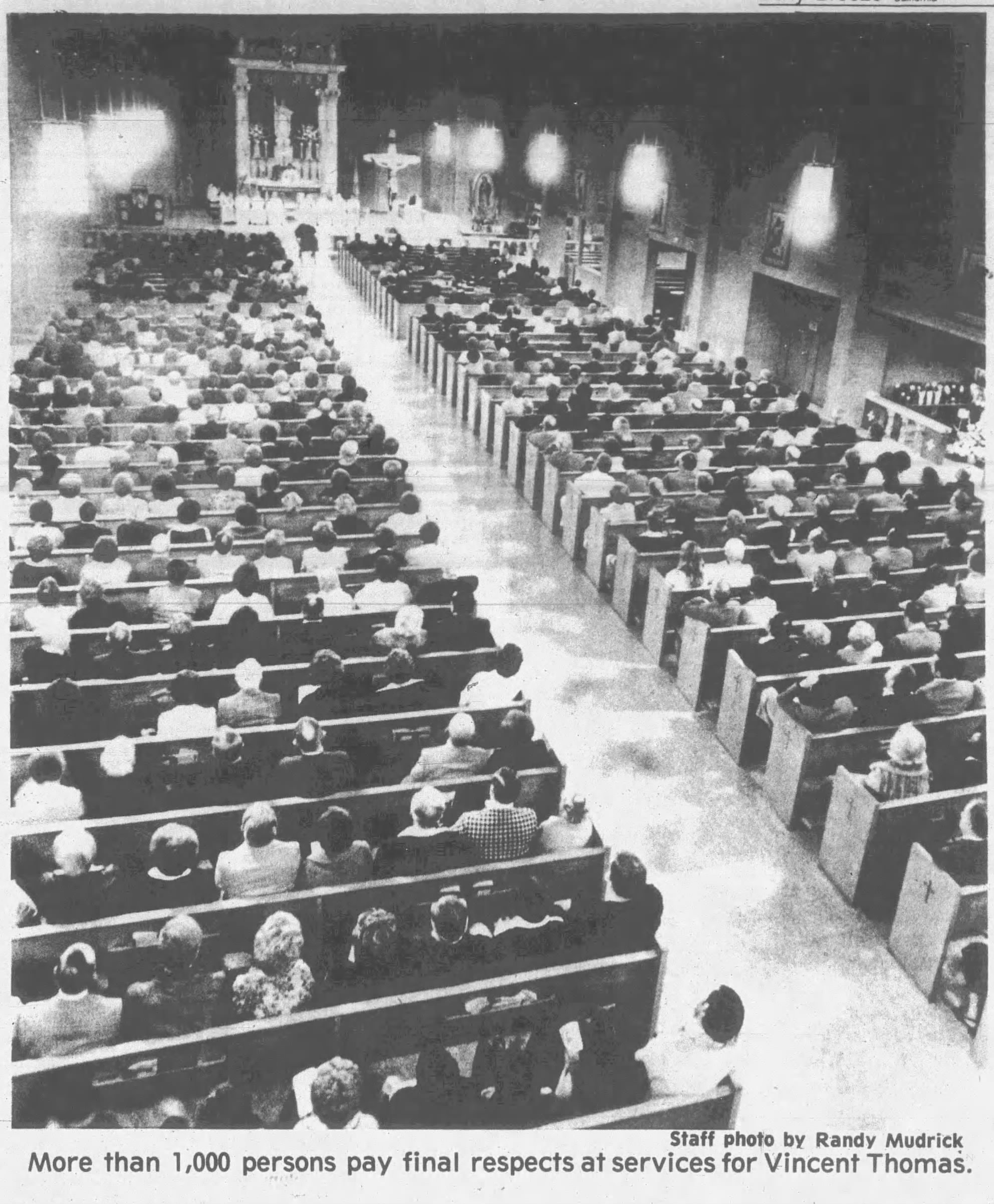
More than 1,000 persons pay final respects at services for Vincent Thomas. Daily Breeze, Feb. 4, 1980, Page 3. Staff photo by Randy Mudrick. (Daily Breeze archives)
Show Caption
1 of 5
A young Vincent Thomas stands in front of his father, Visko, sitting, and mother, Vinca, standing at right in this mid-1910s photo. Also from left, son John, seated, and daughters Zorka and Jane, standing. (San Pedro Bay Historical Society)
While attending San Pedro High School, Thomas’ athletic ability was noted by the school’s football coach, Carl Haney, who encouraged him to participate in sports, including boxing. Thomas remained a boxing fan his entire life.
He also acquired the nickname “Snake Oil,” for a rubdown compound for athletes that he made and sold while in high school. He became an Ephebian, joining the organization that valued youth education and social service.
He was granted a scholarship to the University of Santa Clara upon graduating in 1928. He earned his bachelor’s degree there in philosophy in 1932. He earned his law degree from Loyola University in 1936 — but decided not to practice law.
Instead, he worked for French Sardine, the Terminal Island company that later became Star-Kist Tuna, and also did some lobbying in Sacramento for the fishing industry. His talents were recognized by executives at French Sardine, who encouraged him to run for state Assembly in 1940.
Thomas, a lifelong San Pedro booster, ran on the idea that the town should secede from the city of Los Angeles and take back the port, claiming that the big city 22 miles to the north often ignored Pedro’s unique needs.
He pointed to the 32 years it took the city to make the Municipal Ferry between San Pedro and Terminal Island a reality. The ferryboat moving workers to and from their jobs on Terminal Island opened in 1941; San Pedro became part of Los Angeles in 1909.
Local voters were in tune with Thomas’ ideas, and he won the 68th Assembly District seat by a margin of more than three-to-one in the Nov. 5 election.
He immediately joined several Assembly committees, most notably the Pacific Marine Fisheries Commission. He served as an advocate for the fishing industry for the rest of his tenure.
Speaking of that tenure, it would become, and remains at 38 years, the longest term of service in California State Assembly history. He won 19 consecutive two-year terms there before losing the seat to Gerald Felando in 1978.
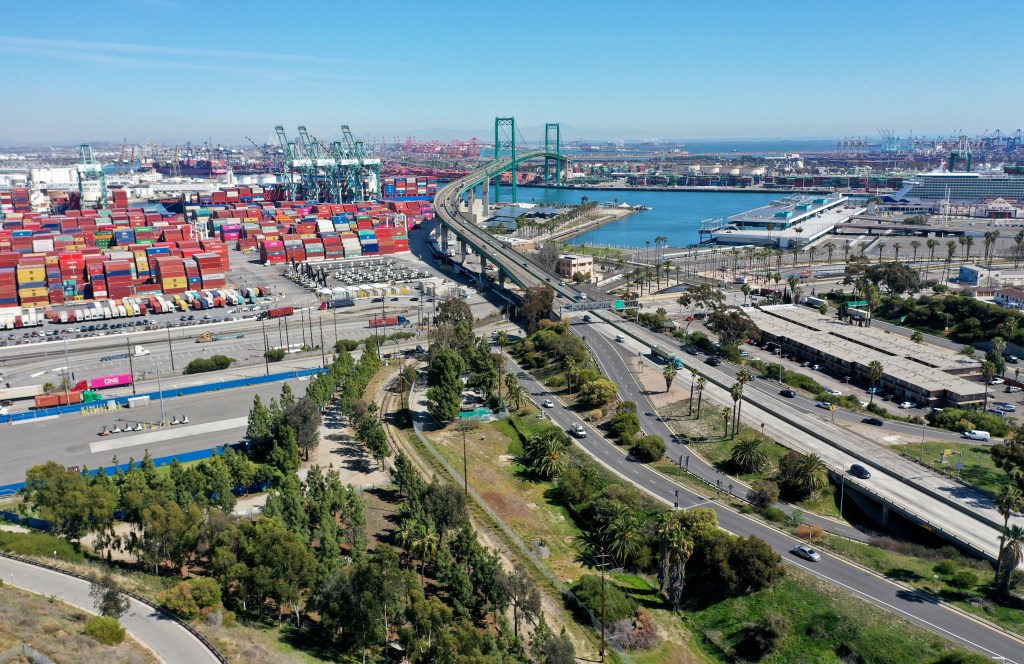
His most memorable accomplishment turned out to be the $21 million, 6,050-foot suspension bridge across the port’s main channel that bears his name. The Vincent Thomas Bridge opened to traffic on Nov. 15, 1963.
Detractors called it a boondoggle and “the bridge to nowhere” during Thomas’ yearslong struggle to get it built. In the end, however, collected tolls from bridge users paid for the bridge after 21 years instead of the projected 40 years.
It wasn’t always planned as a bridge, though. Ever since the early 1920s, the prevailing opinion was that the project connecting San Pedro to Terminal Island would consist of tunnels under the main channel, not a bridge over it.
Legislation to build the underground passage was first proposed in 1938, but failed to advance. Thomas authored a series of bills from 1948 to 1957, paving the way for tunnel construction. After they all had passed, state engineers pointed out to Thomas that a bridge over the channel wouldn’t cost much more than funding the tunnels. By 1958, he’d pivoted, launching the bridge plan instead.
In 1961, the state authorized naming the span “The Vincent Thomas Bridge,” after its longtime champion, a rare case of naming a government structure after a still-living person. The bridge is currently undergoing a roadway refurbishing project estimated to cost $706 million.
The building of the bridge also led to the extension of the 110 Freeway further into San Pedro in order to link it to the bridge. The 110 was originally planned to end at Pacific Coast Highway.
Thomas was disappointed and surprised by his 1980 loss to Felando. He had hoped to complete 40 years of service in the Assembly, but had to settle for 38.
Vincent Thomas died of a heart attack at 1:10 a.m. on Jan. 31, 1980. He was 72. He was survived by Mary DiCarlo of the DiCarlo Bakery family, whom he had married in 1947, and their two children, Mary and Vincent Jr.
Following his death, tributes to him and his nearly four decades of public service poured in from around the state and from then-President Ronald Reagan. More than 1,000 people packed Mary Star of the Sea Catholic Church for his funeral.
One of Thomas’s many accomplishments was the upgrading of boxing industry conditions in the state, and the provision of pension benefits for its practitioners. At the time of his death, he was working on the establishment of a local boxing museum.
Sources: Daily Breeze archives. San Pedro News Pilot archives. “The Vincent Thomas Bridge: San Pedro’s ‘Golden Gate,’” San Pedro Bay Historical Society, 1988. 48 pages. Wikipedia.