
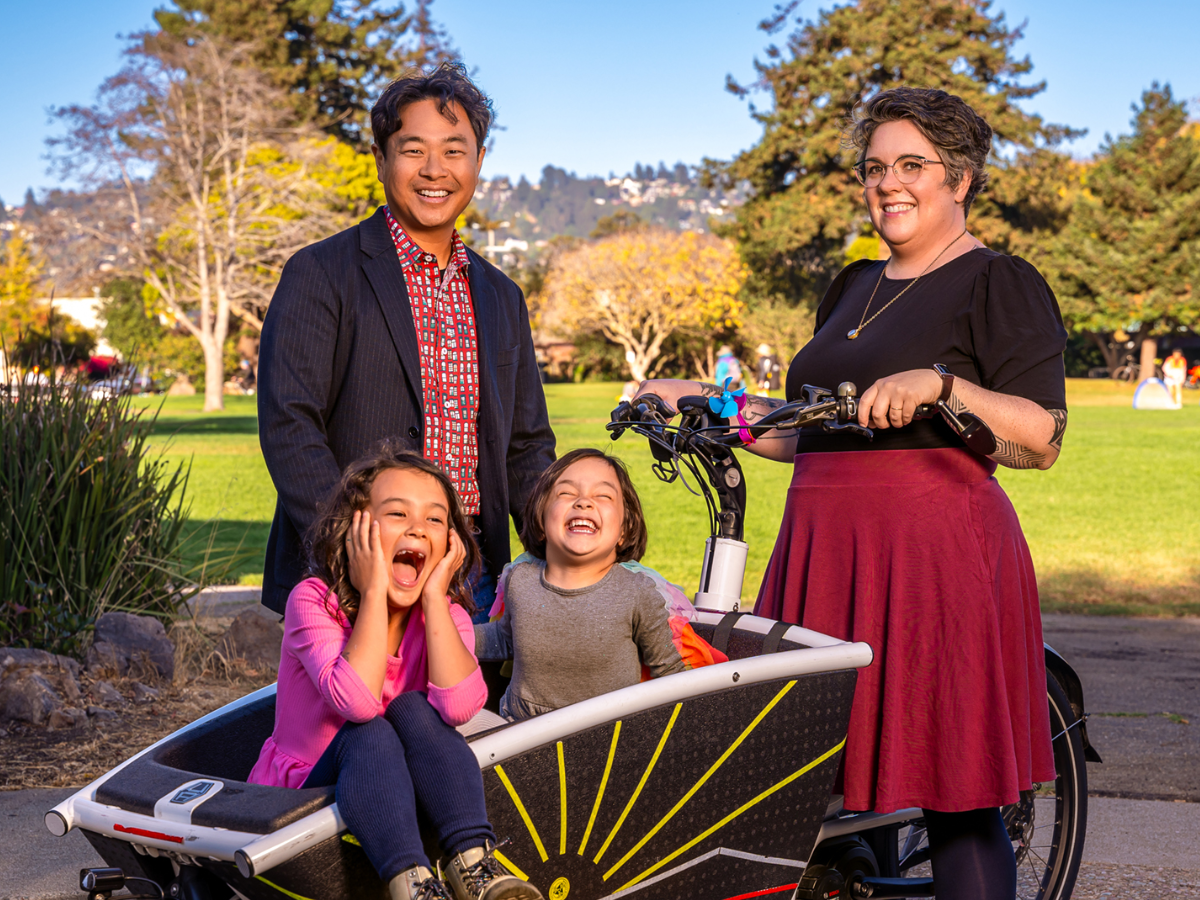
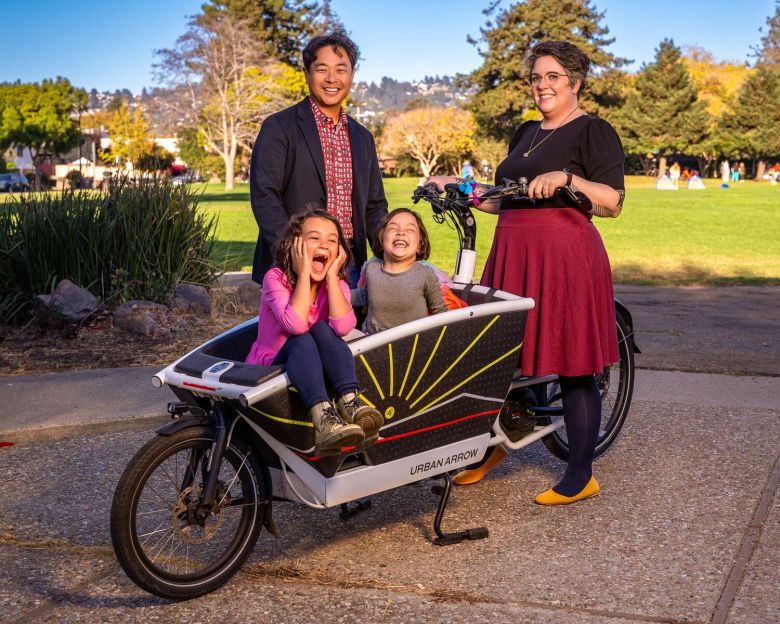
 The Lee-Egan family ditched the family car and now rely on three e-bikes to get around. From left: Chris, Libby and daughters Tilly, 8, and Ginny, 6, in their Urban Arrow in Cedar Rose Park. This photo was used for their 2023 Christmas card. Credit: Eric Panzer
Editors’ note: This week we’re republishing some of our favorite stories of 2025. This story was first published on Oct. 7.
At around 7:30 on a typical weekday morning, Erin Smith hops on her e-bike and rides two blocks to the North Berkeley BART, where she catches a train to San Francisco, then rides three miles from Civic Center to her job at the Cal Academy of Sciences in Golden Gate Park.
Around 8 a.m., Nat Binns maneuvers his cargo e-bike onto Woolsey Street in South Berkeley with his two children, Conor, 6 and Bridget, 3, in back. He drops off Conor at Malcolm X Elementary and then rides a little more than two blocks to drop off Bridget at Via Nova Preschool.
Around 2 p.m., Naveen Gattu leaves his North Berkeley home on Rose Street, heading on his e-bike to pick up his 6-year-old twins, Kyra and Alivia, from their elementary school.
By 4 p.m., 81-year-old Helena Worthen, who lives in the Berkeley Hills, can be found riding her e-bike on the Monterey Avenue bike lane, en route to the Monterey Market.
“The e-bike makes the hills go away,” Worthen said, “and it doesn’t use gas. But it’s fun and easy and replaces the car.” She even uses the bike to tote her cello.
These riders are part of a growing legion of e-bike enthusiasts who can be seen all over town, hauling groceries, children or simply taking in the scenery, replacing cars with a more affordable and earth-friendly form of transport. That motivation — to reduce the use of fossil fuels, as vehicle emissions are the leading driver of climate change locally and nationally — has also spurred several government programs handing out rebates to make e-bikes affordable to low- and middle-income residents.
More than 1 in 4 Berkeley households do not own a private vehicle, with an even higher share of students, low-income residents and residents with a disability forgoing driving, according to a 2023 survey conducted by the U.S. Census. And 9% of Berkeley residents who commute to work do so by bicycle, about 15 times the national average.
The surprisingly large hauling capacity of the ubiquitous cargo e-bike is why an e-bike is replacing the need for a second car for some families, bucking an American tradition already on the wane, or replacing their need for a vehicle altogether.
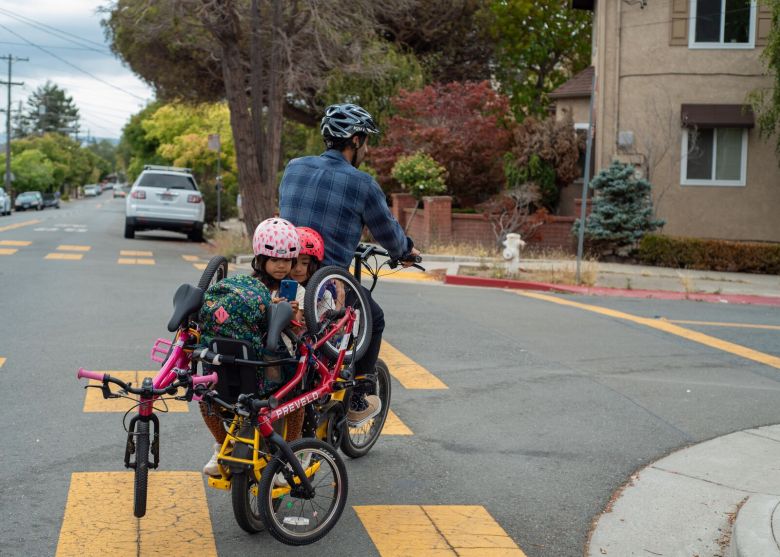 Naveen Gattu can carry his 6-year-old twins — and their pedal bikes — on his cargo e-bike, a Tern GSD. Credit: Ximena Natera for Berkeleyside
Libby and Chris Lee-Egan, a Westbrae couple with two e-bikes and two daughters, found they were using their Subaru Forester so rarely, it was being inhabited by rats. Instead of getting a new car, they did the math and bought a third e-bike, which they use only for local trips.
“All the money we used to spend on insurance, worrying about someone bumping into it or being annoyed in traffic,” Libby said. “I’m very grateful.”
Gattu said what he appreciates about his e-bike is its ability to “move a lot of things and kids and bikes in a very compact way.”
Even though his girls ride to school in the morning on their own non-electric pedal bikes, they don’t want to ride uphill on the way home. So he loads the girls on the back of his cargo bike and straps on their pedal bikes, creating what he described as “a grotesque sculpture.”
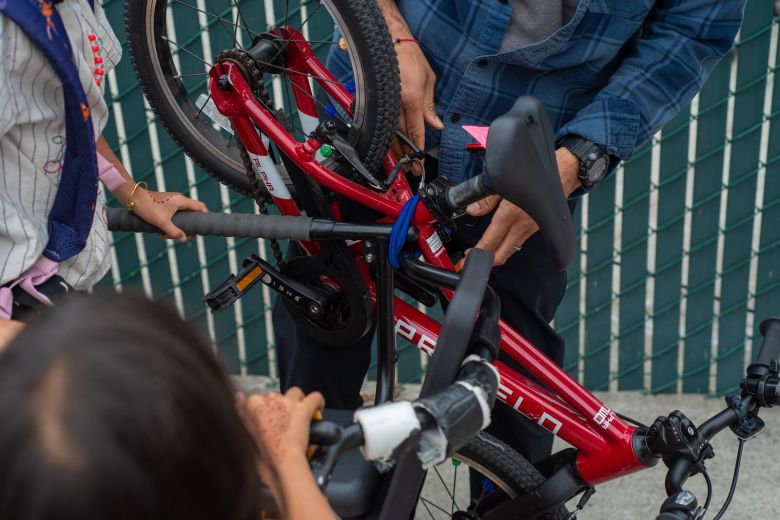 Gattu rigs his daughter’s pedal bike to the family e-bike, assembling what he calls “a grotesque sculpture.” Credit: Ximena Natera for Berkeleyside
How to score an e-bike cheaply
With the average cost of an e-bike at about $3,000, e-bikes offer a cheaper option for those who can’t afford a car, and they don’t require any licensing, insurance or registration that a car or motorcycle does.
Apply now for an e-bike rebate from Ava Community Energy
In recent weeks, many in Berkeley have been able to buy lower-end cargo e-bikes for just $600 or $700 — or even less for low-income residents — through an Ava Community Energy rebate lottery available in Alameda County, along with its service area in Stockton, Lathrop and Tracy in San Joaquin County.
Local bike shops say the rebate, with $10 million behind it, has been much more effective at driving sales than a previous state-run program.
Since e-bikes don’t require any registration, the city doesn’t have any insights into just how many e-bikes are on the road. But those numbers are growing, especially because of the Ava subsidies. Of the more than 10,000 people who have applied to the program since it launched in July, almost 2,000 are Berkeley residents. So far, Ava has dispersed 4,500 rebates from the first three random monthly drawings, with 882 of the winners Berkeley residents, as of the end of September.
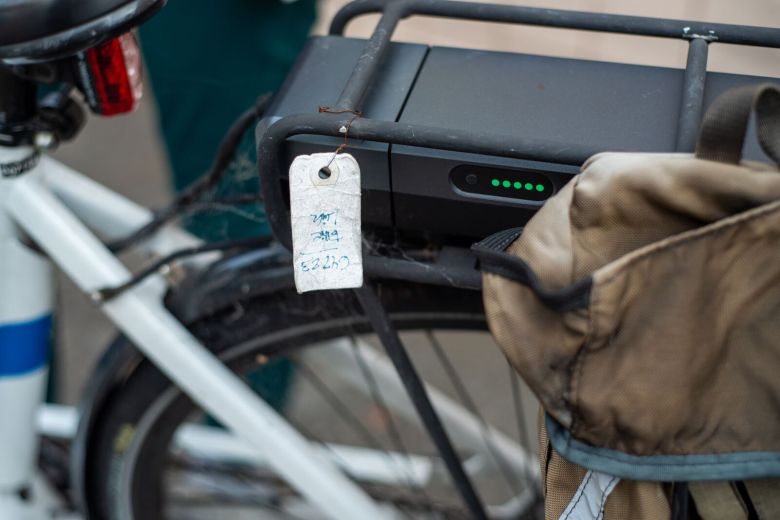 And 9% of Berkeley residents who commute to work do so by bicycle, around 15 times the national average. Credit: Ximena Natera for Berkeleyside
“I don’t sell anything else at this point,” said Grayson Mendivil, of Sports Basement’s bike department. He described the uptick as the largest increase in adoption he has seen in his career. “It’s been more or less taking up all of our time at the shop.”
There are other savings to e-bike ownership.
After the city gave free e-bikes to 56 residents and studied what happened, almost 70% reported saving money on transportation, avoiding nearly $900 in total car ownership costs on average. And 77% of participants who participated in the pilot project reported that once they were given e-bikes or e-trikes, their reliance on cars and motor vehicles decreased.
“Bike culture, in general, tends to be for people who are slim and lightweight,” said Tom Lent, e-bike project coordinator for the Walk Bike Berkeley, a nonprofit that advocates for pedestrian and bike safety in the city, said. “E-bikes are more accessible to all types of bodies. It’s broadened bike culture tremendously because it’s accessible to people who don’t have the interest or just the plain old ability.”
Once Smith, 33, was diagnosed with a progressive heart disease, she wasn’t allowed to ride a pedal bike anymore and found her e-bike to be an “amazing” solution.
“The e-bike lets me keep riding bikes and spend time outside, even though I have this health condition,” she said. “I don’t think that a lot of people realize that e-bikes make things accessible to people with disabilities.”
A legion of former cyclists
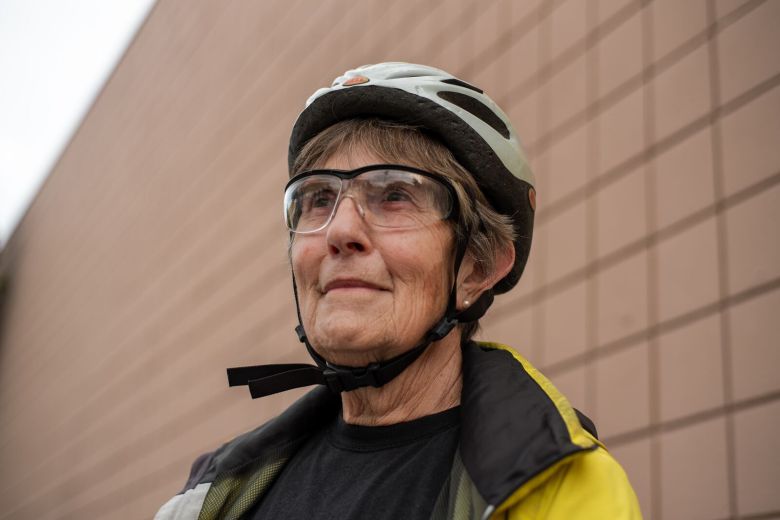 Helena Worthen, 81, a lifelong biker, uses her e-bike to run errands and move up and down the hills. Credit: Ximena Natera for Berkeleyside
Most e-bikers come to the pastime with life-long backgrounds as conventional bikers. Smith described herself as “an avid cyclist” who did bike tours and mountain biking, too. Before working in San Francisco, she rode her pedal bike to Berkeley High School, where she had been a biology teacher for four years.
Worthen, along with her husband, Joe Berry, 76, likewise used “regular bikes” for leisure and groceries. “As time went on, it got harder for me to get up hills.”
Lent, too, had been a rider all his life until a broken ankle forced him to remain couch-bound for a month-and-a-half. He got his first e-bike a little over a year ago.
While most riders use their e-bikes for practical reasons, the vehicles also turn chores into an opportunity to enjoy the great outdoors.
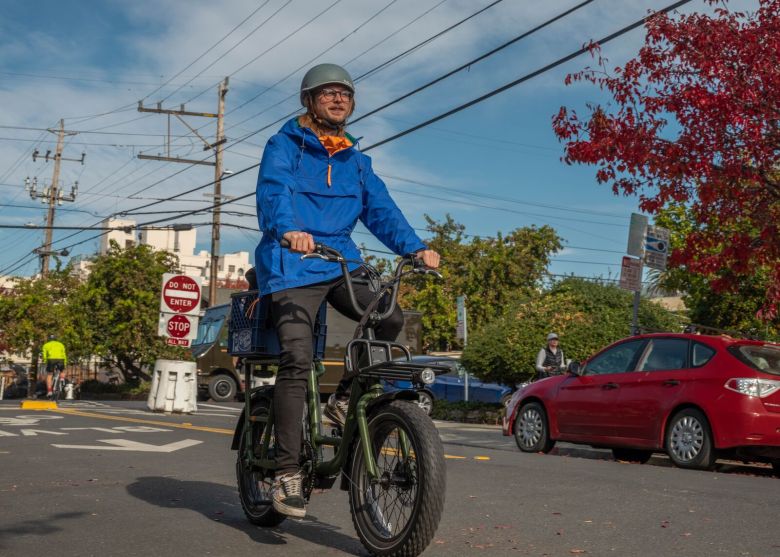 Emil Rofors rides his e-bike in South Berkeley in November 2022. Credit: Ximena Natera, Berkeleyside/CatchLight
“Especially on a sunny, warmish day, just riding around on a bike you experience the city differently,” said Kera Bartlett Binns, the wife of Nat, who picks up Conor and Bridget at the end of the school day. “I notice a lot more than when I’m driving around for sure. It’s a nice alternative to taking a walk.”
Unlike road and mountain bikes, however, e-bikes are typically not purchased solely for fitness, though they do offer some health benefits on a smaller scale.
If Binns wants more of a workout, she will simply lower the pedal assist, similar to lowering the tension on a stationary bike, requiring her to work harder.
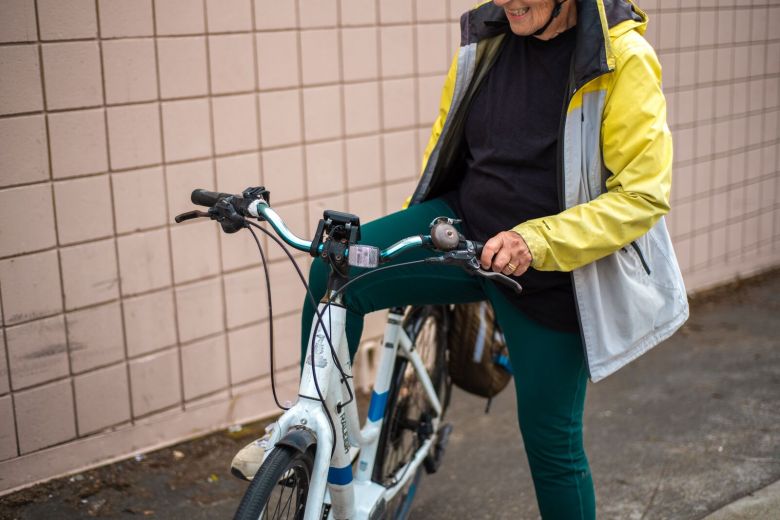 Worthen rides a 2019 Raleigh Detour, an e-bike with pedal assist but no throttle. Credit: Ximena Natera for Berkeleyside
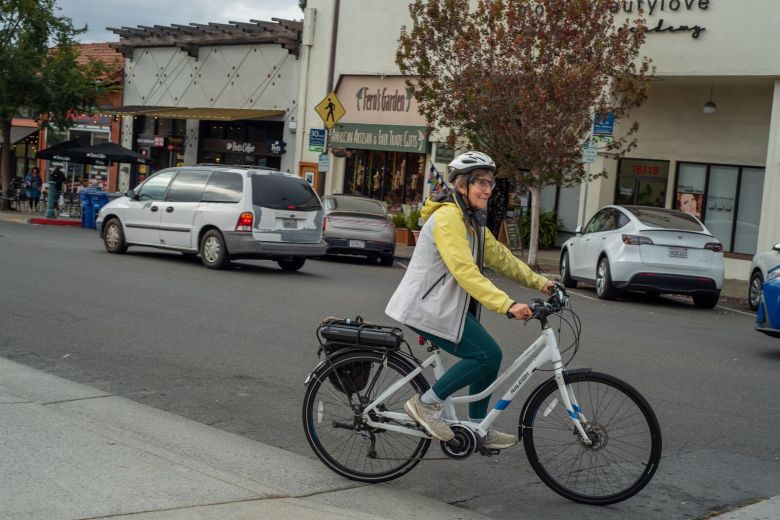 To get back home from the gym, Worthen says she has to battle it out with the 18 bus on Solano Avenue. Credit: Ximena Natera for Berkeleyside
Worthen joins her husband on what she calls “pleasure rides.” They entail riding down Marin Avenue, taking bike paths to the Rosie the Riveter WWII Home Front National Historical Park in Richmond, hopping on the Richmond ferry to San Francisco, coming back on the Oakland ferry and riding home. The round trip: more than 20 miles.
The types of e-bike that cap speeds at 20 mph are allowed on most bike trails and roads and more public spaces have been giving them the green light. In 2023 the East Bay Regional Park District opened over 800 miles of trails to them.
Sales have been climbing, but tariffs could raise prices
E-bikes are a fast-growing mode of transportation.
A recent survey found that e-bikes represent the most rapidly expanding sector in the bike market, making up 63% of the growth in dollar sales of all bicycles between 2019 and 2023. The U.S. imported a record 1.5 million e-bikes in 2024, outpacing that year’s 1.3 million in electric car sales.
Electric bikes are sold at every Berkeley bike shop that sells new road and mountain bikes. Pacific E-Bike has been selling e-bikes the longest, since 2006. In March the store moved from Carleton Street to a San Pablo Avenue location that’s across the street from RAD Power Bikes, a national chain, which opened in 2022.
Store manager Scott LaForgey at Pacific E-Bike said the store’s No. 1 customer is the commuter and that sales took off in 2020, right before the pandemic.
“I couldn’t order ’em fast enough,” he said. “Fewer people wanted to drive. The San Rafael Bridge opened up to bikers and suddenly a whole bunch of commuters could bike to work.”
The store carries 32 brands of e-bikes and most are priced between $1,500 and $2,000. Sports Basement’s top-selling Aventon models are in a similar price range.
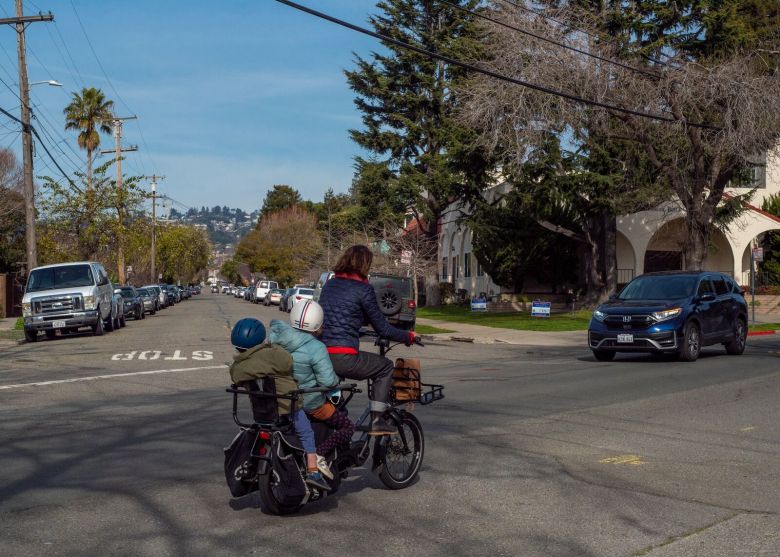 A woman with two children bikes on Hopkins Street in 2023. Credit: Ximena Natera, Berkeleyside/CatchLight
Blue Heron Bikes started selling e-bikes in 2012. In those days bikes were designed, built and finished and then a motor added to it, said Jordan Chase, the store’s manager.
The turning point came about six or seven years ago when the German engineering company Bosch developed an integrated system that incorporated the motor, Chase said. That led to a boom in sales.
Blue Heron’s best sellers are the Tern, which has “a long tail” and can carry one child (about $3,000) or two (about $4,000). Chase compared the Riese & Muller (around $8,000), with various carriers that can haul up to four children, to a minivan.
“You’re getting an e-bike, but it’s a total car replacement in that sense,” Chase said.
Stay True Cycles has been selling e-bikes since its founding five-and-a-half years ago, said owner Nick Hoeper-Tomich. His store’s biggest customers are commuters, especially UC Berkeley students. Such bikes make up about 15% to 20% of sales.
Since most e-bikes and their parts are made in China, future sales may not be as brisk due to a 25% tariff, according to People for Bikes, an advocacy group.
“Prices have already started going up,” LaForgey said. He said he will avoid passing on those increases at least until mid-next year.
For those who cannot afford an e-bike or want to try one out before buying, they can rent one of the 221 Bay Wheels e-bikes that are available at 37 stations across the city. Sports Basement also rents e-bikes. Renting is a frequent choice of UC Berkeley students.
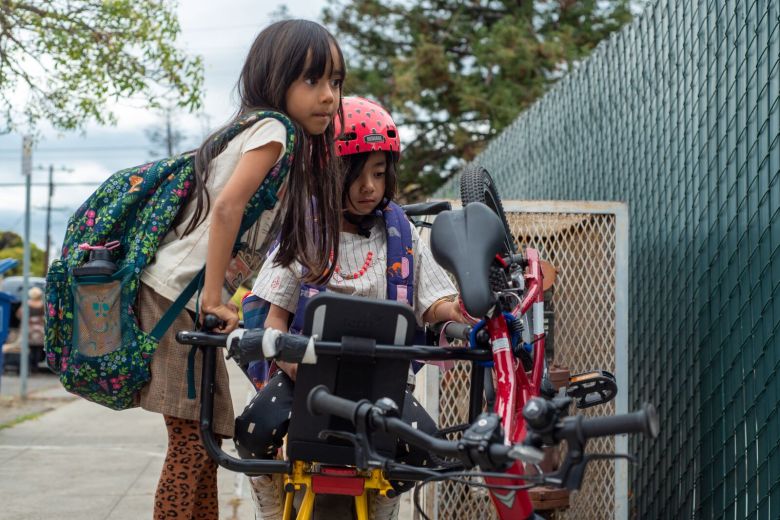 Six-year-old Alivia (left) and her twin sister Kyra board their dad’s e-bike. Credit: Ximena Natera for Berkeleyside
Crashes have led to restrictions elsewhere
The proliferation of e-bikes in Marin County created a sharp increase in crashes involving young riders.
Data from the county’s health department show that e-bikes have a lower crash rate for all age groups over 16 compared to conventional bikes, but result in higher crash rates among riders between 10 and 15. In July, new regulations went into effect banning kids under 16 from riding throttle-powered, Class 2 e-bikes in unincorporated areas of the county, the first legislation of its kind.
Children as young as middle school were tricking-out such bikes to go up to 50 mph or buying faster illegal bikes online.
In Berkeley, a teenager riding an e-bike, who had the right of way, was hit by a car that made an unexpected turn in May 2024, the Berkeley Scanner reported.
And in February, a father who transported his children in an e-bike was hit by a car in West Berkeley, ejecting the child. The father had a minor injury. That crash led to calls for safer bike infrastructure at the intersection at Heinz Avenue and Seventh Street.
But so far, Berkeley has not seen a major upswing in youth e-bike incidents.
“Marin is having this problem, but we don’t see it so much” in Berkeley or Oakland, said Kelly Dunlap, bike education program co-manager at Bike East Bay. That may change, she said, as e-bikes become more popular.
The Berkeley Police Department’s traffic safety data records at least two incidents involving an e-bike since February 2024.
The main complaint Oakland-based Bike East Bay receives about e-bikes in Marin, Clayton and Danville is about kids being reckless on e-bikes, either driving too fast or being discourteous.
To remedy that, the organization offers education classes aimed at traditional bicycles.
One problem she’s seen with bikes in general is that riders are unaware of speed limits on multi-use paths like the Ohlone Greenway and the Bay Trail, which runs along the Berkeley shoreline.
“It’s 15 mph,” Dunlap said.
More bike lanes are on the way in Berkeley
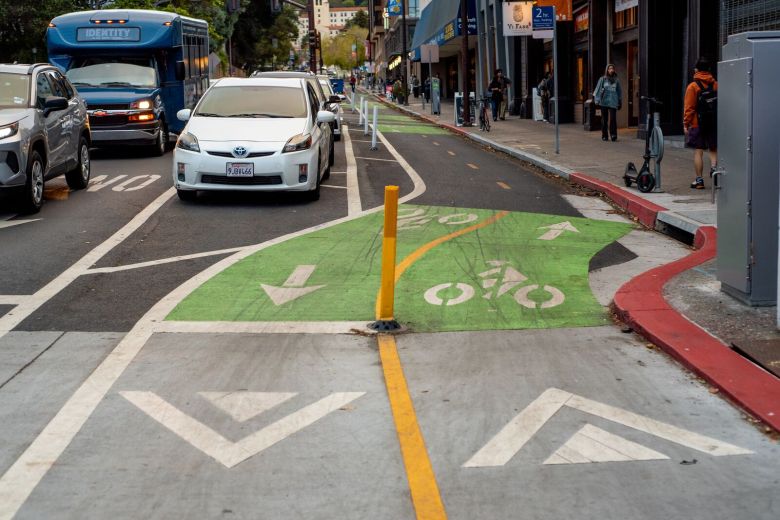 A new protected bike lane at Bancroft Way and Telegraph Avenue, added as part of a $16.5 million redesign of Southside Berkeley’s streets. Credit: Ximena Natera for Berkeleyside
Despite the many plusses, e-biking does pose safety concerns that affect all bikers. Their own experiences and news reports of the occasional collision gives riders pause — and sometimes motivates them.
As a result, many e-bike riders are also involved in safety activism — pushing for better signage, safer intersections, a car-free Telegraph, an expanded network of protected bike lanes and for the city to fulfill its “Vision Zero” pledge to eliminate deadly traffic crashes.
“The dangers are definitely in front of mind,” said Kera Binns. The 2023 death of a four-year-old killed on a bicycle near Lake Merritt motivated her.
“It galvanized me in terms of, how do we create more infrastructure to allow people to bike and reduce opposition?” she said.
Since the adoption of the 2017 Bicycle Plan, the city has built 10 new miles of bikeways – four of which are protected lanes separated from car traffic. These completed, separated bikeways include Milvia Street, Bancroft Way, Hearst Avenue, Dana Street and Fulton Street, among others.
But adding to that infrastructure can be expensive and controversial. A plan to build protected bike lanes along Hopkins Street set off a fierce debate in 2023 between bike advocates, businesses and residents, many of whom worried about the loss of parking spaces the project would require; city officials shelved the project.
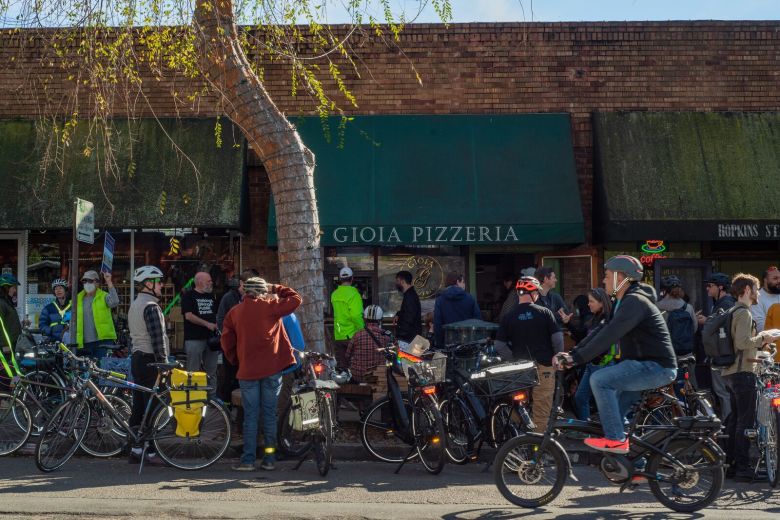 People with their bikes and e-bikes rallied in support of a protected bike lane on Hopkins Street in December 2023. Credit: Ximena Natera/Berkeleyside
More projects are on the way, said city spokesperson Seung Lee, and many activists agree the city is on the verge of a major transformation as money starts flowing from Measure FF toward bike infrastructure projects, pothole repair and other street and sidewalk improvements.
“We’re trying to build out a fuller bicycle network,” Lee said, and the city is soliciting input on an updated bike plan.
Lee himself is an e-biker. He commutes from his home in North Oakland to his offices in downtown Berkeley, a 12-minute trip on Bicycle Boulevards and protected bike lanes on Milvia, where he encounters little vehicular traffic and many Berkeley High School students on e-bikes. “It’s quite leisurely,” he said.
Worthen, who remembers what it was like to bike in early 1970s Berkeley, said that bike safety has improved in Berkeley for all riders.
“I didn’t ride my bike much then,” she said. “There were no bike lanes. And there really wasn’t a consensus that you were supposed to wear a helmet. It’s much safer now.”
What is — and is not — an e-bike
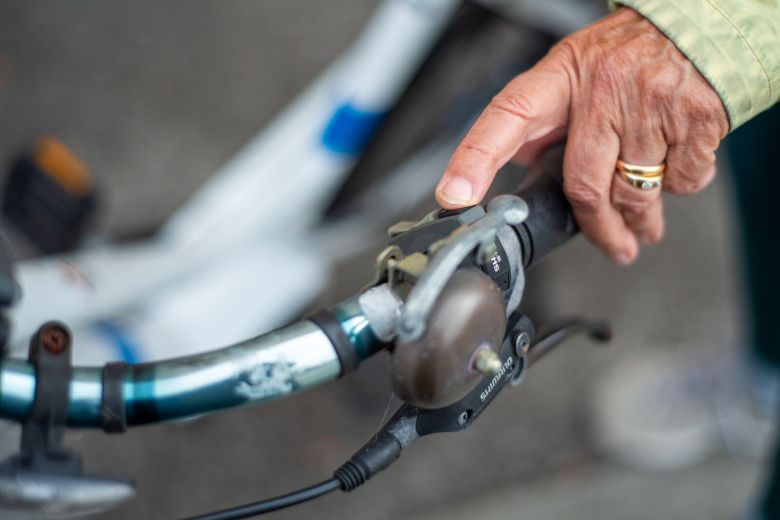 Helena Worthen turns on her e-bike. Credit: Ximena Natera for Berkeleyside
Typically larger and heavier than a road or mountain bike but less beefy than a motorcycle, e-bikes typically weigh between 40-60 pounds. The most lightweight models, many of them folding, come in at as little as 30 pounds.
E-bikes — including cargo and adaptive bikes, like trikes and recumbents — fall into three classifications in California, which have to do with speed and whether a bike is powered by a throttle or a pedal assist.
Class 1 is limited to 20 mph of pedal support with a motor that will help you when needed, but never go over 20 mph.
Class 2 is similar, except it also has a push-button or twist throttle that allows you to use the motor without pedalling, like a lightly powered motorcycle. The motor in this class will also top out at 20 mph.
Class 3, which has only a pedal assist and no throttle, allows riding up to 28 mph before the motor cuts out. All Class 3 riders must wear helmets.
These faster vehicles are sometimes not allowed on public bike trails. California State Parks, for instance, permits only Class 1 e-bikes on roads and trails within recreation areas and on trails that already allow traditional bicycles.
Children can ride Class 1 and 2 e-bikes, but you must be at least 16 to ride the faster, Class 3 bikes. And all Class 3 riders and passengers must wear helmets. (Those under 18 must wear a helmet on any type of bike, motorized or not.)
The boom in e-biking has created an online marketplace for electric bikes that are e-bikes in name only. Online versions may have a pedal for show but are actually more like a moped or a motorcycle, with the ability to go faster than a legal e-bike. Internet sources are also helping youth soup up their e-bikes, another way they can bypass the speed limits of legal e-bikes.
“A lot of people are surprised to learn that a lot of the things sold online are not legally e-bikes,” said Dunlap, bike education program co-manager at Bike East Bay.
“It’s really important when people go shopping for an e-bike that they understand the class system,” she said. “If it’s not in one of those three categories, it’s not streetworthy.”
Because of an uptick in crashes and illegal e-bikes, a bill was introduced in this year’s state legislative session to clarify regulations and specify penalties for violations. But the bill stalled in committee.
“*” indicates required fields