
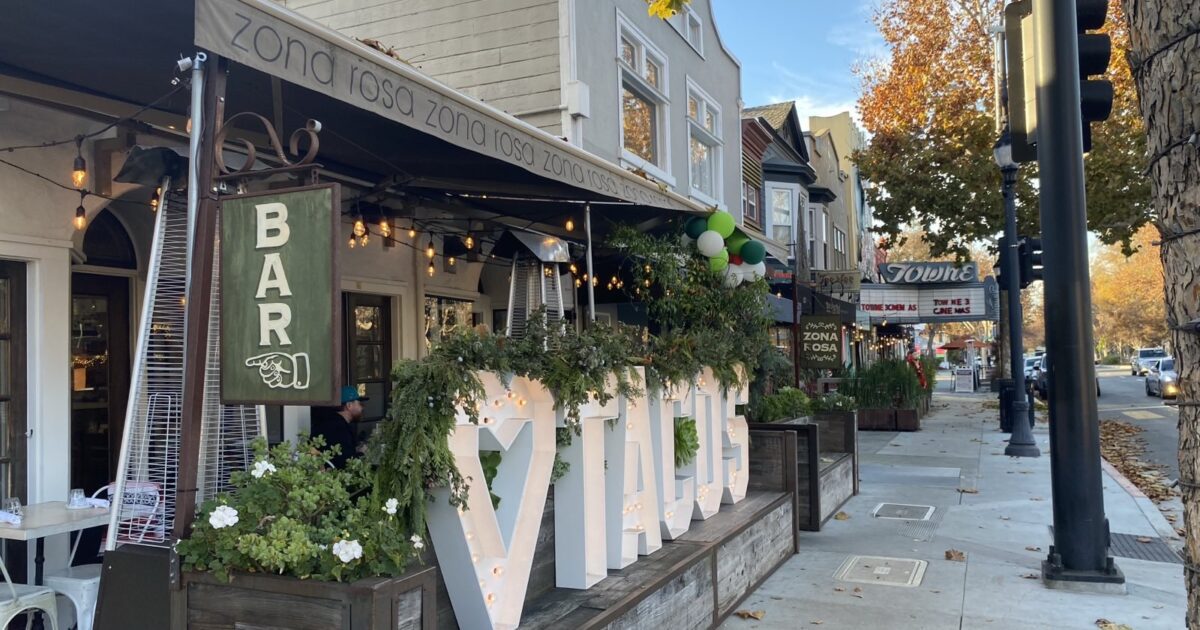
San Jose’s local businesses have faced a whirlwind of economic shocks in recent years. A growing number of small business owners want to find their footing by banding together through the formation of new business improvement districts.
The City Council on Dec. 16 advanced proposals for two such districts — one covering the Alum Rock-Santa Clara Street commercial corridor and the other covering businesses around The Alameda. These proposals are the latest to take shape in a rapid rollout of new business districts that could see the city’s total number rise to 12 by the summer. That would roughly double the city’s business districts over just two years.
Business improvement districts allow companies to pool their resources to pay for services geared toward boosting local commercial activity. San Jose business leaders said the flurry of new district formation will support local companies that have been rocked in recent years by the COVID-19 lockdown, population loss in the city, rapid inflation, tariffs and federal immigration enforcement.
“It’s about long-term economic vitality,” Helen Masamori, a San Jose insurance broker and president of the Alum Rock Santa Clara Street Business Association, told San José Spotlight. “It gives local businesses a voice, local control and the tools to shape the future of their own neighborhood without needing money from the city.”
Business improvement districts are nothing new for San Jose. The city created its first — covering downtown businesses — in 1988. Districts have formed intermittently in the decades since, and as of two years ago the grand total stood at just five.
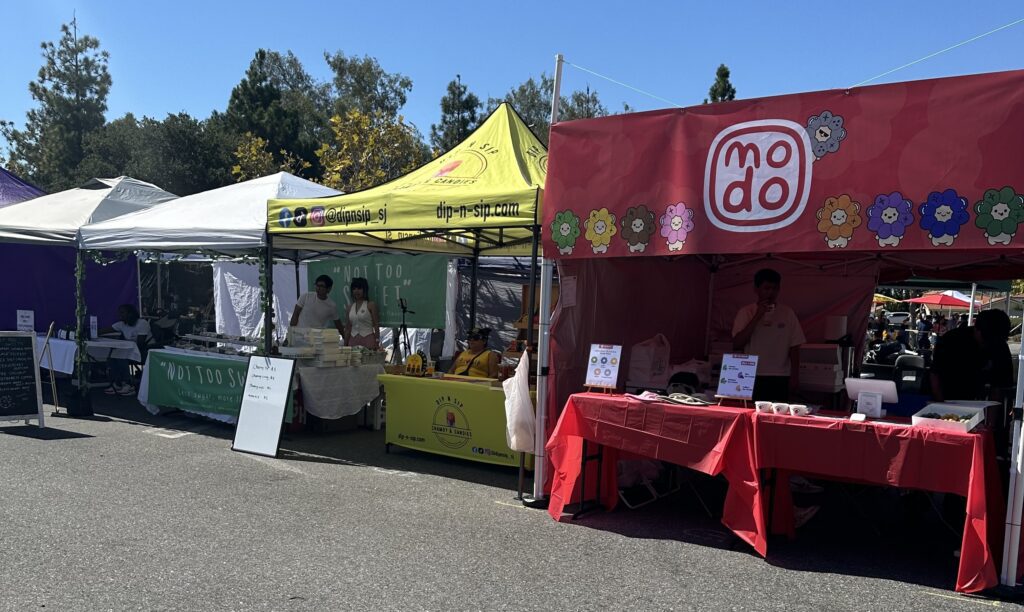 The Tully East Festival took place in East San Jose in September. Its organizers hope to hold more community events thanks to the formation of a business improvement district. Photo courtesy of Christina Bui.
The trendline shot up dramatically in late 2024 when the city added two new districts in rapid succession, with one covering the Monterey Road corridor and another for the area around Tully Road. San Jose approved a new district for The Alameda earlier this year. That district, greenlit in June, is distinct from the latest proposal presently under review for The Alameda neighborhood and is intended to serve somewhat different commercial needs.
Meanwhile, 2026 is expected to spawn yet more improvement districts. City officials said by June they plan to begin the approval process for districts covering Story Road and East Village.
The most immediate proposals advanced in December — covering The Alameda and Alum Rock — will face further public review in the coming months and could be up and running by April, officials said. Once created, those districts will begin assessing fees on the more than 2,200 businesses located within their geographic boundaries. In most cases, the assessment will be set at a flat rate of $350 annually for each business.
The money will be used to promote public safety, beautify neighborhoods, organize events and business activations and drive foot traffic through promotional campaigns, according to memos outlining the planned districts.
The Alum Rock business district alone is projected to generate more than $2 million in revenue over the next 15 years.
“So that’s a considerable amount of money that businesses are investing in their shared concentration areas to help bolster business and raise their place making profile,” Jen Baker, director of the city’s Office of Economic Development and Cultural Affairs, told San José Spotlight.
Masamori, who helped form the Alum Rock district, said she hopes the new services will help to entice more customers to East San Jose.
“If it’s not vibrant, who would want to come here?” Masamori said. “If it’s dark at night, who would want to walk here? Nobody would want to shop here.”
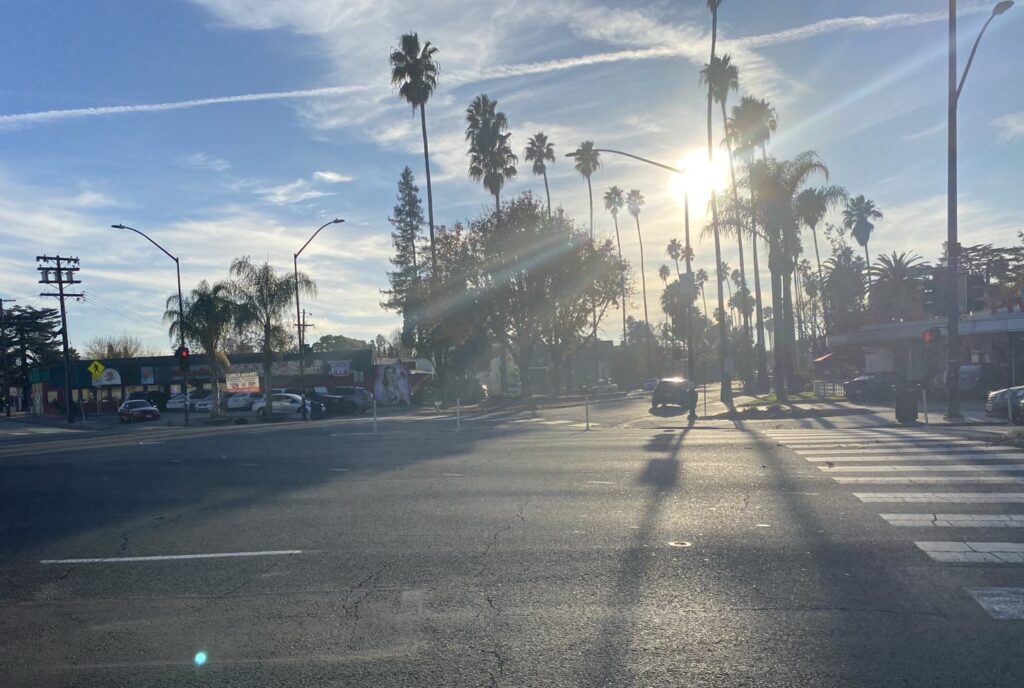 The sun sets over the three-way intersection of The Alameda, Martin Avenue and Race Street, a hub of local business activity. Photo by Keith Menconi.
One factor that has helped so many district plans advance so quickly has been the influx of federal pandemic stimulus money targeted toward small businesses since the start of the pandemic. San Jose has used a portion of the money to hire consultants to aid business associations as they tackle the daunting administrative tasks involved with district formation.
“The city has really supported developing these districts across the city,” Ani Agahian, a local business owner who the city contracted to support the formation of The Alameda Business District, told San José Spotlight. “I think without that support, there really wouldn’t be necessarily the time or capability.”
Some economic indicators suggest the city’s recovery is well underway. Baker noted that over the past three years, the city has issued a record 933 new business tax certificates to food businesses. But she also acknowledged the recovery has been slower to arrive in some neighborhoods compared to others.
Doug Cookerly, who owns Hop & Vine located on The Alameda, said following steep losses during the pandemic, his business has still only regained 60% of its prior revenue. He attributes the slow foot traffic, in part, to a marked deterioration in street conditions throughout the surrounding neighborhood.
“As a small business owner, I was trying to clean up as much of the neighborhood as I possibly could,” Cookerly, who is also president of the The Alameda Business Association, told San José Spotlight. “But it just was financially a task. Physically, emotionally, it was a task.” The hope is The Alameda’s new business improvement districts will be able to lighten that load for Cookerly and other local business owners.
“There’s a lot of ways that we can make The Alameda Business District exciting and desirable,” he said. “Just having programs like this is what gives us hope, strength and a renewed energy to keep pushing through.”
Contact Keith Menconi at [email protected] or @KeithMenconi on X.