
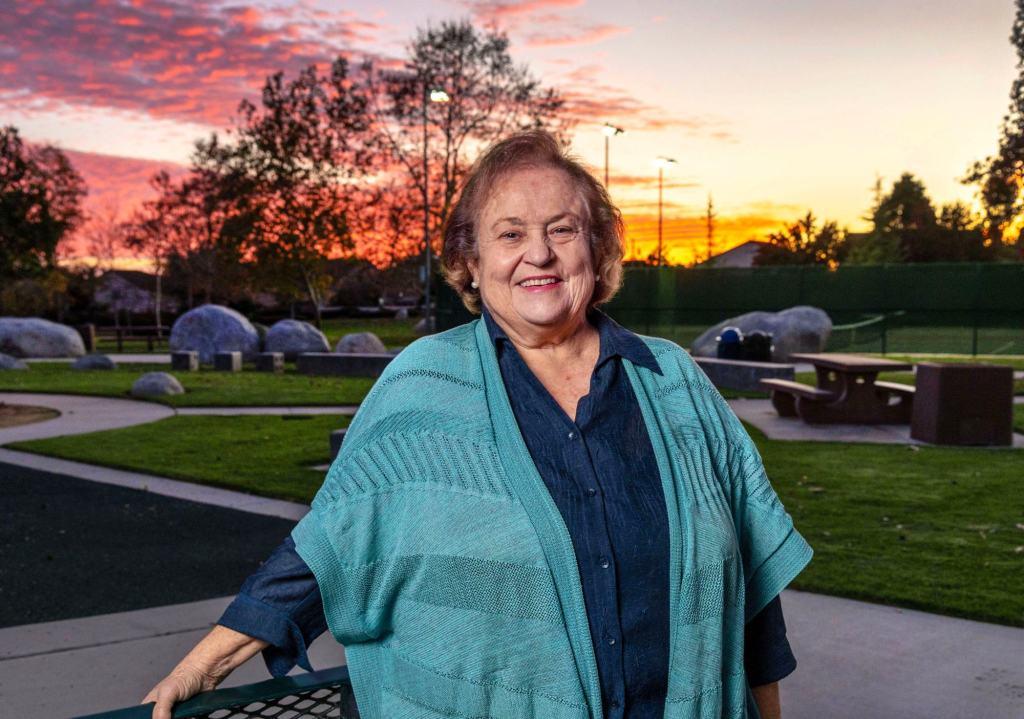
Faye Jonason, head of Camp Pendleton’s History and Museum Branch, came to the Marine Corps base 30 years ago with a mission. Since then, she’s become a major force in telling Camp Pendleton’s story.
That story has been connected to every major American conflict since World War II, when the base was established as a major West Coast Marine Corps training center in 1942. The history before the base opened goes back thousands of years to the Luiseño people and later the missionaries in the late 1700s and cattle ranchers in mid-1800s to 1900s, when it was known as Rancho Santa Margarita y Las Flores.
The 125,000 acre-base has a National Historic Site at the 1840s Santa Margarita Ranch House and National Historic Landmark at the 1868 Las Flores Adobe, along with a number of other historic sites, memorials, monuments and museums, all of which have been under Jonason’s charge.
At the end of the year, Jonason is slated to retire. She has worked with nine base commanding generals since she started in 1995 and leaves behind a legacy of accomplishments.
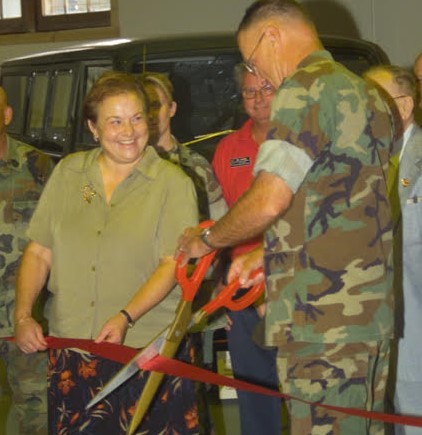 Faye Jonason, Camp Pendleton’s History and Museum Division director, left with Marine Corps Maj. Gen. William G. Bowdon, right, at the ribbon cutting of the Marine Corps Mechanized Museum in 2002 on Camp Pendleton that she had co-founded with Master Gunnery Sgt. James King, center, rear. (Courtesy of Camp Pendleton archives)
Jonason co-founded a museum, created an archive of thousands of historical records, photographs, and artifacts, including oral histories told by veterans and rancho descendants, put together various historical exhibits, oversaw historical restoration projects, led tours and presented educational talks to everyone from commanding generals to schoolchildren.
Her exhibits highlighted histories of Combat Artists in Wartime Vietnam, Development of the Base Fire Departments, Camp Pendleton and its Establishment, Major General Pendleton, Military Working Dogs, Black Women in the U.S. Military and Women Serving as Marines Aboard Camp Pendleton. All this from someone who didn’t want to study history in high school because, as Jonason put it, they “just threw a lot of dates and names at us.”
Jonason refers to herself simply as the base’s historian and is known as an encyclopedia of Camp Pendleton history. But she says she’s still learning and that’s what has kept her at it. Ask her a historical question and she’ll eagerly dig into it.
“It’s a learning experience and I just want to share it with others,” Jonason said.
“Faye possesses that unique ability of looking at the past while connecting to the future,” said retired Marine Brig.Gen. J. W. Bullard, president of the Camp Pendleton Historical Society. “She’s been instrumental in preserving and promulgating the stories of the past and how they connect to the present. Although Faye is stepping down from her role, she will take on a new role as an advisor to the Camp Pendleton Historical Society and remain involved with the community.”
Jonason, who has a bachelor’s degree in art and teaching credentials from California State University, Sacramento, came to Camp Pendleton after working 20 years at several museums across the state. She served as assistant curator of collections at California State Railroad Museum, Sacramento in the late 1970s; as director of Visiting Classroom Programs at the Ocean Institute in Dana Point in the early 1980s; and Registrar of Interpretive Collections at the California African American Museum Los Angeles in the mid-1980s to mid-1990s. As a National Endowment for the Arts fellow, she studied the interpretation of the American Industrial Revolution using American art.
Jonason developed the Camp Pendleton Base Archives, which include roughly 26,000 photographs, more than 10,560 record entries, 21 categories of archival materials, oral histories, maps, plans, documents and video and film recordings. The collection of oral histories includes 100 video recordings of World War II, Korea and Vietnam veterans with interviews by Jonason, who started the base’s Veteran Oral History Program.
“I’m most proud of the oral histories,” Jonason said. “You can hear the history from the veterans who were part of it. The Marines have always been proud of their history.”
In 2002, Jonason helped establish the Marine Corps Mechanized Museum with now retired Master Gunnery Sgt. James King, who worked with volunteers restoring old military vehicles. The base’s History-Museum Branch, under Jonason, worked to acquire the space in a historic building and designed the exhibits for the museum, which was dedicated as part of the base’s 60th anniversary celebration.
“Year after year, Faye fought to obtain funding to make the necessary repairs and save the historically important building and its rolling stock. Faye had to learn on the job under stringent financial constraints, but she was up to the challenge. She was innovative, tenacious and forward-thinking,” said retired Marine Col. Richard B. Rothwell, longtime past president of the Camp Pendleton Historical Society.
The 22,000-square-foot building houses a large part of the more than 120 historical artifact collection ranging from transport and battle vehicles to artillery and is billed as the world’s largest collection of U.S. Marine Corps vehicles from World War II to the Global War on Terrorism.
Jonason worked with the Rancho Santa Margarita y Las Flores Docents to give interpretive tours of the base’s historic sites and landmarks. She has also served as a base liaison to the Camp Pendleton Historical Society and the Docents, which are both nonprofits that preserve and share the base’s history, including acquiring historic artifacts on behalf of the base, helping restore historic buildings, constructing Marine Corps memorial monuments and memorial gardens. She was instrumental in securing and helping design the Veterans Memorial Garden near the base’s main gate.
“Ms. Jonason possesses an encyclopedic knowledge of the history of Rancho Santa Margarita y Las Flores, starting in 1769 with the Portola Expedition through the evolution into Marine Corps Base Camp Pendleton in 1942. Her personality, gift of persuasion, kindness and sense of humor have endeared her to the base’s rancho docents,” said retired Marine Lt. Col. Paul Graham Durrance, chairman of the Rancho Santa Margarita y Las Flores Docents.
Jonason plans to continue her efforts telling the Camp Pendleton story as an advisor to the Camp Pendleton Historical Society.
“In preserving and researching history, we learn about tenacity and courage and the spirit of those who lived that history” Jonason said.