
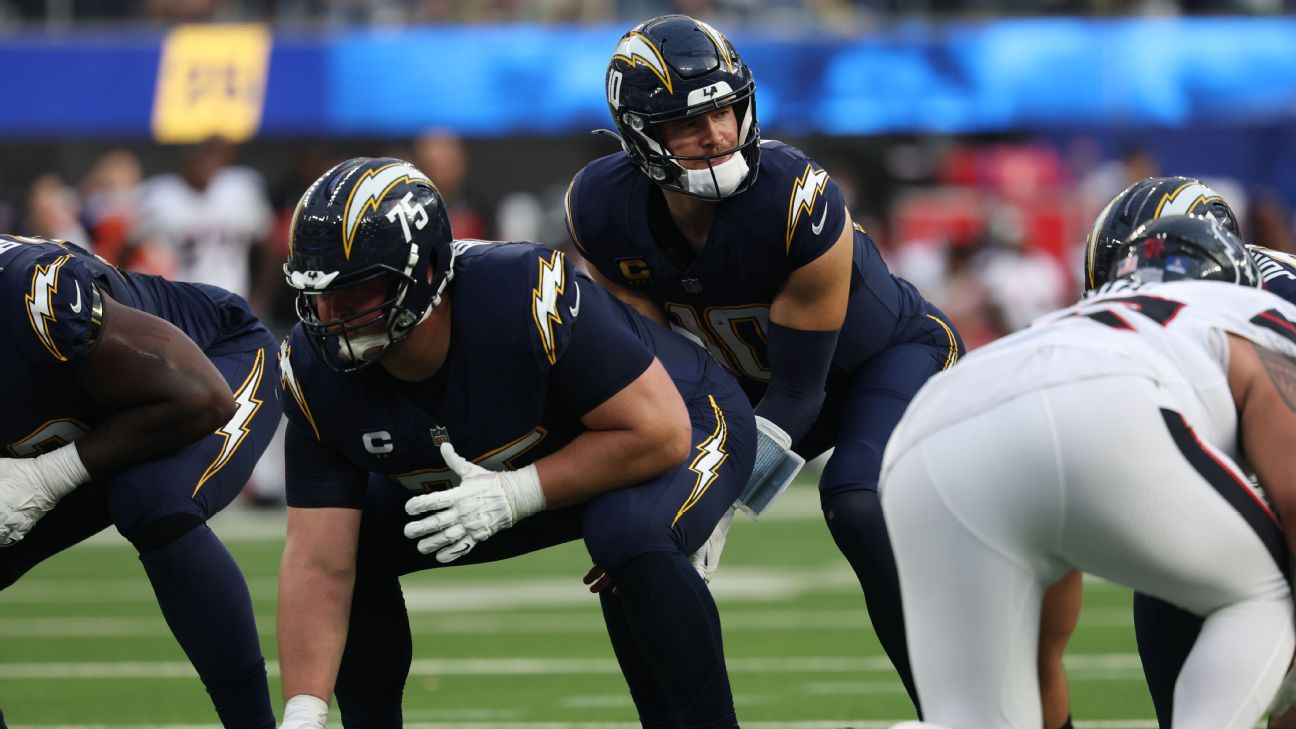
LOS ANGELES — A year after an embarrassing playoff loss exposed their offensive line, the Los Angeles Chargers are back in a familiar place — with a unit that has gone from worrisome to a national punchline.
During a recent segment on the “Pat McAfee Show,” the sports television personality read Pro Football Focus rankings that placed four Chargers linemen at or near the bottom of their positions and mocked the group on-air.
“When we talk about a–, we mean this offensive line here,” McAfee said, while his co-hosts laughed.
What was supposed to be a unit anchored by two of the Chargers’ best players (Joe Alt and Rashawn Slater, who are both out with injuries) has instead become a liability and potentially the reason this team falls short of true contention. L.A. has tried to remedy the issue; cycling through 29 different offensive line combinations, the third-most in the NFL, trading for linemen, signing others and churning through the practice squad. But nothing’s worked.
As the Chargers head into Sunday’s season-finale against the Denver Broncos (4:25 p.m. ET on CBS) — and the playoffs — they’ve run out of time to solve this problem. The formula that produced eleven wins is the only one left: Lean on an elite defense to keep games low scoring and trust quarterback Justin Herbert to make magic behind pockets that collapse almost as soon as they form.
“We all feel it hasn’t went the way we wanted to go, but I feel like we’ve adjusted well as best as we can,” guard Mekhi Becton said.
Last season, the Chargers went to face the Houston Texans as a three-point favorite, according to DraftKings Sportsbook. Instead, they were embarrassed in a 32-12 beatdown.
In that game, the Texans pressured Herbert on 39% of his dropbacks and sacked him four times. He threw four interceptions after throwing just three all season.
“He’s got to be able to finish a throwing motion,” coach Jim Harbaugh said. “Quarterback’s got to be able to do that, and we didn’t put him in the position to do that enough.”
That day in Houston, the Chargers’ offensive line featured Slater at left tackle, Zion Johnson at left guard, Bradley Bozeman at center, Trey Pipkins III at right guard and Alt at right tackle. The entire group played poorly that day, but throughout the season, the Chargers’ tackles had been among the best in the league. The most persistent issues were on the interior.
In the offseason, general manager Joe Hortiz found an upgrade. He signed Becton, a 2020 first-round pick, who was coming off a Super Bowl win and the best season of his career with the Philadelphia Eagles. Becton signed a two-year deal worth up to $20 million.
The Chargers entered the season believing Becton would be a major upgrade at right guard. But things haven’t gone as planned.
Becton ranks 46th as a guard in pass block win rate (91.2%) and 61st out of 62 eligible guards in run block win rate (63.4%). Injuries had been an issue throughout Becton’s career, and they’ve continued this season. He has played 78.1% of the team’s snaps and told ESPN he has grown frustrated with how the team has managed his playing time and handled his injuries.
Despite being one of the richest teams in free agency, Hortiz stopped there at bringing in a starting-caliber offensive lineman. L.A. re-signed Bozeman to a two-year contract worth up to $6.5 million and signed former Raiders center Andre James, who was beaten out in Las Vegas by rookie Jackson Powers-Johnson late last season.
When asked about his comfort level ahead of the 2025 season without upgrades at left guard or center, Hortiz was defensive: “We were pretty good last season. Eleven wins, right?”
Hortiz has said the most sustainable way to reach success in the NFL is through the draft, a philosophy shaped over two decades in Baltimore. His two draft and free agency classes support the theory, as the Chargers have gotten significant contributions from both.
Still, they waited until the sixth round in the 2025 draft to select an offensive lineman, despite it being a significant need. Hortiz chose Branson Taylor, who didn’t make the Chargers 53-man roster and is now on the practice squad.
During training camp and the preseason, the Chargers considered swapping Bozeman and Johnson, with the two players alternating snaps at center and left guard, before ultimately settling on the same combination. L.A. never gave James a legitimate opportunity to compete for a starting role.
Things kept falling apart for the 2025 Chargers. Slater suffered a season-ending left patellar tendon tear in training camp, and Alt played just six games before a season-ending high right ankle injury.
The results have been abysmal.
Herbert has been pressured more than any quarterback (268 times) and is the second-most-sacked (54). The Chargers’ o-line ranks last in PBWR (54.4%) and is second-to-last in RBWR (69%). They allow the second-highest pressure percentage on quarterback dropbacks (38.4%) and rank 28th in yards per rush in runs up the middle (3.5).
“We don’t like that obviously,” Pipkins said earlier this season of the hits on Herbert and the state of the offensive line. “That’s on us and we’ll fix it in our room.”
Bozeman and Johnson, the two biggest concerns coming into this season, have been the most reliable in terms of their availability. Bozeman has played 98.7% of snaps, and Johnson hasn’t missed any. Their play, however, has remained inconsistent.
Johnson has impressed as a run blocker, ranking second in RBWR (79.3%) but is graded as the fifth-worst guard in PBWR (87.4%). Bozeman has struggled particularly as a pass blocker, ranking last among centers in PBWR (92.5%), though he is 18th in RBWR (69.4%).
“We know when play isn’t up to standard,” Johnson said. “We have that voice in our room, in our heads, that we don’t want to let guys down.”
The Chargers have had a revolving door at tackle. Injuries have forced them to play as far down as their seventh-string tackle and at the trade deadline, they acquired Trevor Penning, a 2022 first-round pick who started just one game at tackle before the Chargers ditched that experiment.
After the Chargers’ Week 13 win over the Raiders, Harbaugh said he had landed on a starting group with Jamaree Salyer at left tackle and Pipkins at right tackle. That stability was short-lived. Pipkins missed Weeks 14-16 with an ankle injury, and Salyer exited their Week 16 game with a hamstring injury and hasn’t played since.
This led up to a rematch with the Texans in Week 17, and from a protection standpoint, the game unfolded similarly to how it did last year. The Chargers started Bobby Hart at left tackle, a position he hadn’t played since the 2022 season, and he played just six snaps. After four pressures and three sacks allowed, the Chargers benched him in the third quarter for Austin Deculus. But it didn’t matter.
Herbert was sacked five times and pressured 20 times, his fourth game with at least 20 pressures this season, most by a quarterback in a season since himself in 2022.
“Nobody is hanging their head,” Harbaugh said. “… There’s a lot of good things to go along with and things that can be improved. That’s where I think it’s at.”
The Chargers believed continuity and one swing in free agency would be enough to fix this o-line’s problems, but injuries ruined that plan before it ever had a chance. A season later, the same problem remains, and they’ve run out of time to fix it.br/]
Copyright © 2025 ESPN Internet Ventures. All rights reserved.