
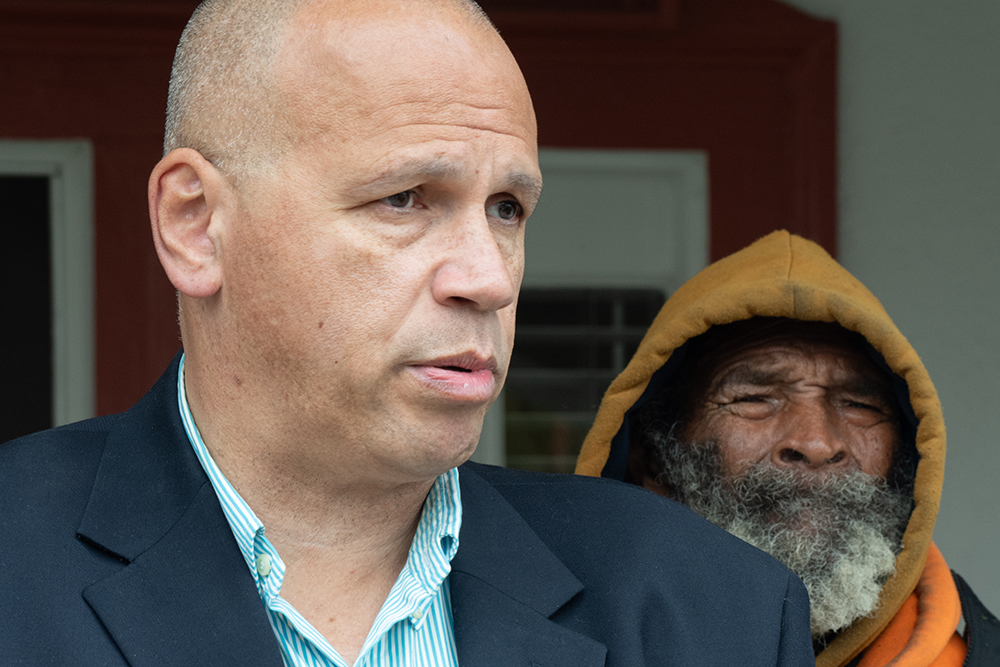
 Attorney Kevin Little, left, with his client Wickey TwoHands. Photo by Peter Maiden
Major Lawsuit Filed Against the City of Fresno
On Dec. 10, civil rights attorney Kevin Little filed a civil complaint lawsuit against the City of Fresno and several police officers on behalf of two unhoused individuals who were previously acquitted of no camping violation charges, Wickey TwoHands and Joseph Quinney.
TwoHands is an employed 65-year-old man unable to afford housing, and Quinney is a disabled 52-year-old. Neither has a substance abuse or mental health disability. Little is representing TwoHands and Quinney pro bono, and the plaintiffs include all other similarly situated individuals.
The class action lawsuit asserts 26 causes of action including, but not limited to, false arrest and malicious prosecution under the Fourth and 14th amendments of the U.S. Constitution, unconstitutional search and seizure of property, violations of the Americans with Disabilities Act, violations of due process/state endangerment, waste of public funds and numerous California civil rights law violations.
The complaint places these individual harms within a broader pattern of systemic abuse.
The latest event in that pattern of abuse is the recent code amendments, passed on Dec. 18, intensifying the City’s anti-camping ordinance, which now will criminalize even pedestrian unhoused persons and give the City broad powers to issue restraining orders against unhoused persons simply based on their status and even if they have never been convicted of any crime.
The addendum to the ordinance would also make possession of a blanket, tent or a sleeping bag illegal.
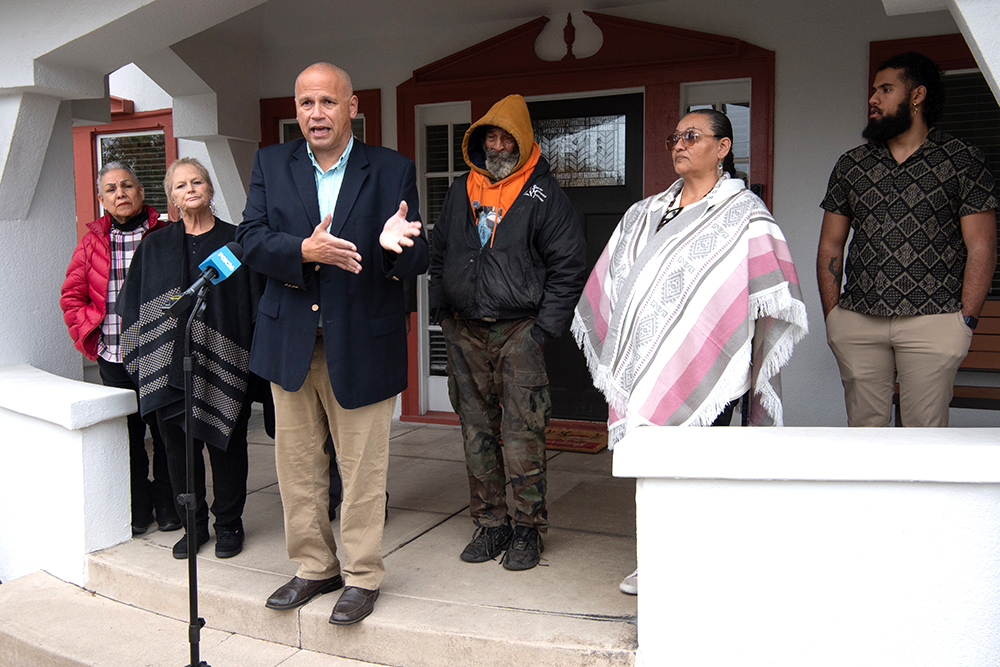 At a press conference on the porch of Kevin Little’s office. Left to right: Rebecca Rangel, Cindy Piombino, Kevin Little, Wickey TwoHands, Desiree Martinez and Enrique Little. Photo by Peter Maiden
Handcuffs, Not Housing
Little says that “rather than address the homelessness crisis through pro-housing and other humanitarian solutions, the City has doubled down on criminalization. The challenged ordinances are enforced selectively and discriminatorily against unhoused persons while housed individuals engaging in identical conduct face no consequences.
“Enforcement practices also include mass arrests, encampment sweeps, immediate destruction of property without preservation for retrieval, failure to provide ADA accommodations, elder abuse, and empty and coercive offers of typically unavailable substance-abuse programs.”
The Lawsuit and Homelessness in Fresno
Little addressed several questions regarding the lawsuit and related issues.
Community Alliance (CA): To date, there have been more than 1,700 citations and arrests for violations of the no camping ordinance since Sept. 23, 2024. What is the status of these cases?
Little: Only 137 have resulted in court filings, and none of them have been brought to trial. The City Attorney’s Office lacks resources to pursue all of the cases.
CA: How is the Public Defender’s Office responding to these cases?
Little: They originally took a stance not to waive time and to ask for trials. I do not know their current stance.
CA: Does the enforcement of the ordinance have a disproportionate impact on minorities?
Little: Yes, there is over-representation of Black and Brown individuals among arrestees. The majority of arrestees are not persons of color, but percentages are skewed. The racial breakdown of arrests shows disparity.
CA: What is your message to the business community and residents of Fresno that drive these policies that criminalize unhoused people?
Little: First of all, have a little bit more respect for your fellow man. Also, you have to have a more long-term vision in terms of what’s good for the city. We have been dealing with this so-called crisis for 20 years and addressing the problem with various public measures, funding initiatives, billions statewide and millions locally gone into addressing this issue with law enforcement, and it just doesn’t work. We have proof it doesn’t work.
CA: What is your critique of the City’s homelessness approach?
Little: It’s ineffective and has been an enforcement-focused strategy for over 20 years. There is still a high homeless population despite significant funding and enforcement. There’s a significant lack of shelter beds.
[Fresno has around 4,000 homeless residents and only 1,400–1,500 shelter beds. More than 100 shelter beds recently became unavailable due to federal and state funding cuts.]
CA: City Attorney Andrew Janz said, in response to the lawsuit, that he is prepared to take the case to the Supreme Court, citing the precedent of the Grants Pass v. Johnson ruling of 2024 that allows cities to punish unhoused people for sleeping or camping in public spaces even if shelters are unavailable.
Little: The Grants Pass decision does not apply to the claims asserted in this lawsuit. [It] does not relate to other constitutional challenges, including the selective enforcement of the ordinance, the equal protection issue, disability discrimination and more. There is strong evidence of equal protection violations and of property destruction.
CA: What is the legal strategy and case strength?
Little: I think it’s a strong case. We have spent the last year putting this case together. We have strong evidence from the months of outreach that we did. We want to get into court, get financial compensation and an injunction against enforcement of these provisions. We, as a community supporting the unhoused and the unhoused have nothing to lose. We are working for a preliminary injunction to end the enforcement [of the no camping ordinance]. Our goals include ending discriminatory practices and securing housing accommodations.
The lawsuit will take months to adjudicate and a settlement is possible, but unlikely given the City Attorney’s stance to date. The next steps are applying for an injunction and scheduling hearings for the case. A scheduling conference is scheduled for April 2026.
Facebook
Twitter
Email
Print