
Welcome to 2026! Cue the horns, confetti 🎉 and sighs of relief that we can finally put 2025 behind us.
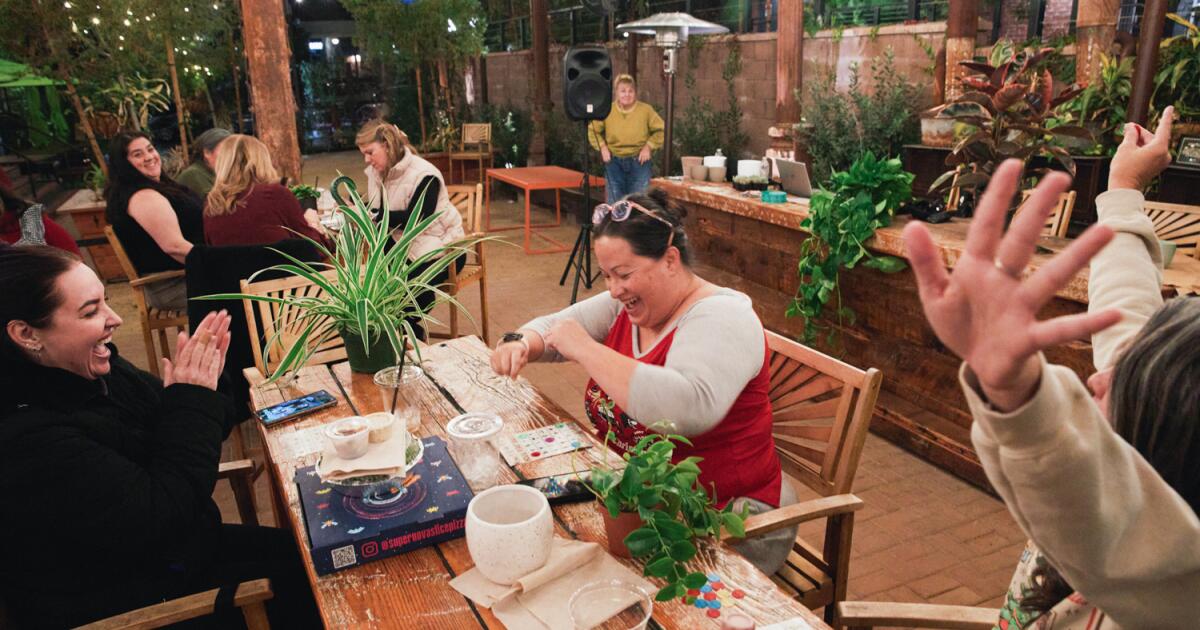
We have a good list of January plant-related activities below. Note that January is the traditional time to start pruning roses and fruit trees in Southern California. But first, I have to tell you about a new gaming opportunity taking greater L.A. by storm. There are pop-up Plant Bingo events where the game cards feature houseplants and the prizes are — you guessed it — glossy houseplants.
Bingo is one of those games that gets under your skin, with the enduring hope that next time, you’ll get the winning numbers. That quest is certainly fueling interest in Plant Bingo events in Southern California, but local organizers say learning about plants, and getting a chance to win a plant, appears just as important.
“People just really love Plant Bingo now,” said Genevieve Aleman, who, with her business (and life) partner Donovan Moreno, owns the Greenprint Co. in Riverside. They’ve been offering multiple pop-up Plant Bingo nights at restaurants and breweries around the Inland Empire every month since September and selling out to crowds of 25 to 40 people every time.
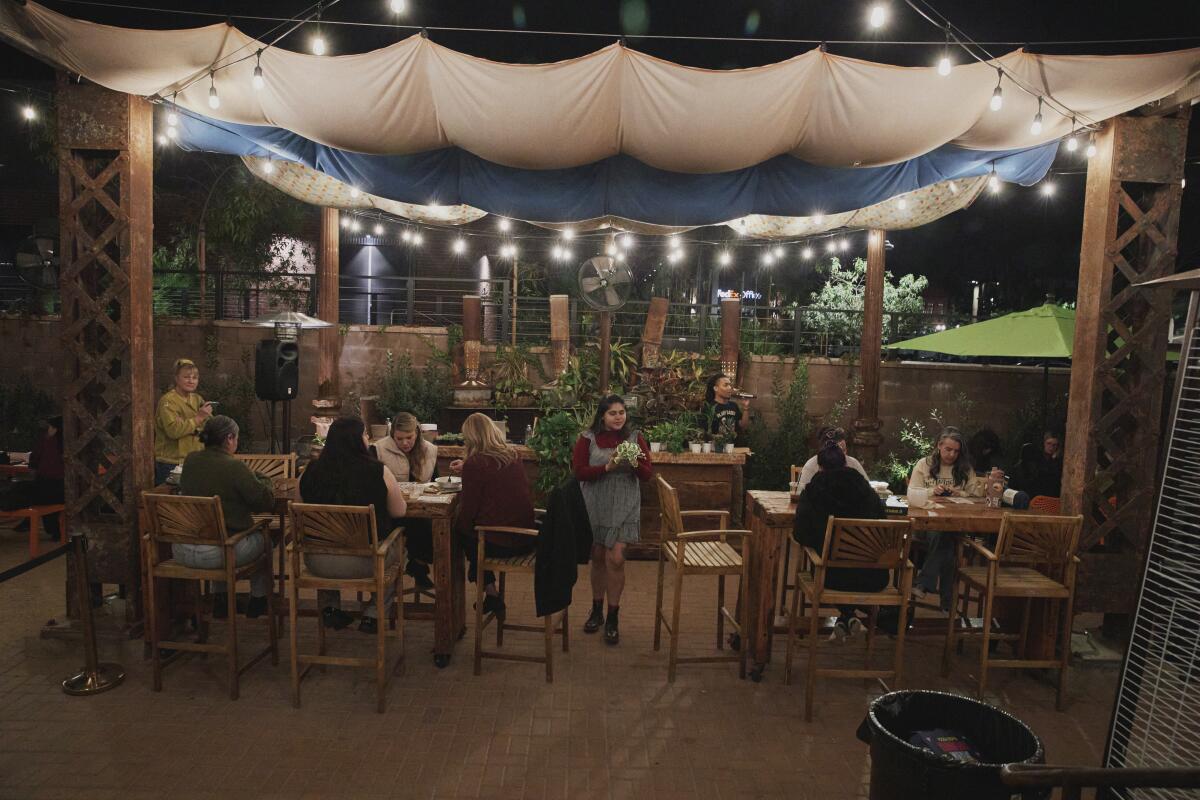
Genevieve Aleman walks around the tables on the patio of the Redlands Public Market on Dec. 14 and shows off a plant the players are competing for during Plant Bingo.
(Miguel Esparza / For The Times)
“We dropped eight dates for November, and they all sold out within a couple of days,” Aleman said. “We just wanted to create a community event where people can come and learn about plants. We get all kinds of age groups — young children, middle-aged, teenagers — and it’s just awesome the way that plants bring all kinds of people together.”
Jenny Fernandez-Navarro, owner of Long-Beach-based Que Chulas Plantas (“What Beautiful Plants”), which sells plants and plant services online, began her pop-up Plant Bingo events in Long Beach and Pico Rivera in June and has seen a similar enthusiastic response of sold-out events.
“I’ve been selling plants since 2020 but I noticed something was missing,” she said. “A lot of my customers are first timers and have never had plants before, so I’m helping to educate them. I want to help people be successful with plants, and they like that they’re learning about plants while playing Plant Bingo.”
That was certainly the vibe in mid-December, when Aleman and Moreno hosted a sold-out Plant Bingo event on the patio of the Redlands Public Market. Most of the 40 people there were young to middle-aged women, but there were also a few men and children in the group of participants. Aleman and Moreno brought a sound system with a lively playlist and covered a table with lushly green houseplants of various species and sizes, along with a small assortment of succulents and plant accessories such as pots.
Plant Bingo games are available for purchase, with cards that look similar to traditional bingo cards, except instead of letters and numbers, each square is filled with a picture of a houseplant. The magic with the pop-up events is all the information people get during the games. Aleman and Moreno take turns wandering through the crowd, displaying the prize for each game, such as a distinctive Calathea fishbone plant, a.k.a. fishbone prayer plant, and offering advice about how to keep it healthy.
“This guy is a humidity lover,” Aleman says, “so when you take a shower, put him in the bathroom to get the humidity from the shower once a week.”
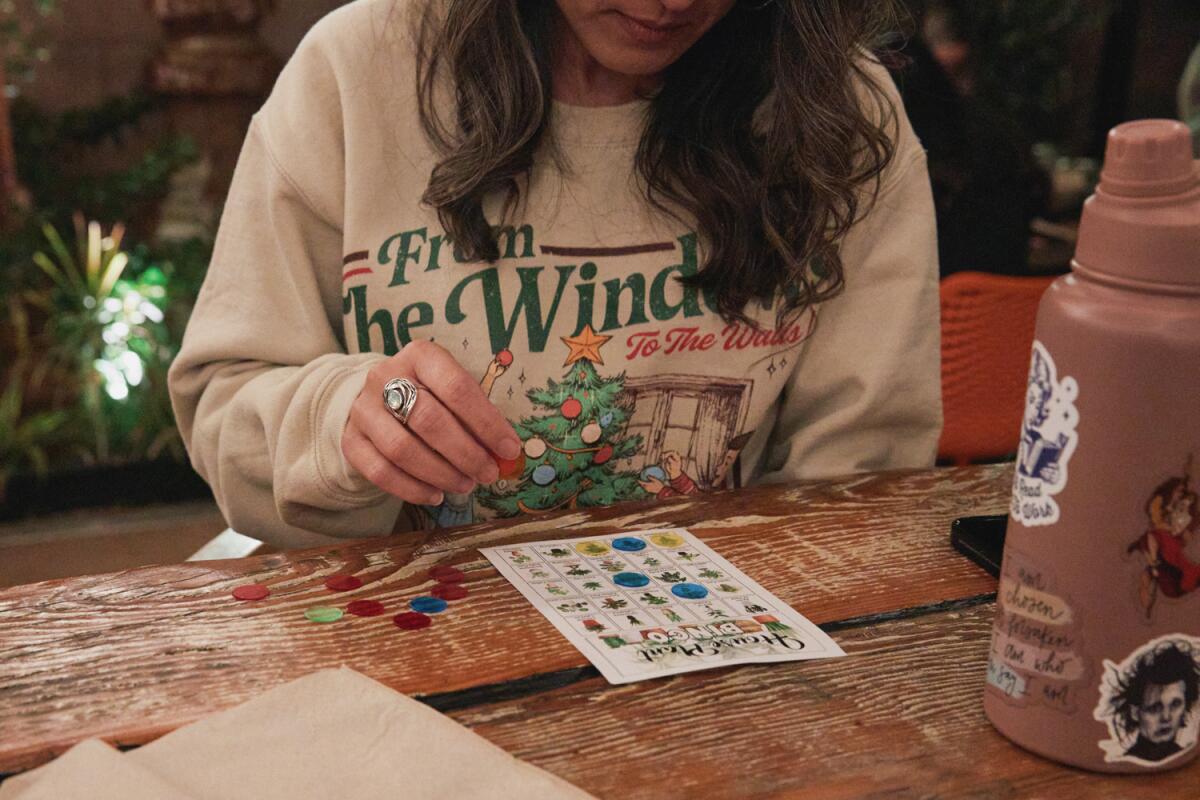
Rosalie Rivera holds a bingo chip in anticipation of the next plant to be called during Plant Bingo.
(Miguel Esparza / For The Times)
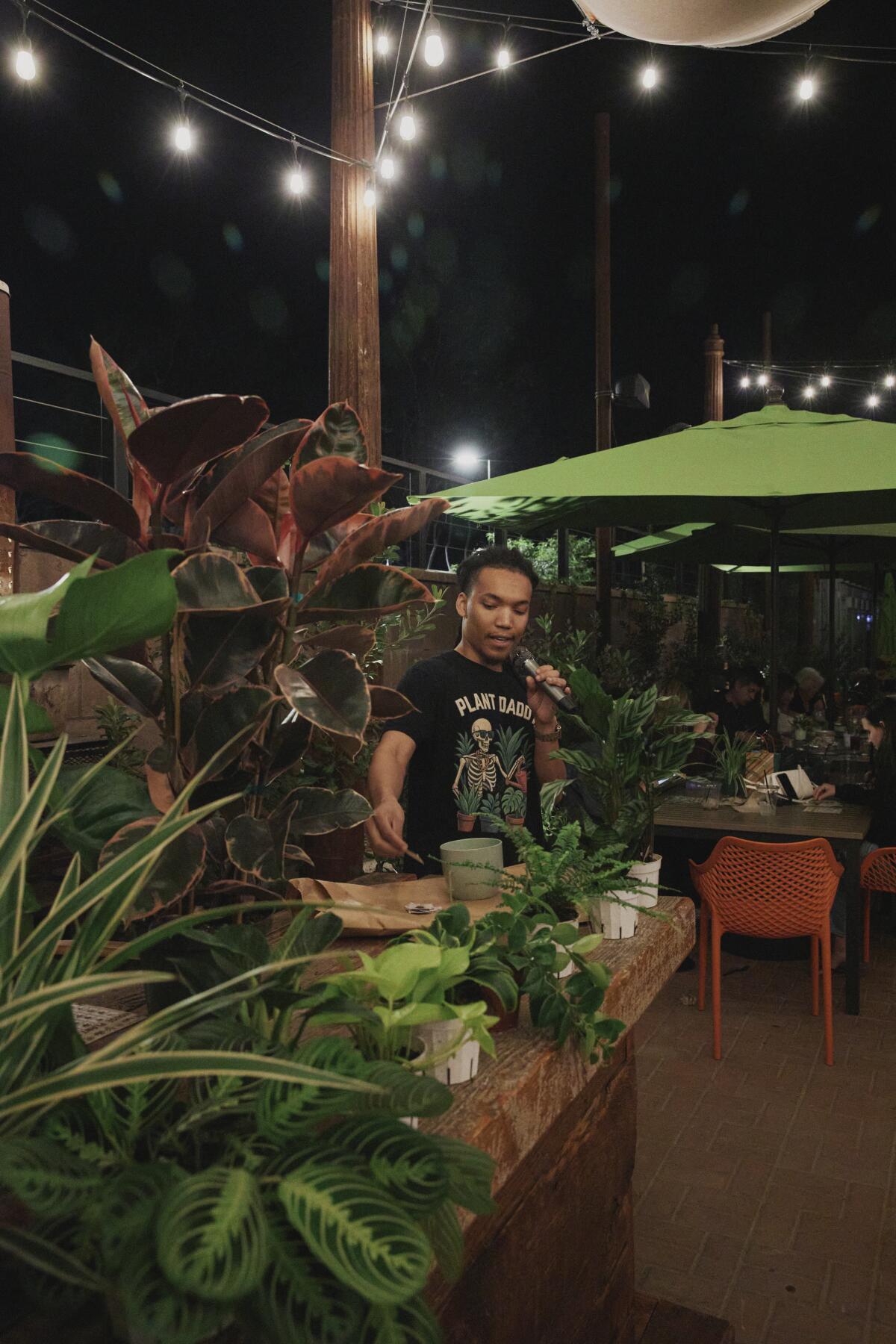
Donovan Moreno calls out the plants for another round of Plant Bingo by pulling the names out of a pot.
(Miguel Esparza / For The Times)
After a brief tutorial on how to play, Aleman or Moreno calls out the winning pattern for that particular game. Once they confirm the person has a bingo, the winner gets the plant that’s offered for that game. If they’ve already won, they have to choose from the accessories pile.
The last five championship games offer the biggest plant prizes and are open to anyone whether they’ve won before.
Psychiatrist Mohamed El-Menshawi of Redlands came alone that evening, but was soon chatting with a husband and wife at his table waiting for the game to begin. This was his first time to play Plant Bingo, but El-Menshawi said he was attracted by the chance to win a plant. “I’m a plant lover, a plant daddy,” he said, laughing. “I once had about 200 houseplants but I had to downsize a little in my new place. I only have about 100 now.”
He sees parallels in nurturing plants and his patients, primarily middle-school-aged children. “If houseplants aren’t doing well, you don’t blame the plant; because you know it’s not getting what it needs to flourish,” and the same can be said for humans too, he said.
Carey Sanchez, a CalTrans employee who lives in San Bernardino, started attending Plant Bingo nights in October because she wanted plants but had no aptitude for keeping them alive. “They would last for a while and then they would die, and I didn’t know why,” she said. But since she’s been attending, she said she’s won several plants and learned lots about their care.
“I’ve even learned to propagate them and give the new plants away as gifts, which is wonderful,” she said.
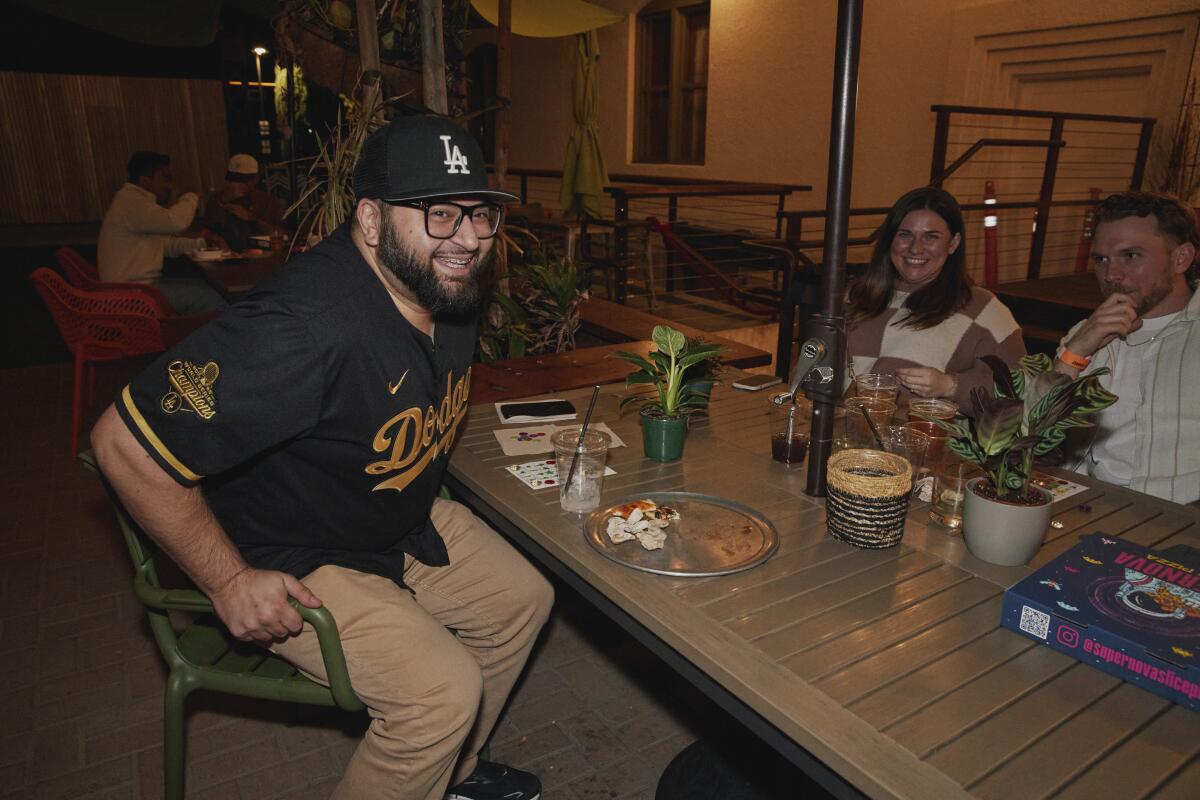
Mohamed El-Menshawi plays Rock, Paper, Scissors for a tie-breaker during Plant Bingo at Redlands Public Market on Dec. 14. It was his second tie. He lost the first one, but won a plant the second time.
(Miguel Esparza / For The Times)
Aleman and Moreno, both 23, used to sell houseplants from their apartment, inviting people to come shop at their home. After their daughter, Reign, was born in early 2025, they decided to transition to Plant Bingo events. They set up at restaurants mostly and sell tickets for about $40 that include a meal and soft drink, along with 25 rounds of bingo games. They’ve hosted a few events at breweries, Aleman said, but their goal is having events that are more family friendly.
“Our meal offerings are non-alcoholic, but people can purchase alcohol if they want,” she said. “We like to provide food because not everybody wins, so at least you can say you got out, had dinner, played bingo and learned something about plants.”
There are worse ways to start the year. Wishing you and yours a green, plant-filled 2026 full of love and happy adventures.
 Other garden bits
Calling sago palm experts: Scott Wardlaw, president of Altadena’s Christmas Tree Lane Assn., writes that his friend, John Jackson, lost his home and nearly everything else in the Eaton fire, save a large sago palm (about eight feet tall) on his patio “under which John held court at his many dinners and lunches for his multitudes of friends.” Jackson wants to rebuild his home, but the new plans call for relocating the sago, so the project is on hold until he can figure out a way to save his beloved plant. Sagos (Cycas revoluta) are actually slow-growing, ancient cycads that look like palms with stiff, feathery (and very pokey) fronds, but are actually more closely related to conifers. They are natives of Japan and can live for centuries, which is Jackson’s hope. Are there any experts out there who can advise him about how to safely move his sago, so he can start rebuilding? Email me at jeanette.marantos@latimes.com, and I’ll pass your ideas along.
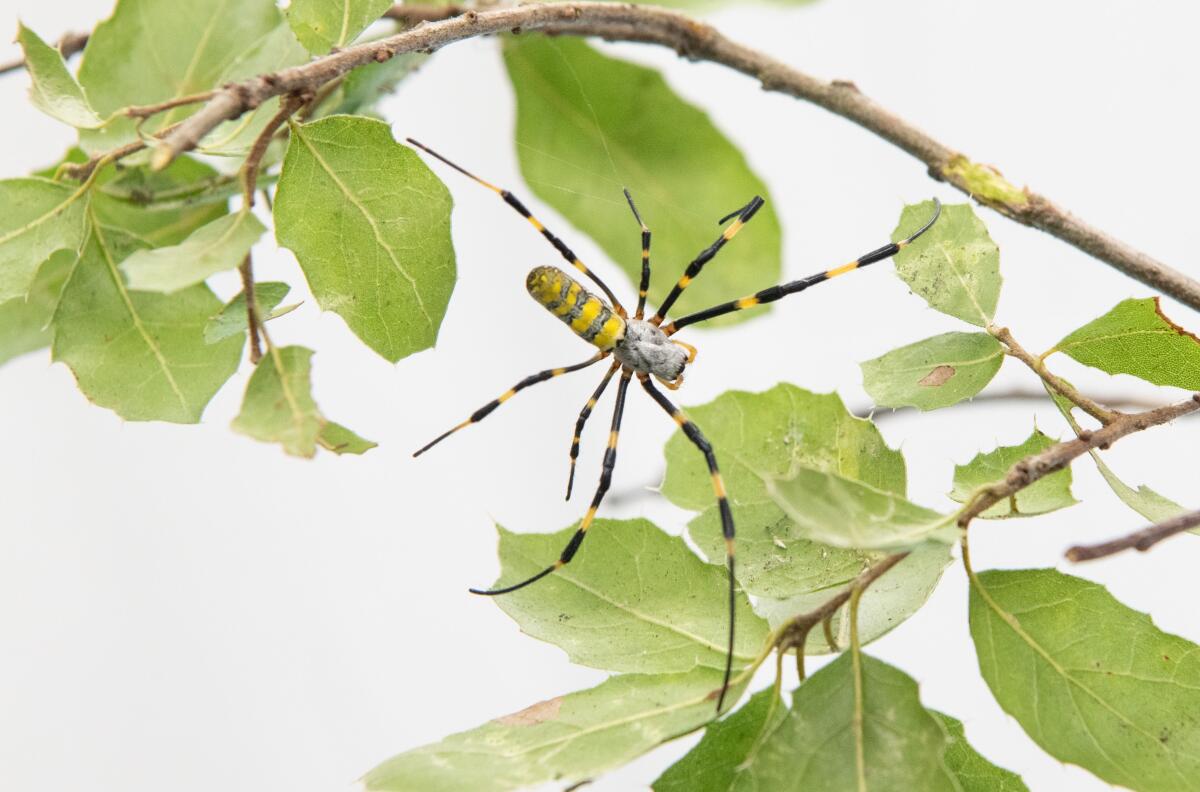
This Joro spider, a type of orbweaver native to East Asia, was found in Santa Barbara County this fall, likely a hitchhiker on a plant that was delivered nearby.
(Santa Barbara Museum of Natural History)
Harmless to humans, but … gah! The Santa Barbara Museum of Natural History reports that a 3-inch-long, brightly colored Joro spider — an orbweaver spider from East Asia — “was spotted lurking in the manicured landscaping at a high-end coastal business in Santa Barbara County this fall.” Joro spiders were first spotted in the U.S. in Georgia in 2014 and have been found as far west as Oklahoma, according to a news release from the museum, “but the discovery in Santa Barbara is the first report west of the Great Plains.” Bottom line: The spider was discovered “near an area where shipments of flowers and plants are received,” so it was likely a hitchhiker on a plant from another part of the country. No other Joro spiders or their webs have been spotted since around Santa Barbara, and the captured spider is now part of the museum’s permanent specimen collection. But if you happen to see any others around SoCal, contact the museum’s chair of entomology, Alex Harman.
You’re reading the L.A. Times Plants newsletter
Jeanette Marantos gives you a roundup of upcoming plant-related activities and events in Southern California, along with our latest plant stories.
By continuing, you agree to our Terms of Service and our Privacy Policy.
 Upcoming events
Consider subscribing to the Los Angeles Times
Your support helps us deliver the news that matters most. Become a subscriber.
Jan. 4
Hummingbirds at the Huntington, a class about hummingbirds at the Huntington’s Tiffany Sisters Hummingbird Gazebo, 11 a.m. to noon, free with $34 general admission, $28 seniors, students 12-18 and military with ID, $15 ages 4-11 and children ages 3 and younger free. huntington.org
Jan. 7, 14 and 21
3-Part California Native Garden Design with landscape designer Mari Taylor, noon to 4 p.m. at the Theodore Payne Foundation in Sun Valley. Register online, $396.11 for individuals, $471.96 for two adults working on one design. events.humanitix.com
Jan. 7
Cherry Blossom Garden Club Program: All About Medicinal and Healing Herbs, 10 a.m. at the Sepulveda Garden Center in Encino. Admission is free. facebook.com
Jan. 10, 17, 24 and 31
Otto & Sons Nursery Rose Care University 2026, two-hour sessions in rose pruning, feeding and other rose-care tips, 10 a.m. to noon each Saturday in January (except Jan. 31 from 1 to 3 p.m.) at the nursery in Fillmore. Register online; each class is $28 and includes a goodie bag and $10 gift certificate toward a purchase at the nursery. ottoandsonsnursery.com
Jan. 11
Bolivia in Bloom, a presentation by avid cactus collector Gary Duke about his three-week tour cactus hunting in Bolivia for the South Coast Cactus & Succulent Society monthly meeting at 1 a.m. at the Fred Hesse Jr. Community Park in Rancho Palos Verdes. Free to members or first-time visitors; membership is $25 a year. southcoastcss.org
Jan. 13
Botanical Workshop: Rose Pruning, two workshops with Stephen Reid, head gardener of the Huntington’s rose garden, at 9 to 10 a.m. or 11 a.m. to noon at the Huntington in San Marino; includes a pair of Felco 2 pruning shears. Register online $140. huntington.org
Orange County Organic Gardening Club welcomes speaker Elizabeth Bruckner, author of “The Homesteader Mindset: Build a Sustainable Life Wherever You Are,” for its monthly meeting at 7 p.m. at the Orange County Fairgrounds in Costa Mesa. Admission is free. californiagardenclubs.com
Jan. 15
The Huntington’s Annual Bare Root Rose Talk and Sale, 2:30 to 5 p.m. at the Huntington’s Rothenberg Hall in San Marino. The sale proceeds after the talk by rose garden curator Tom Carruth. Admission is free with reservation. huntington.org
Jan. 19
MLK Jr. Day of Service with Palos Verdes Peninsula Land Conservancy, 9 a.m. to noon at the White Point Nature Preserve in San Pedro. Free, but registration is required. pvplc.volunteerhub.com
Jan. 24
Botanical Printing on Paper: A Natural Dye Workshop with painter Linda Illumanardi, 11:30 a.m. to 2:30 p.m. at the Theodore Payne Foundation in Sun Valley; about creating Victorian puzzle books dyed with California native leaves and wildflowers. All materials included, but participants should bring their own scissors and a ruler. Register online $100. events.humanitix.com
Jan. 31
13th Annual Santa Barbara Botanic Garden Conservation Symposium, 10 a.m. to 1 p.m. at Santa Barbara City College includes a keynote talk by author and entomologist Doug Tallamy, who will receive the 2026 Honorable John C. Pritzlaff Conservation Award, and presentations about native plant research and safeguarding. Register online, $40 ($15 students, online attendance is free but registration is required.) sbbotanicgarden.org
Finding Our Way Home with Fungi, 10 a.m. to noon in the Crescenta Valley, a Theodore Payne Foundation workshop led by mycologist Aaron Tupac, chair of the American Mycological Assn.’s Conservation and Stewardship Committee. This is a walk-and-talk class to learn about local fungi and does not include foraging. The exact meeting location will be revealed after registration. Register online, $42.85. events.humantix.com
 What we’re reading
This is tangentially plant-related, but you know, inquiring minds are asking: What’s the deal with … banana water? My Times colleague Deborah Vankin found some answers.
L.A. Times outdoors writer Jaclyn Cosgrove has created a terrific (and very handy) hiking and camping guide to the 700,000-acre wonderland that borders north L.A.: the Angeles National Forest.
Someone is hacking the leaves off giant agaves, a.k.a century plants, outside posh homes in east Torrance. The question isn’t just “who?” but “why?”
Speaking of 2026, my creative colleagues have come up with 25 ways to say goodbye (and good riddance) to 2025.
Finally, it was my pleasure to meet the Robles family and tell the inspiring story about a family who has been selling Christmas trees in Los Angeles for four generations.