

A host of South Orange County cities have grappled with issues surrounding elections over the past several years as towns struggle with transitioning to district elections, voting rights lawsuits, campaign contribution limits and more.
While Laguna Hills finalizes a transition to district elections after legal threats to do so, leaders in Rancho Santa Margarita and Laguna Niguel allegedly continue to refuse to pay fees to the lawyer who sent letters claiming each city violated the California Voting Rights Act.
District voting creates election districts in cities and restricts voters to only elect the city council member who is running in their specific district. For example, if there were three open city council seats, voters would only be able to cast their ballot for one candidate who lives in the district based on their home address.
That’s different from at-large voting, which gives voters the opportunity to elect every open city council seat. If there are three open city council seats during an election, every registered voter gets to cast their vote for all three open seats.
At the same time, elections in Mission Viejo are still on an abnormal schedule after a years-long battle over switching the city’s election system to district voting and after a judge found council members improperly extended their terms in 2022.
And in Aliso Viejo, council members voted to increase their campaign contribution limit nearly five times after choosing a new council member without opening applications to the public.
Laguna Hills Approves Final Move to Election Districts
Officials in Laguna Hills held their last public hearing to transition to district-based elections in early December, voting 3-1 to finalize implementing election districts.
Councilmember Dave Wheeler voted no and Councilmember Erica Pezold recused herself from the discussion because she’s friends with Michelle Jackson, the lawyer who represented the voting rights challenge that claimed at-large voting disenfranchises minority voters.
“I’m recusing myself from the issue for ethical purposes,” Pezold said during the council’s Dec. 9 meeting. “Although I’m not the only person who knows Miss Jackson, I feel it’s important that as an elected official we’re free from bias as leaders.”
[Read: Laguna Hills City Council Adopts Election District Map]
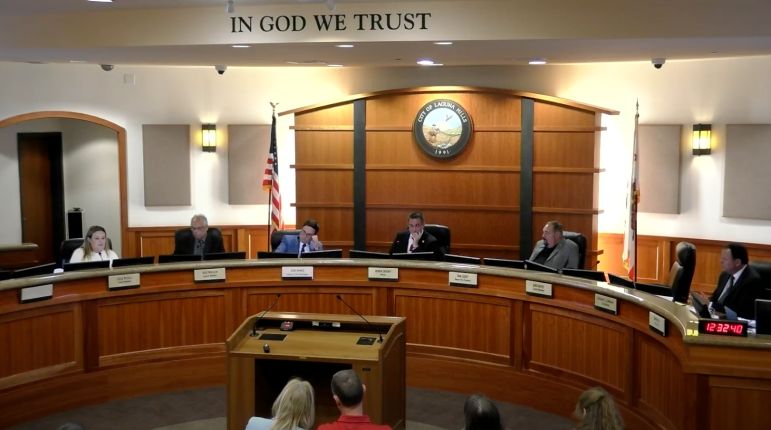 The Laguna Hills City Council meeting on Sept. 23, 2025. Credit: City of Laguna Hills livestream
Wheeler said it doesn’t make sense to break Laguna Hills into districts since the city is so small.
“If you have the vote of all the people for all their elected officials, then the people really get to choose who it is that represents them,” he said, “and they get to vote for everybody in the whole city and they get to have representation everywhere and not be limited to a silly little district.”
“All you’re getting is you get to vote for one fifth of your city,” he said. “We’re a small, tiny, little city. Dividing us up into micro-pieces, where do you stop? This whole thing is, in my opinion, totally ridiculous. If it’s passed and goes forward, it’s one of the worst things that could ever happen to our city.”
Mayor Don Caskey, who was selected as mayor earlier during the same meeting, said the council made the best decision they could.
“At the end of the day, we have to look at all of these and just pick the [election district map] we feel will work the best over time,” he said. “And that’s what we did. For the next census, because the city is growing, then these maps might change. We got a census coming in five years — there’s only two elections between now and then, and if we made a mistake and/or things grow in different ways and we need to rebalance some of that, then so be it.”
[Read: Laguna Hills Becomes Latest OC City to Adopt District Elections Amid Legal Threats]
Art Sanchez, a Laguna Hills resident who’s been working alongside Jackson, identified himself as the potential plaintiff against the city if they don’t transition to election districts.
“I am pleased to see you have adopted this ordinance to transition to by-district elections, ensuring that all areas and all demographics within Laguna Hills finally have a meaningful voice in choosing their representatives,” he said at the meeting.
“Residents in Laguna Hills are tired of being ignored and tired of fiscal mismanagement,” he continued. “We want representation that genuinely serves the public interest and embraces real cost-benefit analysis… We all know that the fiscally responsible next step is to pay the approximately $30,000 in fees to the counsel.”
Two South OC Cities Push Back Against Attorney Fees
While Sanchez and Jackson wait to see if Laguna Hills pays their attorney’s fees, officials in Rancho Santa Margarita and Laguna Niguel are allegedly pushing back against paying attorney’s fees.
[Read: Two South OC Cities Allegedly Refused to Pay Up Over Voting Rights Lawsuit]
Jackson said both cities haven’t paid her fees after alleging a host of South Orange County cities were violating the California Voting Rights Act (CVRA) by not transitioning to district-based elections.
She sued the cities for allegedly failing to reimburse her fees after sending separate letters claiming each city violated the CVRA and forcing a switch to district elections.
In November, a judge ruled in favor of the city of Rancho Santa Margarita, determining that the city owes Jackson $0.
“We are very appreciative of the Court’s thorough review in this matter,” Mayor Tony Beall said in a statement from the city. “The evidence was abundantly clear: this was a meritless lawsuit based on a frivolous demand for payment.”
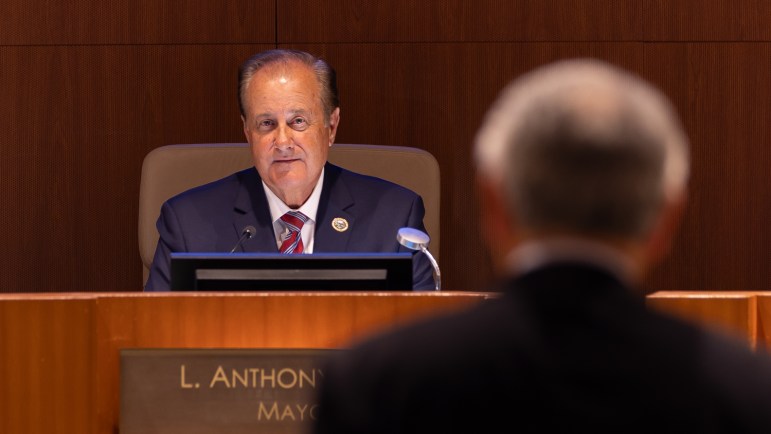 Mayor Anthony Beall at the Rancho Santa Margarita City Council meeting on April 23, 2025. Credit: ERIKA TAYLOR, Voice of OC
The city argued that Jackson’s claim for reimbursement wasn’t supported by enough evidence, especially since the prospective plaintiff in the case was not identified.
Jackson said she offered to disclose the plaintiff’s identity confidentially to the city, and she’s working on filing an appeal in this case.
“The thing I wanted most was to make sure, especially since they used the safe harbor, that the potential plaintiffs were protected,” she said in a phone interview. “So these rulings are really disturbing to me because we offered to provide them with the name on a confidential basis. And the fact that they want to blast it and make sure it’s public … that’s a bit concerning.”
In order to comply with the California Voting Rights Act, Rancho Santa Margarita and Laguna Niguel followed the “safe harbor” procedure which allows municipalities 90 days to hold the public meetings necessary to transition to district-based elections. It also caps legal fees at around $30,000.
For the case involving Laguna Niguel, no decision has been made at this point.
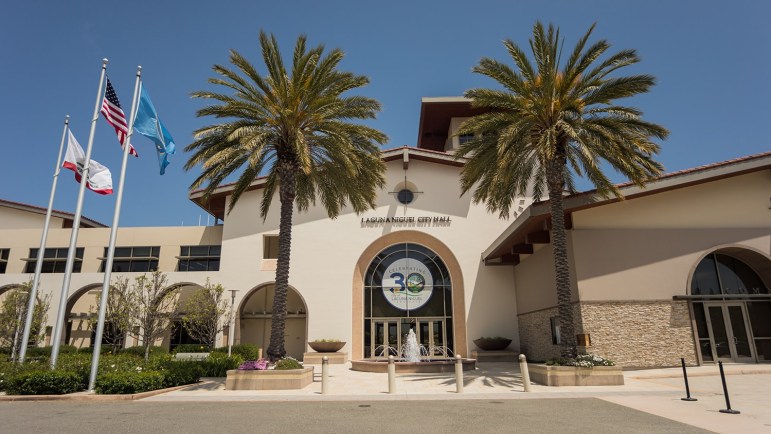 Laguna Niguel City Hall. Credit: JESSICA RUIZ, Voice of OC
It’s also been about a year since former Rancho Santa Margarita Mayor and longtime Councilmember Carol Gamble pleaded guilty to falsifying her nomination paperwork to run for re-election — falsely stating she personally collected the signatures needed to qualify her to run for office, according to the district attorney’s office.
It’s the same city that continues to refuse to livestream city council meetings with video, even as residents take up the responsibility to record meetings themselves.
[Read: Santana: Putting Politicians on Notice in Rancho Santa Margarita]
Mission Viejo Hasn’t Had a Normal Election in Years
Mission Viejo is staggering city council term limits after the entire council stood for election in 2022 — that was the result after a judge found council members improperly extended their terms.
In October, Mission Viejo City Council members voted to stagger councilmember term lengths following the 2026 election, giving four-year terms for Districts 1, 3 and 5, while Districts 2 and 4 get two-year terms.
After the 2028 election, all council seats will return to the full four-year terms in staggered elections — meaning three seats will be on the ballot one election cycle, followed by two seats in the next election cycle.
All council positions will be up for reelection in 2026 again.
[Read: Mission Viejo to Stagger City Council Term Lengths After 2026 Election]
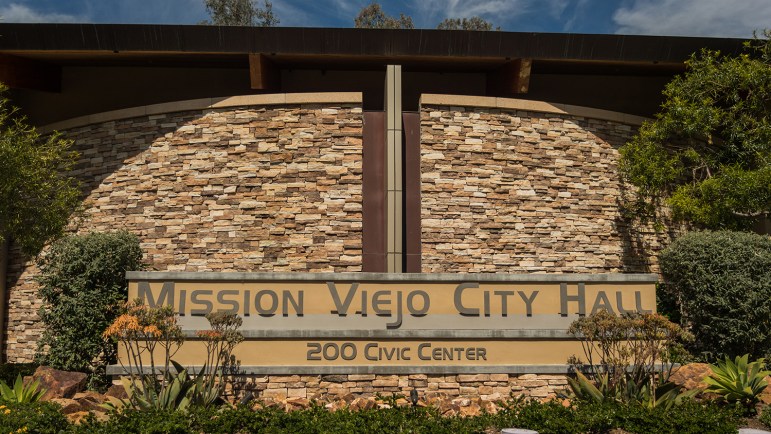 Mission Viejo City Hall. Credit: JESSICA RUIZ, Voice of OC
It’s the fallout after Mission Viejo’s election system controversy began in 2018; back then, elected officials began debating a new voting system for the city after legal threats alleged the old voting system disenfranchised minority voters.
The city council had begun exploring the idea of transitioning to a cumulative voting system to replace their at-large system.
Cumulative voting allows residents to distribute multiple votes among their top-choice candidates.
For example, if three seats are available in a cumulative voting system, residents can distribute three votes in any way they choose, including giving all of their votes to a single candidate or splitting them up between multiple candidates.
The idea was ultimately denied by Secretary of State Alex Padilla, starting the city’s process toward district elections instead.
[Read: Local Judge Throws Majority of Mission Viejo’s City Councilmembers Off Dais]
Aliso Viejo Ups Campaign Contribution Limit After Choosing New Councilmember
City council members in Aliso Viejo recently voted to increase the city’s campaign contribution limit by nearly five times to align with the state’s default.
Aliso Viejo previously had an $1,000 limit, meaning council candidates could only accept donations toward their campaign up to $1,000 per donor, per election. Councilmembers previously voted to create that limit in 2022.
Under California law, the default limit is $5,900 per donor, per election.
[Read: Aliso Viejo Officials Raise Campaign Contribution Limit]
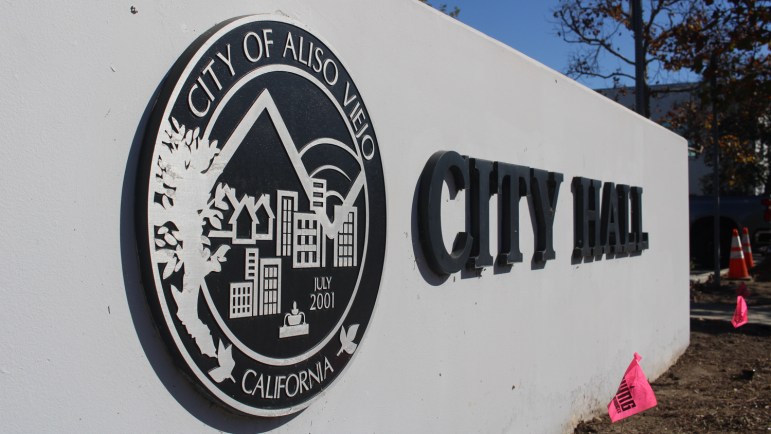 A sign at Aliso Viejo City Hall on Nov. 28, 2023. Credit: ERIKA TAYLOR, Voice of OC.
Mayor Tiffany Ackley voiced concern about the increase.
“Local politics is meant to stay local,” Ackley said at the council’s Nov. 19 meeting. “It’s meant so that you don’t have a buddy who can give you $5,900 and his wife can give you $5,900 and their two kids can give you $5,900.”
It also comes after councilmembers filled a council vacancy through a nomination and appointment process — forgoing opening up public applications. Ackley was also the only council member who argued there should be a public application period.
Angelina Hicks is the Voice of OC Collegiate News Service Editor. Contact her at ahicks@voiceofoc.org or on Twitter @angelinahicks13.
Related