
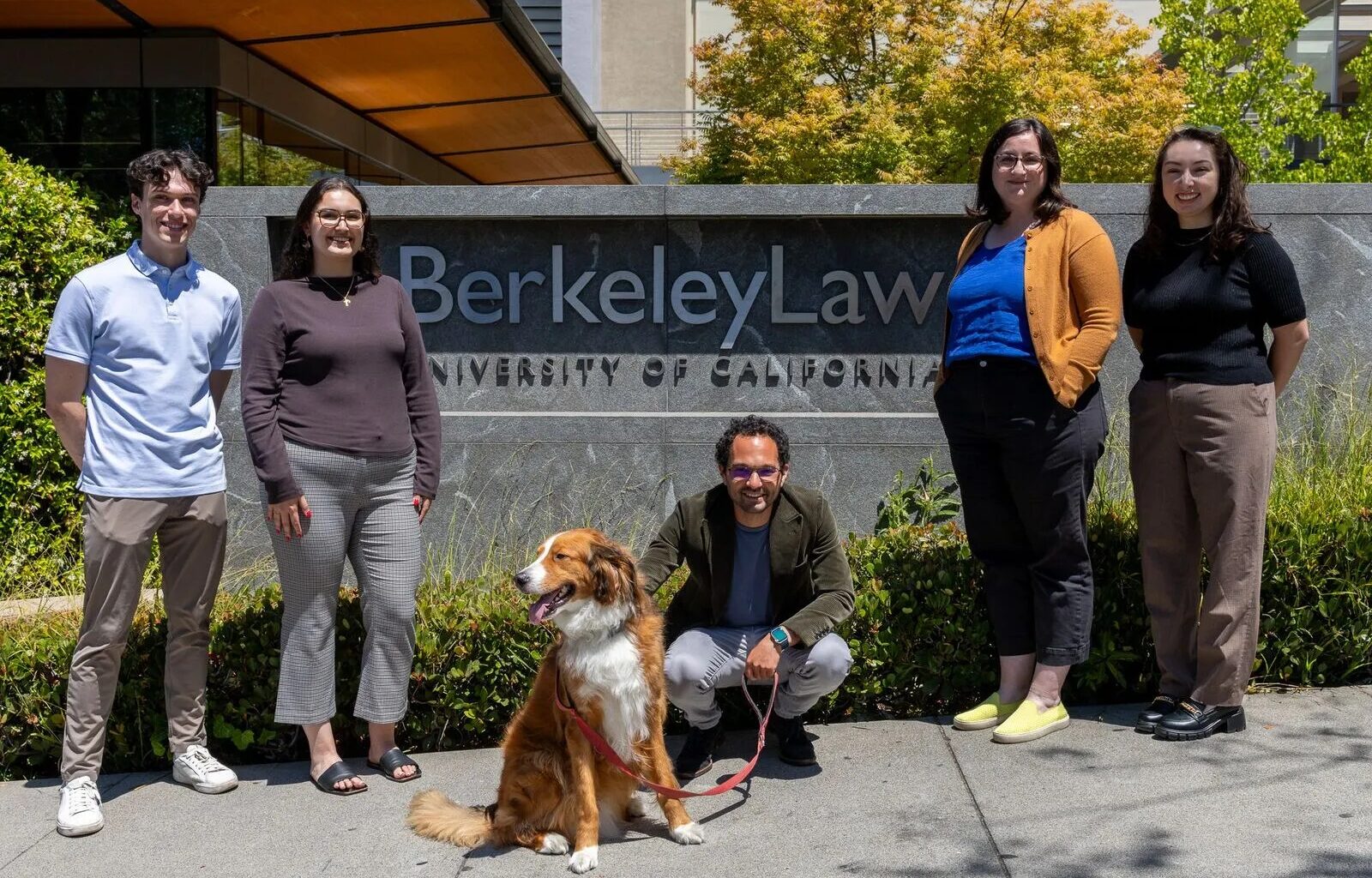
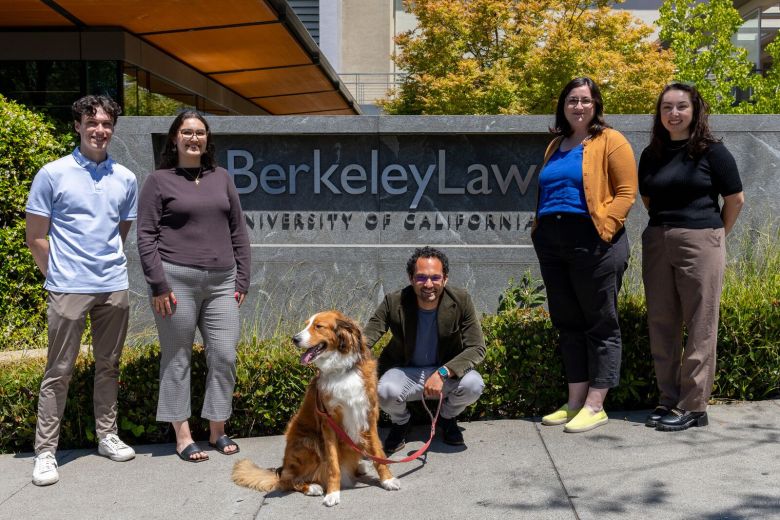
 Members of the Deportation Data Project team — Alexander Stratton, Elena Gonzalez, Berkeley Law professor David Hausman (and his dog, Ernie), Claudia Liss-Schultz and Lorena Ortega Guerrero — stand outside UC Berkeley School of Law. Credit: Sara Martin/Berkeleyside
Editors’ note: This week we’re republishing some of our favorite stories of 2025. This story was first published on Aug. 19.
After President Donald Trump’s campaign pledge to carry out the largest mass deportation in U.S. history, his second term has been marked by scenes of masked agents grabbing people from work sites and city streets and sending them to unsanitary makeshift detention sites or prisons in foreign countries where they have no ties.
Top administration officials say those being detained and deported are the “worst of the worst.” But statistics tell a different story. The trouble is that it can be tricky to know what is happening inside the byzantine network of agencies that make up the country’s immigration system. Under Trump, the Department of Homeland Security stopped publishing monthly statistics on removals and deportations and now only publishes detentions, as mandated by Congress. Even then, the releases tend to be inconsistent, not linked and seldom explain the numbers they contain.
Now journalists, lawyers and others seeking accurate immigration data have a powerful new resource, thanks to a group of data scientists and lawyers at UC Berkeley’s School of Law.
Launched in March, it’s called Deportation Data Project and it’s a free repository of immigration enforcement data. Since the Trump administration has tamped down on immigration statistics, the project’s releases have been the only source of detailed Immigration and Customs Enforcement (ICE) data since the inauguration.
The team, which is funded by an anonymous donor, compiles available statistics and submits monthly Freedom of Information Act requests to the government. And when it doesn’t get the information it seeks or is simply ignored, the group has filed lawsuits.
In the last two releases, “we sued because ICE had not responded to our request at all; a lawsuit was the only way to get the data in any reasonably timely way,” said David Hausman, an assistant professor at Berkeley Law who heads the Deportation Data Project.
The project’s data has been cited in hundreds of news stories across the country — appearing in outlets from the New York Times to CNN to the LA Times.
The data has been used to show that arrests nationwide have more than doubled since January, to break down ICE arrests by people’s country of origin and to reveal that ICE is using more detention facilities than ever before. The project also obtained and made available online a dataset with anonymized identifiers that correspond to individuals, allowing users to follow immigrants through the enforcement process.
But the most striking finding to come from the project’s data is that despite the Trump administration’s rhetoric, most migrants deported this year have no criminal conviction. In Los Angeles, most people arrested had no criminal record whatsoever. And as arrests numbers rise, non-criminals are increasingly getting caught in the crosshairs.
Hausman says the Deportation Data Project is driven only by a desire for transparency.
“We don’t see ourselves as antagonistic and try to strike a collaborative tone because we think the agencies can actually benefit from releasing the information,” said Hausman. “Our goal in the most basic way is to get data out to the people, to update it and publicize it.”
Local news site used project’s data to reveal extent of ICE activity in San Francisco area
For months, San Francisco-based reporter Kelly Waldron and her colleagues at Mission Local, a news site about San Francisco, have struggled with how to best measure and write about deportations locally. They attended deportation hearings and sought out family members of people who had been scooped up in raids on workplaces and the street. But they suspected they were seeing just a fraction of what was happening and were often hamstrung by lack of data.
But after Waldron, a recent graduate of Columbia Graduate School of Journalism, dug into the Deportation Data Project’s spreadsheets, she saw how the data could boost the reporting she was already doing. Waldron and a colleague, Frankie Solinsky Duryea, used three datasets — on ICE arrests, detentions and deportations — to follow journeys of people arrested, where they were held once detained, how long and what countries they were ultimately deported to.
Although the data was anonymized, they were then able to combine it with personal stories of people detained by ICE to show the impact on them and their families.
“We didn’t know where people were going once arrested and didn’t know what their pattern [of deportation] was,” Waldron told Berkeleyside. “This data helped us stitch together the journeys of people arrested in our local jurisdictions. It was an incredible help and I don’t know how we would have gotten this information otherwise.”
Idea for Deportation Data Project preceded Trump’s reelection
Though the project was launched in the midst of the Trump administration’s immigration crackdown, Hausman said the idea had been percolating in his mind for a while.
He grew up in Appleton, Wisconsin, and moved to California in 2010 to attend law school at Stanford, clerked for the D.C. Circuit Court of Appeals and then returned to Stanford to complete a Ph.D. in political science. He has been teaching at Berkeley Law since 2022 and says the project combines his dual professional identities: as an immigrant rights lawyer and an academic.
 Hausman sits on a desk in a classroom during a discussion with the Deportation Data Project team. Credit: Sara Martin/Berkeleyside
Hausman collaborates with colleagues Graeme Blair, a political scientist at UCLA and Amber Qureshi, a former National Lawyers Guild attorney now a federal litigator focusing on immigration and transparency, along with several research assistants.
The project also shares its data, and helps journalists, researchers and lawyers make sense of what they’re seeing. Data sets released by the government are often convoluted and incomplete, so the team works to clean the data and present it in a more accessible way.
“It’s about making data more relevant and having more frequent updates,” Hausman said. “It allows us to know what’s happening at any given moment and is useful to the ongoing public conversation.”
Lorena Ortega Guerrero is a recent Berkeley Law grad and one of several students working with Hausman to help compile data. She researched laws around the Freedom of Information Act, what is permissible under the law and learned how to best frame legal arguments to obtain data.
“Information is power and having information is incredibly important when people don’t know what’s going on,” Ortega Guerrero said. “Having access to this data that we have a right to, allows us to keep the government accountable.”
“*” indicates required fields