
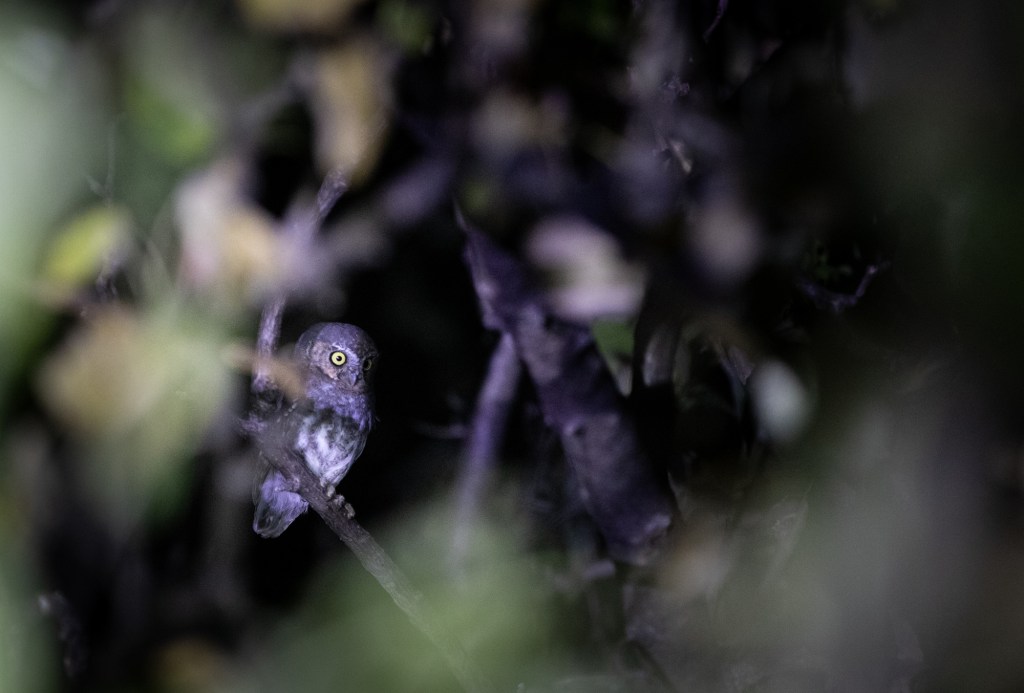
Crickets chirp in the night as Gerardo Marrón calls to an elf owl on a Baja California Sur mountainside in late October.
Marrón and a group of scientists from Mexico and the San Diego Natural History Museum are on an expedition in the Sierra de las Cacachilas, southeast of La Paz, to study the area’s biodiversity. Tonight they’re hoping to glimpse the world’s smallest owl species, about 5 inches tall.
By 8 p.m., the heat of the day has finally eased. A gentle breeze crosses the trail. And Marrón’s bird calls — first pre-recorded ones, then ones he does himself — are like a haunting message repeating in the otherwise quiet night.
Marrón is an ornithologist from La Paz and a research coordinator for Pronatura Noroeste, a Mexican environmental organization that works closely with the Natural History Museum. At 39, he’s worked in the field for nearly two decades, his research largely focused on Baja Sur and its more than 400 bird species.
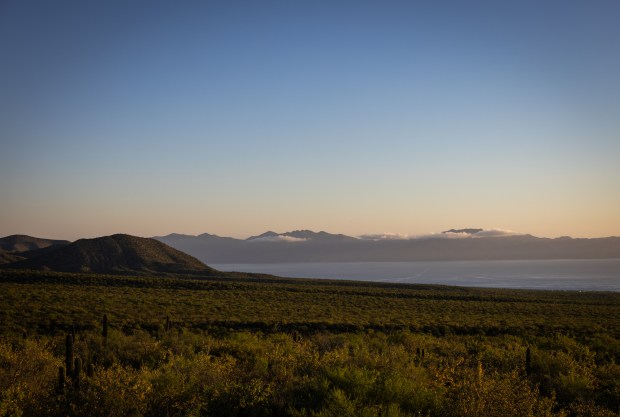 A sunrise over the Sea of Cortez on Wednesday, Oct. 29, 2025. (Ana Ramirez / The San Diego Union-Tribune)
Marron’s interests go beyond birds. He’s bringing science to the community, recently helping organize a Christmas bird count in Las Cacachilas. And he’s dedicated to creating a bridge between young kids and science through educational programming for Pronatura Noroeste.
He’s trying to “fill the holes” of research on a peninsula better known for its beaches and marine life, where he says most research and conservation efforts go toward the sea.
Elf owls are relatively common in Baja California Sur but endangered in the U.S. state of California — so spotting one is a particularly special experience for Marrón’s San Diego colleagues.
Once they spot one perched in a nearby tree, a hushed giddiness falls over the group.
After the expedition, we caught up with Marrón to learn more about his life and work.
When did your love of nature begin?
My parents are very connected with nature. My dad was born on a ranch, and my mom was born in a coastal community of fishermen. But that kind of interest, at least that I remember, came from me naturally. Like, I went into the backyard and there were ants, and I wanted to know where they live, what they eat.
I did some stuff I probably shouldn’t have… My mother was very protective, and she didn’t want me to go outside the house, so I didn’t have access to other ants. I’m not proud of this, but I arranged ant fights at school. I told the other kids to bring their own ants from their house. For them, it was to see them fight. For me, it was to see if they recognized each other, even if they are the same species.
I didn’t have books; I didn’t have access to the internet. Now I know that it was not the best way to discover that, but I was curious.
How did birds come into the picture?
I started with the bird lab at the Autonomous University of Baja California Sur when I was a marine biology student. They invited me to go with them on a field trip to Guerrero Negro, and I fell in love with the locality, with the landscape, with the birds and with the work that they were doing there.
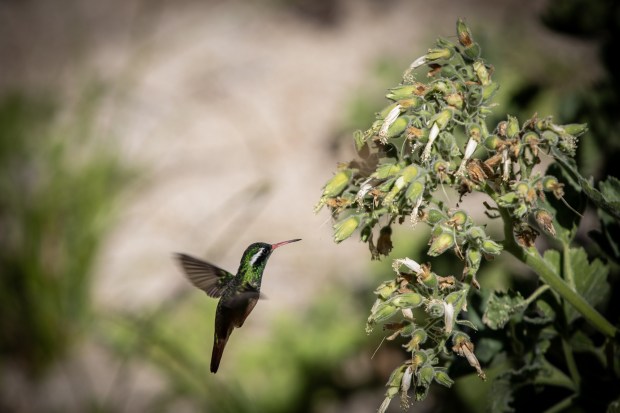 A Xantus’s hummingbird drinks nectar from a plant in the Sierra de las Cacachilas on Monday, Oct. 27, 2025. The hummingbird is endemic to the region. (Ana Ramirez / The San Diego Union-Tribune)
The first time that I went to Guerrero Negro, there were thousands of shorebirds and hundreds of ducks. Birds everywhere. When I was a kid, a dream that I had was to go into the field and say, like, “This bird is that, this one is that” — this was the first time I saw someone doing something like that.
What’s your favorite part of the job?
It’s basically everything about exploring. There are a lot of places in Baja California Sur that have not been touched … and different places in the state where I really need answers. All my life has been about exploring.
We spotted an elf owl in the Sierra de las Cacachilas. What other unique birds have you spotted in Baja California?
If I answer that, I will be here for hours. I’m not just an ornithologist, but I’m also a birder, and I really like to go and look at very unique birds. All the time in the field has given me the opportunity to see birds such as the marsh sandpiper, or the sharp-tailed sandpiper that was the second one recorded in Mexico. I’m lucky to see a lot of cool stuff.
Every time I see an owl, it’s just fantastic. I think I appreciate it more when I get to work with them. When we worked with the gray vireo in the northern mountains in the peninsula, or when I wrote an article about the Magnificent frigatebirds population declining, or when we were working with Belding’s yellowthroated warblers through the San Ignacio Oasis — it’s when I really have a connection.
You’d think that all ornithologists are birders at heart.
All ornithologists have to go birding, and all the birders have a little bit of ornithology in them. But the real thing is that technically, ornithology is the science — you study with the scientific method, and you have hypotheses.
There are a lot of ways to do ornithology, but there are infinite ways to do birding — because birding is about enjoying and connecting with nature. So when you enjoy it, if you go and look for rare birds, if you go and see the common birds, if you want to take pictures, if you want to see those that nest in your area, or whatever you want to do, it’s just for you.
You said during the expedition in Las Cacachilas that calling to the birds and trying to capture their attention is like a dance. What’s the process to find and call them?
When I am by myself, most likely I don’t call them. I prefer not to interfere with nature. But I will when I really want to confirm a rare species, when I want a picture of an endemic bird that we don’t have enough records for, or when I show someone who is learning.
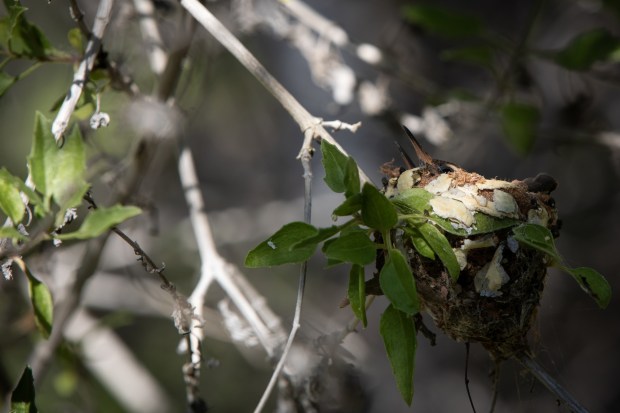 Nestling Xantus’s hummingbirds in the Sierra de las Cacachilas on Tuesday, Oct. 28, 2025. (Ana Ramirez / The San Diego Union-Tribune)
Usually you can do one or two things. You go with general calls — like “pishing” is calling for small birds — to try to attract birds when they are in their territory, even with the migrants. Or you can try, for the specific sound, something that attracts them, like we did with the owls.
Bringing science to kids and younger generations is important to you and your work at Pronatura Noroeste. How are you and Pronatura Noroeste working to bring more kids to the outdoors?
What we want to do is try to bring the researchers to the young people, especially in communities outside of La Paz. When I was a kid, I never had the chance to know that was a possibility. And what we want to do is let girls, boys, whoever has an interest know that they are able to do that.
That case of the Cacachilas spider: It was discovered in the Cacachilas on the last expedition, but then we realized that it is actually all around the Cape region. So when we were with some young people in middle school, we told them, “It is in your backyard. Nobody had discovered it before, so it could be you. Even if that species is already discovered, it could be another one.”