
Content warning: This story contains information related to suicide. If you or someone you know may be experiencing a mental health crisis or contemplating suicide or self-harm, call, text or chat 988 (opens in new tab) for free and confidential support.
The first responders crowded in the harsh light of the doorway of Suchir Balaji’s San Francisco apartment. It was Nov. 26, 2024, and nobody had heard from Balaji for days. His mother paced outside the building, worried but not expecting the worst — could the firefighters check if his toiletries were in the bathroom? He might be traveling.
The team breached the door of the Hayes Valley apartment. The smell of death flooded the hallway.
“Is there any chance of … yeah, no,” a police officer said, in bodycam footage newly obtained by The Standard. Balaji’s body was in the bathroom, with a bullet wound to the forehead.
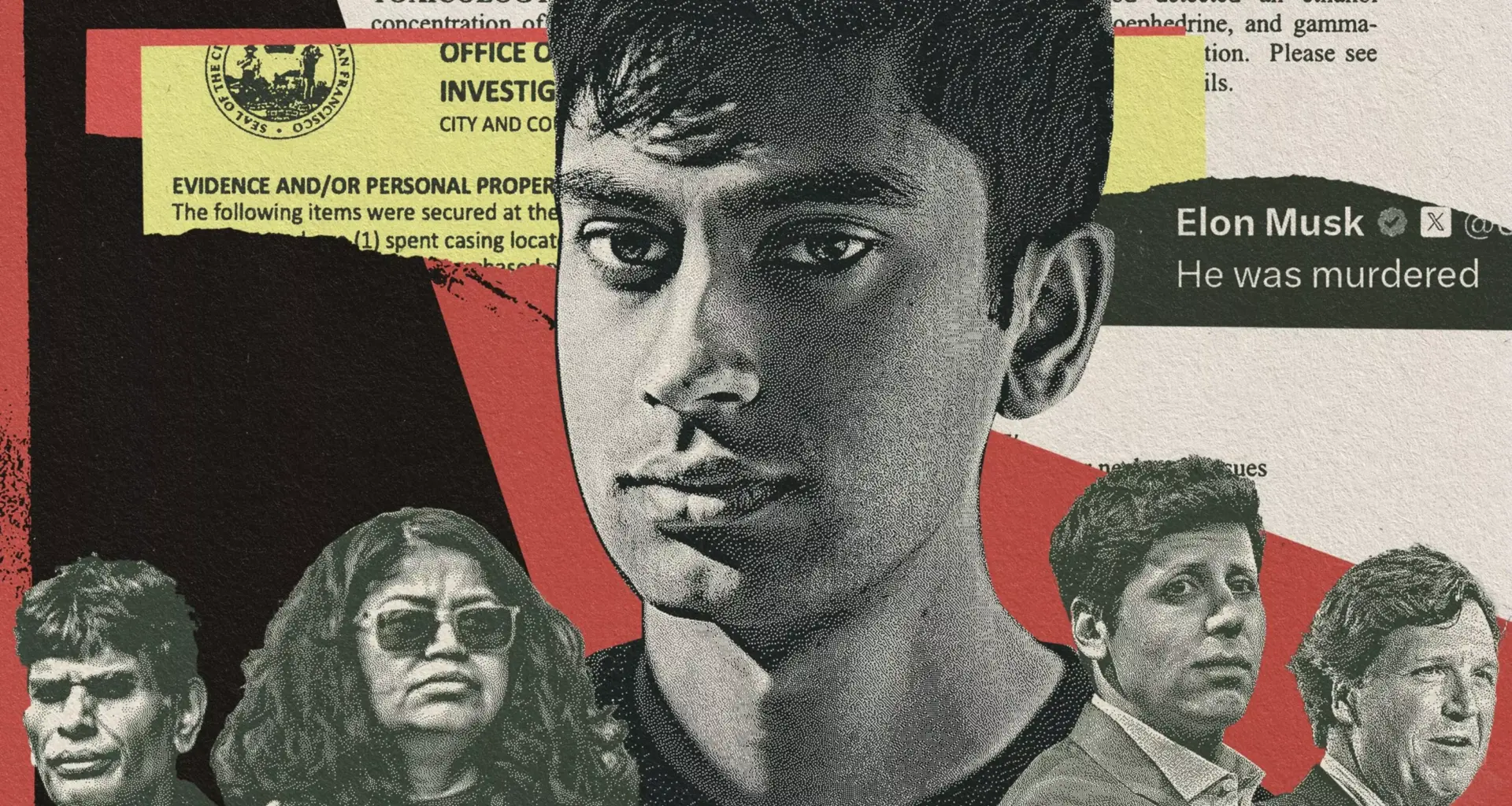
The five men in the apartment — three firefighters, a cop, and a property manager — could not have known the magnitude of what they had just discovered. The gruesome facts of Balaji’s death, which the San Francisco medical examiner ruled a suicide the same day, would soon litter the internet and attract the attention of tech titans and members of Congress, fueling an obsessive cycle of online scrutiny and conspiracy.
Police body-camera footage taken Nov. 26, 2024, at Suchir Balaji’s apartment. | Source: Courtesy San Francisco Police Department
Every skeptic has a theory about how Balaji died. These alternate narratives all hinge on two beliefs: that the gifted 26-year-old engineer would not, in fact could not, have killed himself; and that a month before his death, when Balaji blew the whistle on alleged copyright violations by OpenAI, his employer of nearly four years, he aligned himself against powerful, malignant interests who secretly set out to eliminate him.
These theories have had no greater champion than Balaji’s mother, Poornima Ramarao, who has suggested that her only child was assassinated. Others have accused Sam Altman, OpenAI’s chief executive, of ordering a hit on Balaji. Altman has categorically denied any wrongdoing and expressed sympathy for the family.
Ramarao has gone to exceptional lengths to independently investigate her son’s death. She has propagated a multitude of grim theories in social media posts and in interviews, citing what she has characterized as hard evidence. He was forced to ingest alcohol and the drug GHB. He was shot in the forehead at an angle from which he likely couldn’t have shot himself (opens in new tab). He was struck in the head, but when that didn’t kill him, his assailants electrocuted him (opens in new tab).
But interviews with Balaji’s mother and nearly two dozen friends, coworkers, and people who have investigated the case, along with reams of new documents and footage obtained exclusively by The Standard, show that what Ramarao and other skeptics have characterized as proof of foul play is not what it seems. Claims that there were obvious signs of a struggle and blood throughout the apartment are not supported by police body-camera footage. Claims that a secondary autopsy found definitive evidence of murder are not reflected in documents provided by Balaji’s family.
 Balaji. | Source: Ulysses Ortega for The Standard
In reality, Balaji had a history of depression and was taking antidepressants at the time of his death, according to documents and an interview with Ramarao — facts the family had not previously shared publicly.
But Ramarao remains undeterred in her quest to prove that her son did not die by his own hand. She told The Standard that she and her husband, Balaji Ramamurthy, spent as much as $300,000 last year on consultants, commissioned reports, and rent on the apartment where Balaji died.
When asked about evidence that undermines her alternate theories, Ramarao maintained that the reports she commissioned are credible and that the medical examiner’s official findings cannot be trusted. She accused The Standard of propagating its own conspiracy theory, and an attorney representing her and her husband sent a cease-and-desist letter seeking to stop publication of this article. “People are going to see who is who and what is what,” Ramarao said.

A sense of momentum defined Balaji’s young life. The Cupertino-raised wunderkind, the son of Indian immigrants, had by age 13 built his first computer. In high school, he spent a summer at the invitation-only USA Computing Olympiad Training Camp in South Carolina, studying complex programming and algorithms alongside two dozen of the country’s top computer science students.
Aayush Gupta, another camp attendee, said he was surprised to learn Balaji was from the Bay Area, because he’d never run into him at local coding classes or events. “I came to learn that he was almost entirely self-taught,” said Gupta. “He was piercingly intelligent and curious.”
After high school, Balaji took a gap year to work as a software engineer at Quora, then matriculated at UC Berkeley, where he was accepted into a prestigious program (opens in new tab) for students who intend to work at tech startups. He spent summers interning at OpenAI and Scale AI, where he became obsessed with the idea of building artificial general intelligence — machines with human-level cognitive abilities — that could cure diseases and stop aging.
By the time Balaji graduated in 2021 and began working at OpenAI full time, he was a rising star in artificial intelligence. He became an essential contributor (opens in new tab) on the project that would pave the way for ChatGPT. He then worked on OpenAI’s pre-training team, where he helped gather and organize the vast amounts of internet data required to train GPT-4, the large language model that formed the basis for OpenAI’s breakthrough chatbot. It was this work that prompted Balaji to question the technology he was building, especially as newspapers and authors began suing OpenAI for copyright infringement.
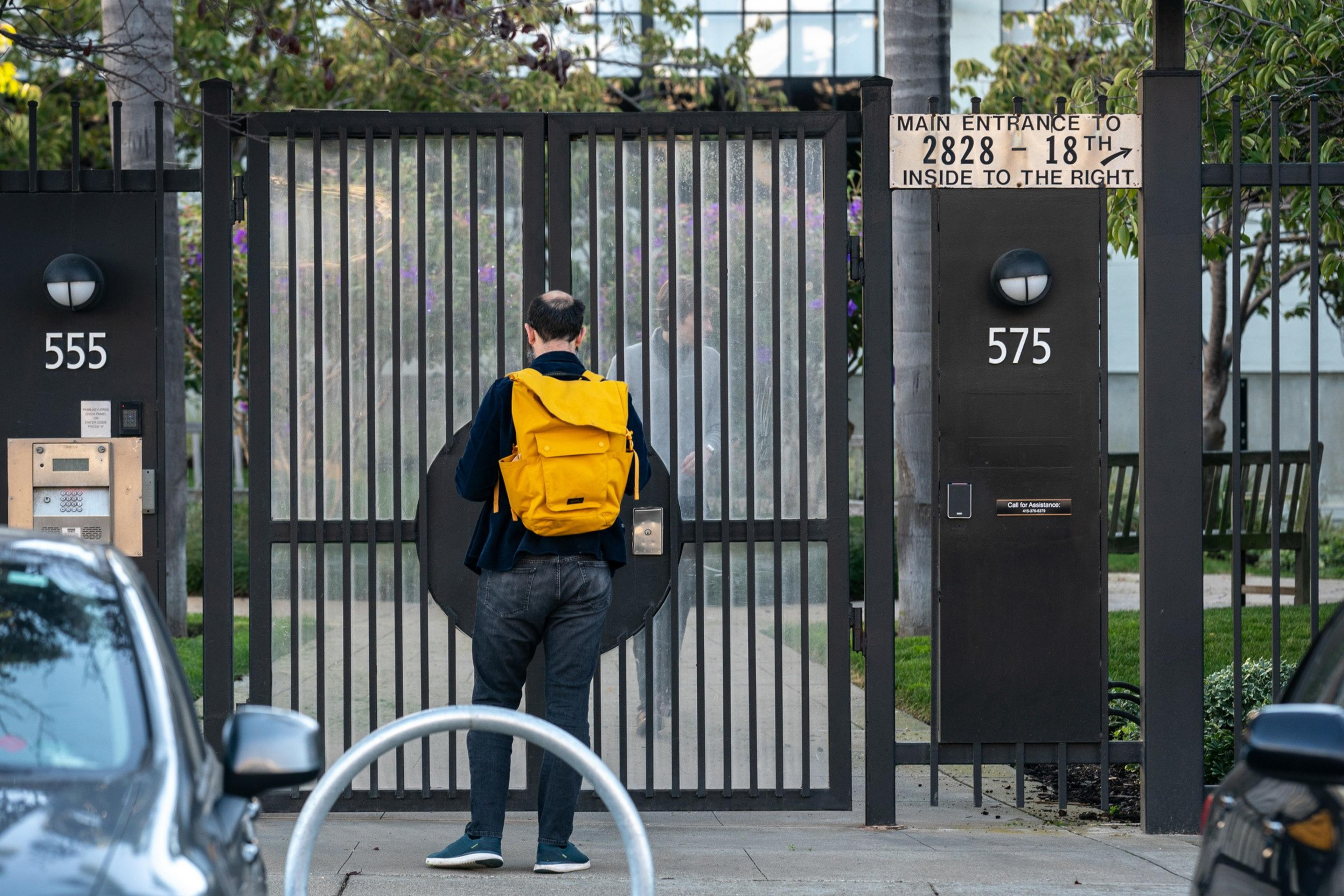 The office complex that houses OpenAI at 555-575 Florida St. | Source: Jungho Kim for The Standard
As internal turmoil at OpenAI led to a series of high-profile departures and the firing and rehiring of Altman in 2024, Balaji grew disillusioned, he told the Associated Press (opens in new tab) that October. Balaji said he was broadly concerned about the rollout of the company’s commercial products and their propensity for hallucinating. But of the “bag of issues” he was concerned about, he decided to focus on alleged copyright violations, because it was “actually possible to do something about.”
In August 2024, Balaji severed ties with OpenAI. In a lengthy blog post (opens in new tab), he emphasized that it was “pretty obvious” to him that ChatGPT causes “market harm” to copyright holders.
“If you believe what I believe, you have to just leave the company,” Balaji told The New York Times (opens in new tab). Weeks later, Times lawyers named him in a Nov. 18 court filing as someone with “unique and relevant documents” supporting allegations of OpenAI’s willful copyright infringement.
Balaji was among the first employees of a major AI company to walk away and publicly challenge its practices. In the weeks after leaving OpenAI, he frequented San Francisco house parties and “Minecraft” nights. He was courted by startups and was batting around ideas for a venture of his own.
In his last weeks, he was thinking deeply about the human brain. He shared a working draft (opens in new tab) with friends, distilling his thoughts on the state of AI research, in which he argued that true general intelligence would not emerge from making today’s AI models bigger but by building systems that learn like the human brain — motivated by curiosity rather than memorizing.
In photos from a November 2024 birthday trip with high school friends to Catalina Island, Balaji is seen smiling, wearing a large, green backpack. According to a friend who was there, he acted normally during the weeklong trip.
Back in San Francisco, while chatting on the phone with his dad Nov. 22, Balaji returned to his apartment, ordered takeout, and made plans to go to Las Vegas with his parents.
He was found dead four days later.
Six weeks later, Ramarao took to X with a shocking claim. “We hired private investigator and did second autopsy to throw light on cause of death,” she wrote. “It’s a cold blooded mu*d*r.” The post (opens in new tab) was viewed 2.8 million times.
Ramarao had been posting about her son’s death for weeks, saying the suicide ruling “does not align with his happy mood.” This was the first time her claims went viral, in part because Elon Musk commented, “This doesn’t seem like a suicide.”
Encouraged by Musk, Ramarao and her supporters flooded social media with their interpretations of a raft of circumstantial evidence. When Balaji was found dead in his apartment with a bullet to the head, he left no note. His friends thought he was perfectly happy. He was preparing to testify against OpenAI. Worst of all, the San Francisco medical examiner’s office took 11 weeks to release its full autopsy, which appeared to some like an extraordinary delay — did that indicate a coverup?
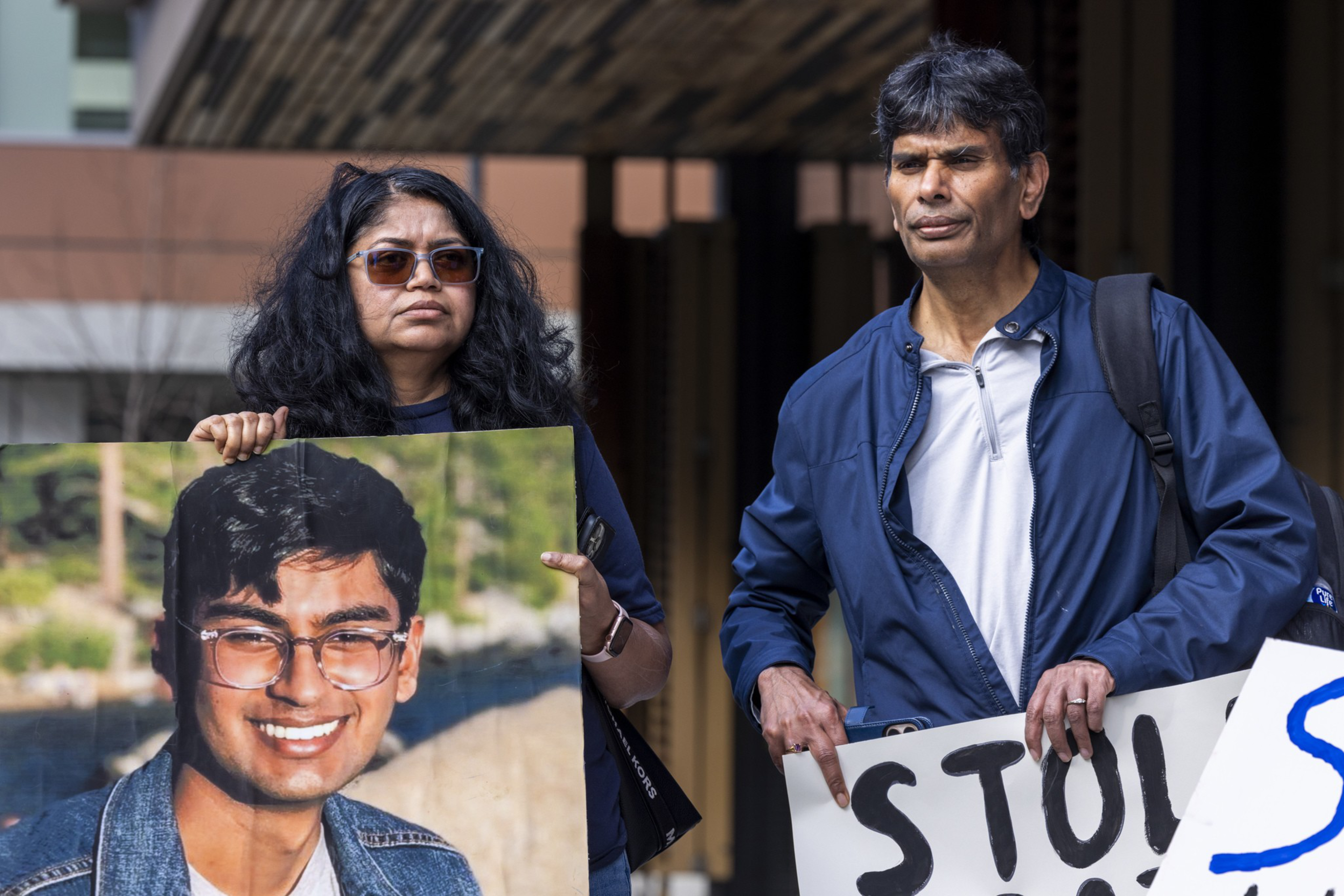 Balaji’s parents, Poornima Romarao and Balaji Ramamurthy, protest outside OpenAI’s office Feb. 22. | Source: Autumn DeGrazia/The Standard
In the year since her son’s death, Ramarao has hired and fired a cast of attorneys and private investigators across the U.S. and India and has commissioned at least six independent reports, including the private autopsy cited in her tweet. Ramarao has declined to share a copy of that autopsy; however, Joe Goethals, the family’s former attorney, told The Standard in January 2025 that he “would not characterize it as conclusively proving murder.”
In one of the reports the family paid for, a blood splatter analysis claimed Balaji may not have been shot but was wounded by an unidentified object before walking around the apartment. (The practice of blood splatter analysis has come under scrutiny (opens in new tab) in recent years for high error rates.)
Another report, by a Michigan firearms consultant, claimed that a lack of soot on Balaji’s forehead meant he was shot from at least two feet away. (The official autopsy said soot “may be obscured by changes of postmortem decomposition.”)
A third report, by an Alabama toxicologist, concluded that Balaji “more likely than not” took the drug GHB before his death, which Ramarao has interpreted to mean he was sedated by an attacker. (The San Francisco medical examiner said the low levels of the drug in his system were likely due to a natural decomposition process; the Alabama toxicologist acknowledged that could also be the case.)
The most high-profile of Ramarao’s commissioned reports is a typo-ridden 28-page document written by Dinesh Rao, an India-based pathologist who drew conclusions based on photos taken in the apartment after Balaji’s death.
Balaji may have been standing, or bending over, or crawling, or sitting before he was shot, Rao surmised from the photos. He hypothesized that a “known person” may have gained access to the building and apartment, but the “food and Chocolates Strewen” in the kitchen indicated the “possibility of Fights/Ressistance/Rage.” He concluded that a photo of dried blood in the bathroom showed a tuft of wig hair that likely belonged to an assailant.
By the time the San Francisco medical examiner completed and released Balaji’s official autopsy, Ramarao’s campaign was in full swing. The Office of the Chief Medical Examiner took the extraordinary step of releasing a detailed letter to Balaji’s family explaining its investigation and its reasons for ruling the death a suicide.
“OCME found no evidence or information to establish a cause and manner of death for Mr. Balaji other than a suicide by self-inflicted gunshot wound to the head,” the office and San Francisco Police Department wrote to Balaji’s family in February.
Nearly a year before his death, Balaji purchased the gun he used to kill himself, the medical examiner wrote. Balaji’s DNA was found on the firearm. Key fob records and video surveillance showed no record of anyone entering his residence, and there was no sign of forced entry. Balaji’s windows were affixed with mechanisms that allowed them to open only 4 inches, and an attacker would have had to scale four stories to get to those windows. Balaji had a significant amount of alcohol in his system — more than twice the legal driving limit.
If the letters were meant to put the theories to rest, they only fanned the flames. “There are tons of inconsistencies in their decision,” Ramarao wrote (opens in new tab) on X. “We are fighting for justice.”
Ramarao’s attorney, Phoenix Thottam, wrote to The Standard in the cease-and-desist letter sent prior to the publication of this story that “any statement suggesting that the San Francisco Office of the Chief Medical Examiner conducted a full autopsy consistent with accepted forensic standards is materially misleading.”
A representative for the medical examiner said they conducted a “thorough medicolegal investigation in this case, consistent with established standards and protocols,” and that the office “stands by its independent forensic findings and conclusions.”
Even more powerful than any physical evidence appears to be Ramarao’s unshakable belief that her son simply could not have done what the authorities said he did. He was not unhappy, she maintained, and thus could not have killed himself. “How does someone so courageous do a cowardly act?” Ramarao asked in a January 2025 interview (opens in new tab) with Tucker Carlson.
However, a second report by Rao said Balaji had a history of depression and “was under treatment” — a fact that has not previously been made public. Balaji’s father, Ramamurthy, told The Standard in January 2025 that his son had “fear and anxiousness” after blowing the whistle on OpenAI. In a December interview, Ramarao said Balaji began taking antidepressants after leaving OpenAI but was not seeing a therapist.
Ramarao, however, has long maintained that her son had no history of mental illness and contended that his depression was not relevant to his death. “Even I take antidepressants,” she said. “There is a difference between mild depression and being suicidal.”
While people tend to exhibit warning signs prior to suicide, research has shown (opens in new tab) that close friends and family can often miss them. This applies even to high achievers. Studies (opens in new tab) have found that when perfectionists become depressed, they are particularly at risk of dying by suicide. And studies show (opens in new tab) that 4 in 5 adults who die by suicide don’t leave a note.
What began as a single family’s grief quickly accelerated thanks to supporters high and low. Some Ramarao reached out to herself; others found her.
In January 2025, she sat across from Carlson, the former Fox News host, in his Maine cabin for a lengthy interview. “I don’t think any honest person looking at this would conclude this was a suicide,” Carlson said, stone-faced. He brandished Rao’s report, which he said contained credible evidence that Balaji was murdered. “There’s blood all over the apartment.”
No image in the report, or body-camera footage reviewed by The Standard, showed blood anywhere other than the bathroom and its immediate vicinity, which is where first responders found Balaji.
Eight months later, Carlson confronted (opens in new tab) Altman over Balaji’s death, again repeating claims not supported by body-camera footage, including that there were obvious signs of a struggle.
 Police body-camera footage. | Source: Courtesy San Francisco Police Department
“His mother claims he was murdered on your orders,” Carlson said in an instantly viral exchange.
“Do you believe that?” Altman asked.
“Well, I’m asking.”
“You just said it, so do you believe that?”
“I think that it is worth looking into.”
The interview was quickly clipped and shared across the internet, reaching tens of millions of viewers who proceeded to put Altman on virtual trial. “Never thought I’d agree with Tucker Carlson,” one Instagram commenter wrote. Carlson did not respond to questions about the interviews, and Altman has denied any wrongdoing.
Interest in Balaji’s death has come in waves over the last year, spiking after Carlson’s high-profile interviews and an October episode of Joe Rogan’s podcast, in which Musk repeated Carlson’s claims.
“Look, I don’t know if he’s guilty,” Musk said of Altman, “but it’s not possible to look more guilty.”
The suspicions have propagated on Musk’s X, uniting an odd coalition of conspiracy-minded journalists, tech figures, and public officials who ultimately spread the theory beyond the platform.
California Rep. Ro Khanna called for (opens in new tab) a “full and transparent” investigation by the FBI, given the “very serious concerns about foul play.” Autism Capital, a popular X account in tech circles, wrote (opens in new tab), “they’re really out here offing whistleblowers in these streets lmao.” The popular influencer Mario Nawfal racked up millions of views on posts (opens in new tab) with titles such as “WAS OPENAI WHISTLEBLOWER KILLED!?”
Progressive San Francisco supervisor Jackie Fielder retweeted (opens in new tab) a post that said the SFPD had reopened its investigation into Balaji’s death. (That was false: The SFPD never closed the case.) One supporter even made a crypto “meme coin (opens in new tab)” named after Balaji and spread the word on X.
While Carlson was confronting Altman, passion boiled over in other realms. The medical examiner’s office began receiving threats by phone and email. “There is an interview on Tucker Carlson which is fantastic with this boy’s parents,” said one voicemail to the office. “[Medical Examiner] David Serrano Sewell is a mafia thug who’s either complicit and compromised or he’s been paid off. This is disgusting. The corruption at your level is appalling and shocking, and everyone’s waking up to it.”
There is no evidence to support the caller’s claims against Serrano Sewell.
Through it all, Ramamurthy has been more reserved in his advocacy. In joint interviews with his wife, Ramarao, he often sits silently. But he is active on social media. In November, he shared a post that superimposed his son’s face on an image (opens in new tab) of Abraham Lincoln, John F. Kennedy, Martin Luther King Jr., Jesus Christ, and Charlie Kirk with the line “ALL BECAUSE OF WORDS.”
Within San Francisco tech circles, many believe Balaji did not die by suicide. Few have gone so far as to publicly suggest OpenAI or Altman played a role, but several pointed to public safety issues in San Francisco and speculated his death could have been a freak act of violence.
“I think most people who have really looked into the facts of the case think he was murdered, to be honest,” said a Y Combinator startup founder who asked to remain anonymous to speak freely. He said he’s discussed the circumstances of Balaji’s death with other founders on multiple occasions: “It’s such a strange sequence of events. There are too many missing pieces.”
 OpenAI CEO Sam Altman. | Source: Justin Katigbak/The Standard
Ed Newton-Rex, CEO of a nonprofit that certifies generative AI models, expressed similar skepticism in a message posted to LinkedIn (opens in new tab) on the anniversary of Balaji’s death.
“There are many questions around the circumstances of his death. What is clear is that it came as a total shock to all who knew him,” Newton-Rex wrote. In the comments, a Google employee wrote: “That Sam A interview with Tucker really wasn’t much to reassure the skeptical.”
Balaji’s death coincided with OpenAI’s meteoric rise to prominence — and increased scrutiny from the public. In the year since Balaji died, the company has come under fire for cases in which its flagship product, ChatGPT, allegedly encouraged users to kill themselves and drove others into violent and life-derailing (opens in new tab) delusions. Ramarao has found allies in groups critical of OpenAI and has sought vengeance against the company by filing a ballot initiative in December seeking to stymie the organization’s conversion to a for-profit.
When asked for comment, an OpenAI spokesperson pointed to a statement the company made in January that said Balaji was a “valued member of our team and we are still heartbroken by his passing.” It continued: “Out of respect, we won’t be commenting further.”
Ramarao remains adamant that her son was assassinated. In some ways, she has found solace in what she says is evidence that Balaji battled his assailants. “I was happy that my son fought for his life,” she said. “He didn’t just give up.”
When presented with questions about evidence she has cited, Ramarao maintained that the reports she commissioned were credible. She vowed to “expose” journalists who she believes are on OpenAI’s payroll. She also pledged to sue the San Francisco medical examiner’s office, which she characterized as a corrupt institution.
Ramarao has taken some of her accusations to court. In January 2025, she and her husband sued the San Francisco Police Department, alleging it withheld records related to Balaji’s death. Ramarao later dropped the case. In September, the family sued the owners and management company of Balaji’s apartment building, claiming they concealed evidence and obstructed the investigation into the death. Alta Laguna LLC and Holland Partner Group, the defendants, did not respond to requests for comment.
Thottam, Ramarao’s attorney, said the family is in the process of gathering additional evidence and seeking justice. Ramarao said she wasn’t convinced by any of the information The Standard presented her. She continues to lead the crusade against the official findings and remains unshaken in her belief that her son was murdered.
“It was a very rough year,” Ramarao said. “But now we have come to terms that he lost his life for a cause.”