
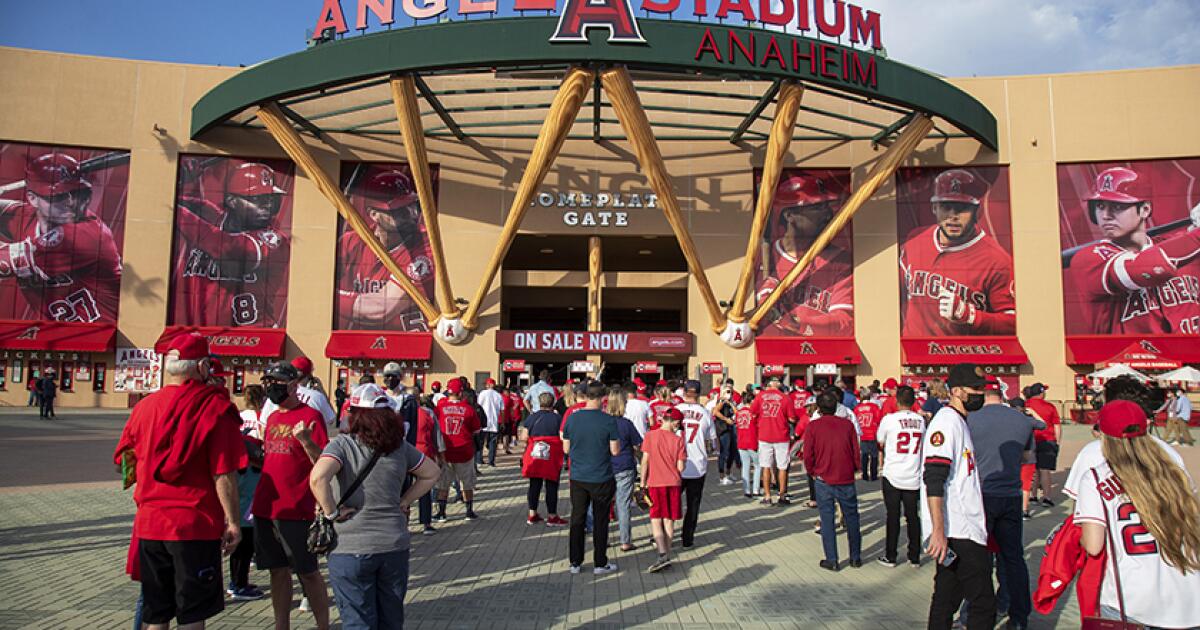
Five years ago, Anaheim city officials received a calendar invitation to rehearse a council meeting that could have led to a deal to sell Angel Stadium.
The idea was to rehearse with Angel executives and consultants in advance of a formal council meeting that would move ownership of the stadium and the land around it from the city to a company headed by Angels owner Arte Moreno.
Jeff Flint, a consultant hired by Moreno’s SRB Management, sent the “debate prep” invitation on Sept. 12, 2020.
A week later, Flint followed up with an email and attachment that assigned Angels executives, councilmembers and city staff with roles to play in preparation for the real meeting.
Evidence of the planned Sept. 21, 2020 mock City Council meeting surfaced publicly two years ago when former Anaheim Mayor Harry Sidhu accepted a plea deal as part of an FBI political corruption probe — one that led to the stadium deal’s termination.
But the question of whether the rehearsal actually happened had remained open until now.
Former Anaheim Chamber of Commerce chief executive Todd Ament confirmed the meeting took place in recorded comments he made during a teleconference the next day.
“Yesterday, Jeff [Flint] led a mock council meeting here with the mayor and a couple of councilmembers … prepping them for what the other side will do,” Ament reported to chamber board members in audio recordings reviewed by TimesOC. “How this gets framed in the public is very important.”
According to a source whose name is being withheld due to the sensitive nature of the subject, Angels President John Carpino, Senior Vice President Molly Jolly and then-team General Counsel Alex Winsberg arrived at the chamber’s office across from Angel Stadium the day of the meeting.
The conference room, where Flint had scheduled the rehearsal, had its curtains drawn, the typical practice before any meeting takes place, the source said.
New details about the council rehearsal have emerged as city staff have been allowed to restart conversations with state housing officials about a law governing the sale of Anaheim’s biggest city-owned asset.
Flint’s assignments in 2020 came with directions for the three-hour mock meeting.
Two other rehearsals were scheduled for Sept. 24 and Sept. 29, with the final date coming just hours before Anaheim City Council approved an agreement with SRB Management to reduce the stadium sale price from $320 million to $150 million in exchange for community benefits, including affordable housing and a 7-acre park, on the 150-acre site.
“We will run through a mock council session straight through one time at the start to identify pitfalls and areas of vulnerability,” Flint wrote of the first session. “Time permitting, we will do a second run-through, stopping at key points to emphasize key moments.”
Flint and Ament did not return requests for comment. Flint has not been accused of wrongdoing. Ament is attempting to withdraw his plea deal ahead of sentencing in March on a retail cannabis-related wire fraud charge and other crimes.
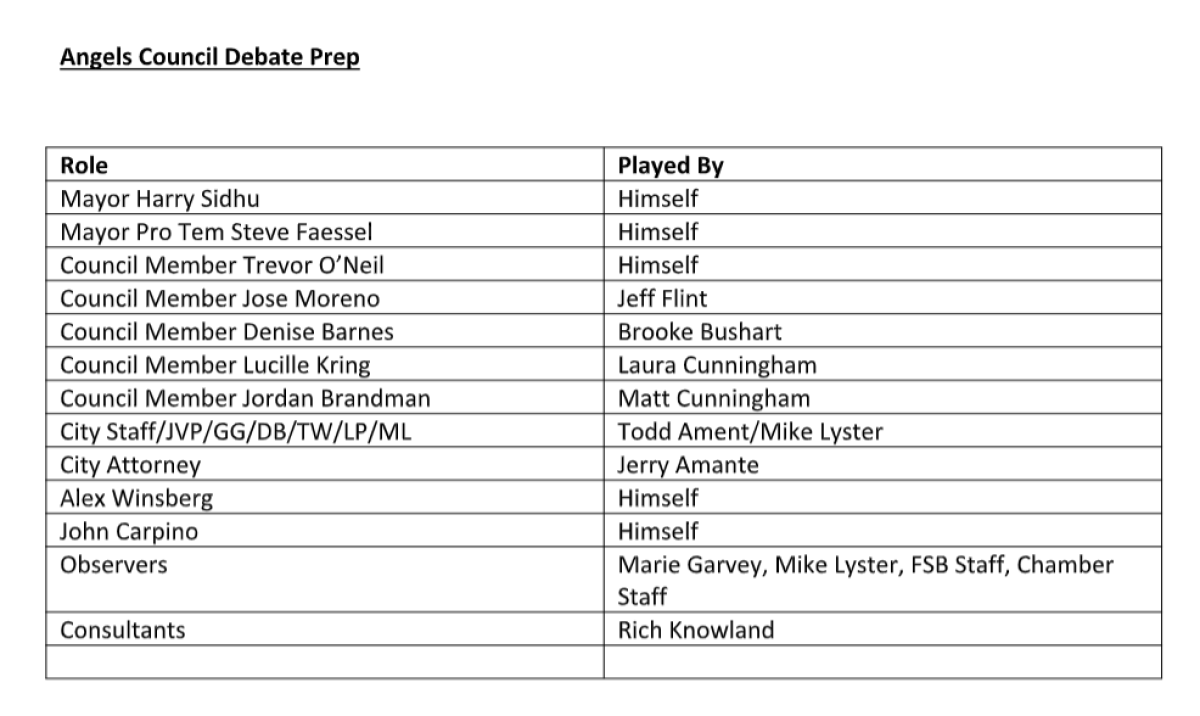
A consultant sent this list to officials invited to a prep session for public debate about whether to sell Angel Stadium.
(Screenshot by Gabriel San Román)
Carpino and Winsberg had assignments to portray themselves and rehearse how they would field questions about the stadium deal during the actual council meeting.
At the Sept. 29, 2020 council meeting, Winsberg spoke on behalf of the stadium deal’s approval and responded to councilmember questions.
Winsberg did not respond to a request for comment for this story.
Jolly also received the email, but didn’t have an assigned role.
Marie Garvey, an Angels spokesperson, did not respond to a request for comment. Flint assigned her to observe the mock meeting, per the email attachment. A senior director of communications for the Angels also did not respond.
No one on the Angels staff was accused of wrongdoing.
However, revelations about the meeting raised questions surrounding ethics and transparency at the time.
A politician who, as a former councilmember, voted to terminate the stadium deal, called for a more transparent process in deciding any future development on stadium land.
“This corruption is extremely disappointing and reinforces why Anaheim residents lost trust in the city’s handling of the Angel Stadium deal,” Assemblymember Avelino Valencia (D-Anaheim) said. “To proceed, the city and the state must develop a transparent, community-driven process that is independent of the Angels organization or any private entity.”
In his plea agreement, Sidhu admitted to deleting correspondence sent to his private email after first lying to FBI agents about not using the account to conduct city business.
Two other councilmembers and city employees also received the email on private accounts.
Mayor Ashleigh Aitken called on any city officials who “facilitated or participated” in the mock meeting to resign.
But since the email attachment was not fully disclosed in court documents, and key details about it remained unclear, nobody connected to it stepped down.
Former Councilmember Stephen Faessel termed out of office last year with a proclamation recognizing him for his service.
In a statement to The Times in 2023, former Councilmember Trevor O’Neil denied a mock council meeting took place with coached comments.
“We simply had a discussion of items and policy,” he said.
Sidhu, O’Neil and Faessel were directed to play themselves, according to the memo.
Sidhu was expected to “be a strong defender of the deal and know its terms.”
Flint reserved the role of former Councilmember Jose Moreno, a chief critic of the stadium deal, for himself and outlined expected points of attack including the cost of community benefits and the value of city-owned land.
Laura Cunningham, the chamber’s vice president at the time, was assigned to role play former Councilmember Lucille Kring. Matthew Cunningham, Laura’s husband and a blogger, was given the role of former Councilmember Jordan Brandman.
“I didn’t participate in any mock council meeting,” Matthew Cunningham said.
City spokesman Mike Lyster, one of two city employees listed in the debate prep document, had two roles assigned. In addition to being an observer, he was to share duties with Ament in roleplaying key Anaheim city staff, including City Manager Jim Vanderpool.
No department heads appear to have been invited to the mock meeting. The other city employee invited was Annie Mezzacappa, Sidhu’s chief of staff.
Two years ago, Lyster downplayed the email, which court documents only referred to a chief communications officer having received it.
“I reject any suggestion of being involved in the planning of any meeting, which I also have no indication of taking place,” he told the Orange County Register.
Lyster reaffirmed that position in a recent interview with TimesOC.
“I don’t recall taking part in a practice session,” he recently told TimesOC. “I can’t comment other than that meeting preparation is common at cities and must adhere to the requirements of the Brown Act.”
The Brown Act is California’s open meetings law, which requires that government’s business be noticed and conducted in public, though there are qualified exceptions for legal and real estate matters in certain.
Three councilmembers participating in a mock meeting would not form a quorum in violation of the law.
Lyster did not address questions about whether he recalled receiving three invitations from Flint for each of the planned mock meetings.
Anaheim is looking to potentially restart discussions about developing the land around Angel Stadium.
(Steve Cukrov & Louise Shumbris-C/Steve Cukrov – stock.adobe.com)
Between sessions, Flint offered his consulting team’s services to help develop “zingers” — pointed questions and responses — and other suggestions to improve performance.
The day before councilmembers approved the stadium deal, Flint sent out a “FINAL PREP on GAME DAY’ invite to more than a dozen people. He scheduled the final run-through to take place just hours before the council meeting.
In addition to rehearsals, Sidhu also had a script prepared that week for his opening remarks on the stadium deal as he presided over the council meeting.
Flint, the Angels’ consultant, emailed the mayor a first draft and included Ament and Mezzacappa in the correspondence, according to obtained documents.
When time came for councilmembers to discuss the stadium deal, Sidhu recited several passages from the Flint-emailed script almost verbatim, including a word-for-word claim near the end of his comments.
“After, tonight, I hope, all that hard work will have been worth it,” Sidhu said, matching the script, “and we will have done something phenomenal and special for our city that I truly believe residents for generations to come will thank us for.”