
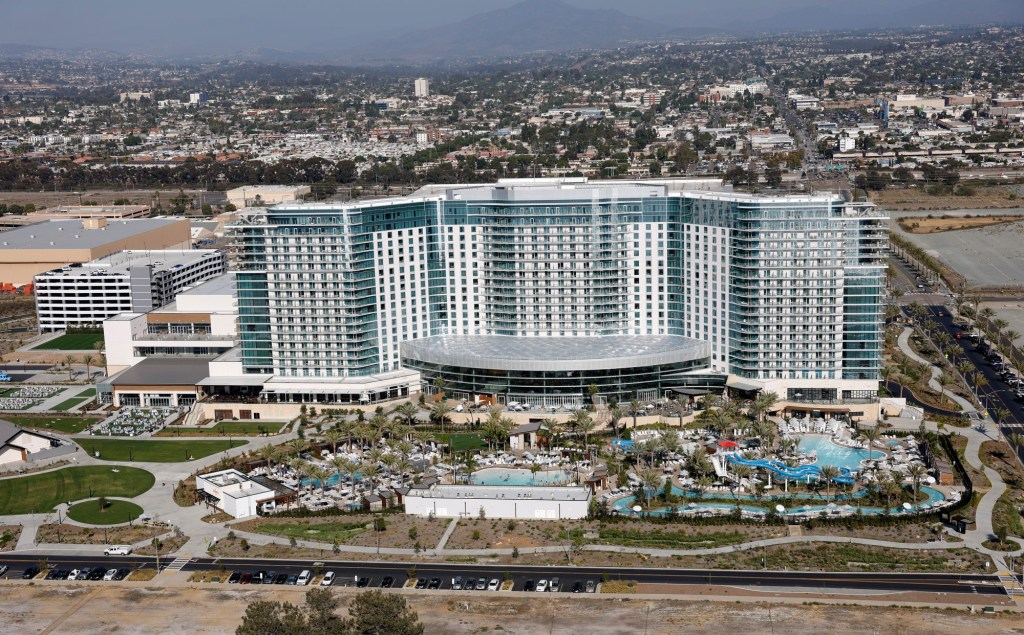
When the Gaylord Pacific Resort and Convention Center opened in May, Mayor John McCann saw more than just Marriott’s largest property cutting ribbons on the city’s bayfront. He saw validation.
“The Gaylord Project is a 22-year overnight success story,” McCann said, describing the decades-long journey from the 2003 Bayfront Master Plan to the 1,600-room resort that now anchors the city’s waterfront. “It took 22 years to get through the process of the California Coastal Commission, all the processing, financing, and then actually to get it built.”
Now, city and state officials are betting that success will catalyze an ambitious slate of development projects aimed at transforming the second-largest city in San Diego County into what McCann calls “the economic engine for the region.” The vision includes a bayfront sports complex, luxury housing, an entertainment district with film studios, and the crown jewel: a four-year university for a city of nearly 300,000 people.
But Chula Vista’s development track record carries cautionary notes. Major companies including Amazon have considered locating in the city, only to go elsewhere. And the university concept has circulated in different iterations since the 1990s, such as the proposed Cal State Chula Vista that failed in 2020.
City officials acknowledge the challenges, but point to recent momentum as evidence this time is different.
“The Gaylord Pacific has certainly put us on the map as it’s the biggest resort on the West Coast,” said Councilmember Michael Inzunza. “But what it’s done is it’s opened up the floodgates for tourism, athletic opportunities, sports opportunities, and becoming a destination point for jobs.”
The Gaylord’s impact extends beyond tourism. According to Port Commissioner Ann Moore, who presented to the City Council on Dec. 16, the resort generated more than 7,000 construction jobs and now employs over 1,200 people. The hotel had “the largest opening in Marriott’s history,” with the sales team selling more than one million group room nights before opening day, Moore told the council.
The resort has already generated $88 million in revenue for the city, McCann said.
That success undergirds the city’s pitch to developers: Chula Vista can deliver on large-scale projects, and there’s market demand to support them.
The most immediate bayfront project is Amara Bay, which has cleared the California Coastal Commission and completed groundbreaking. The development will feature seven towers with 1,500 luxury condos, a high-end hotel and retail, with construction on three initial buildings expected in the coming years.
Farther south on the bayfront, the Pangea project envisions a massive sports and recreation complex.
The Port of San Diego entered an exclusive negotiating agreement with developers that runs from January through July, Moore said. The proposal includes a tennis center with multi-surface courts, hotels, water polo facilities, retail, a wellness center and stadium to host soccer matches.
“This project would bring unique recreational opportunities that do not exist in Chula Vista today,” Moore told the council. “It would create new local union construction and permanent jobs.”
But Moore emphasized the agreement is “not a development agreement. It’s not a lease of port land. It’s not a financing agreement, nor is it a formal CEQA review. It’s also not a funding commitment by the port, and it’s certainly not a deal.”
Although the Port has not made any final commitments or decisions about the Pangea project, the negotiating agreement gives the developers exclusive rights to negotiate with the Port for six months, which gives the developers a window to work out planning details.
Away from the waterfront, the city is pursuing what Inzunza calls the “innovation district” in eastern Chula Vista. The Millenia Library, funded by a $40 million state grant secured by Assemblyman David Alvarez, will house the Chula Vista Entertainment Complex — a film production facility focused on special effects, documentaries and virtual production.
Plans call for two additional studios on eight acres across the street and potentially a 30-to-40-acre full film lot.
McCann said the city is working with the county to create a layered tax incentive program to make filming in their complex far cheaper than Los Angeles. Combined with a new state tax credit, the structure would allow film productions to stack city, county and state credits, he said.
The university project remains the most ambitious and uncertain. Chula Vista is one of five California cities with over 200,000 people without a four-year university — Santa Ana, Fontana, Moreno Valley and Oxnard are the other four.
Alvarez said six bachelor’s degree programs will be offered at Southwestern College, a community college in Chula Vista, starting fall 2026 — the first ever in the city. UCSD will offer public health, SDSU will provide nursing and industrial organizational psychology, and CSU San Marcos will teach cybersecurity.
“That is a major step,” Alvarez said. “And so those are all components that needed to happen in order for that bigger vision to really come through.”
Gov. Gavin Newsom signed Alvarez’s Assembly Bill 662 this year, creating the Chula Vista University Task Force to determine how the proposed institution would operate and be funded. The university would be “a new type of institution that does not exist in California,” Alvarez said, similar to Denver’s Aurora campus, which houses multiple university systems.
The task force must complete its work by 2027, but Alvarez cautioned the full university would require “a very, very large investment” in “the nine figures in terms of dollars.”
The biggest obstacle to all development, McCann said, is “government red tape.” He used the Gaylord as an example.
“It is so funny because for years we’d been pitching it, working on it, working on it, working on it, and then finally we got it approved,” he said. “And then when they started building it, then it took about approximately two years to get built.”
Inzunza identified another challenge: federal budget cuts that affect state funding for the city’s university plans.
“If the federal government is withholding allocations or money to the state of California, well then the state of California is going to be that much more apprehensive of budgeting for any new universities or education institutions,” he said.
For Alvarez, the challenge is overcoming decades of skepticism.
“Because this has been talked about for so long, I believe there was fatigue and a sense of people who maybe stopped believing in it,” he said. “But I don’t hear that sentiment much anymore. In fact, quite the opposite. I genuinely just hear, wow, this university thing is happening.”
McCann projects Chula Vista’s population will exceed 300,000 within five to 10 years. Whether the city’s development vision keeps pace with that growth may depend on whether the Gaylord’s success proves replicable — or remains a 22-year exception.