

The synergy between proper nutrition and athletic performance is becoming increasingly more prevalent in today’s evolving sports world.
At a Glance:
San Jose Earthquakes partner with Thomas Cuisine on sports nutrition
Personalized, performance-focused meals support recovery and health
Registered dietitian Jayne Pinsky bridges kitchen and locker room
Real, scratch-made foods replace traditional pre-packaged options
The concept of using healthy foods to help professional athletes perform better, as well as recover better and quicker, has led to a unique partnership between the San Jose Earthquakes, one of 30 Major League Soccer (MLS) organizations, and Boise-based food service provider Thomas Cuisine.
The result is a personalized, high-performance food service model for players, one that fully supports a healthy bridge between the kitchen and the locker room.
 Alison Patt
“Similar to companies that we serve, [the Quakes] saw food as a lever for recruiting and retaining great players as part of the overall experience,” said Alison Patt, president and CEO of Thomas Cuisine. “And they felt like they could do better.”
The key ingredient to help boost player performance and health falls on the plate of Jayne Pinsky, a registered dietician and graduate of Salisbury University in Maryland, who completed her undergraduate studies in exercise science and psychology when not competing on the soccer field for the school.
A “two-way” performer, Pinsky serves as both the food services director for Thomas Cuisine and the team’s dietician.
“I’m ultimately overseeing a kitchen operation while working within a sports medicine and performance team,” she said. “I’m acting as a disseminator between the two.”
Bouncing between the dual roles, Pinsky is no stranger to multitasking. Her resume includes Post Baccalaureate studies in nutrition services and dietetics at La Salle University in Philadelphia, followed by a nearly four-year stint working with the University of California, Berkeley, football team and the school’s sports nutrition program.
“It all comes down to education on what nutrition does for these players on both the kitchen side and on the athletic performance side,” Pinsky, said. “And it can truly come from all angles.”
In this case, all angles meet head-on as a result of the cohesive partnership being built between the players who need to eat and fuel well, and those whose expertise is prioritizing foods that are functional, support circulation and are considered rich in nitrates for the bodies that need them.
“You can’t thrive and flourish as an athlete without the nutritional piece and emphasizing how to fuel your body with intention and mindfulness,” Pinsky said.
For Quakes forward Ousseni Bouda, understanding how to eat right directly translates to getting a leg up on his opponents.
“In professional soccer, where every detail matters and you are looking for every advantage, taking care of your nutrition and educating yourself will take you a long ways,” Bouda said.
Now in his fourth season with the club, he acknowledges a stark difference in the way he eats and feels since the two sides teamed up. “For the first three years playing professionally, I think I was trying to eat healthy, but I don’t think I was eating enough, or more especially, eating the right things.”
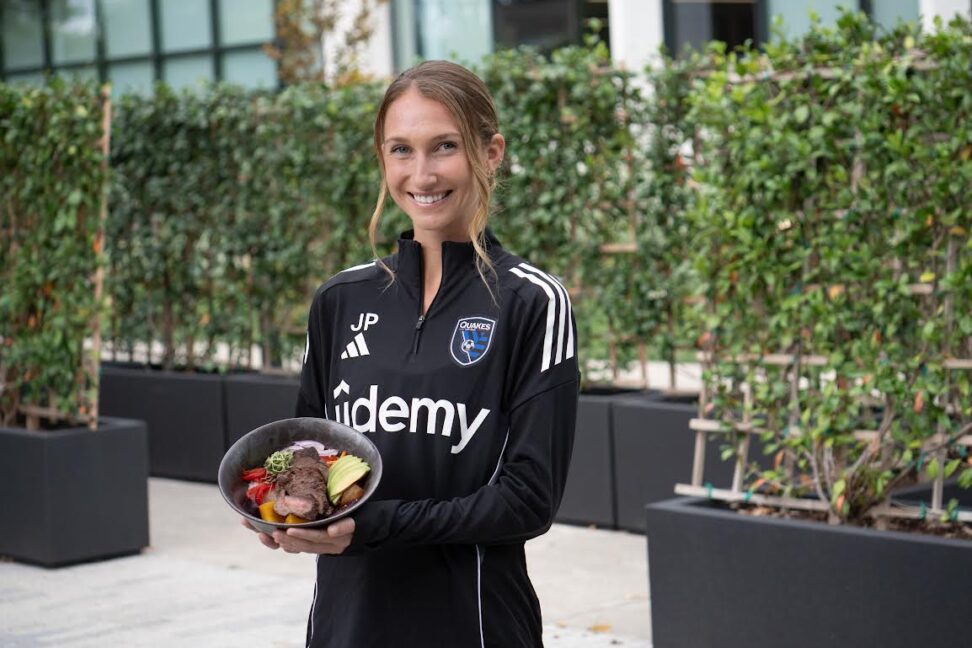 Jayne Pinsky
While breakfast has typically been labeled the most important meal of the day, not all subscribe to this train of thought. But Bouda, a former standout player for the Cardinal at Stanford University, where he earned a degree in international relations, now values the importance of proper nutrition to start his day right.
“I really don’t think I was prioritizing what I was eating for breakfast,” he said. “But now with Jayne and Thomas Cuisine, I know I am eating right and better.”
“These players are body sensitive and know themselves really well,” Pinsky said. “But for what I am doing, there is an education gap, and I can provide them the education that can help take their performance to the next level in a way they might not have known was possible.”
On the field and off, terms like “carb-loading,” she stressed, can often create confusion, even for athletes. “Players sometimes think they may burn a certain amount of fuel during a workout and then just eat to replenish.”
As partnerships go, this one came together right at midfield. Looking to make healthy changes for its squad, the Quakes have given a swift kick to a more traditional post-game spread, and meals and snacks available to players during the season.
“This is an arena that truly understands what you put into a body matters,” Patt said. “Instead of pre-packaged foods, you’ll find scratch-made energy balls, granola bars. Instead of sodas, we produce fresh smoothies. It’s the cornerstone of what we do, and it typically happens in our café space onsite.”
The food line-up now features tailored meals served restaurant style that allow players to choose, a rotating menu of “global cuisine” is how Pinsky describes it. “It’s all so individualized and there are so many variables. Players are creatures of habit, but they have found the perfect recipe and what works for them.”
Whether plant-based, protein-focused or heavy on carbohydrates, meal selections are based on a player’s individual plan developed through Pinsky and the team’s performance coach.
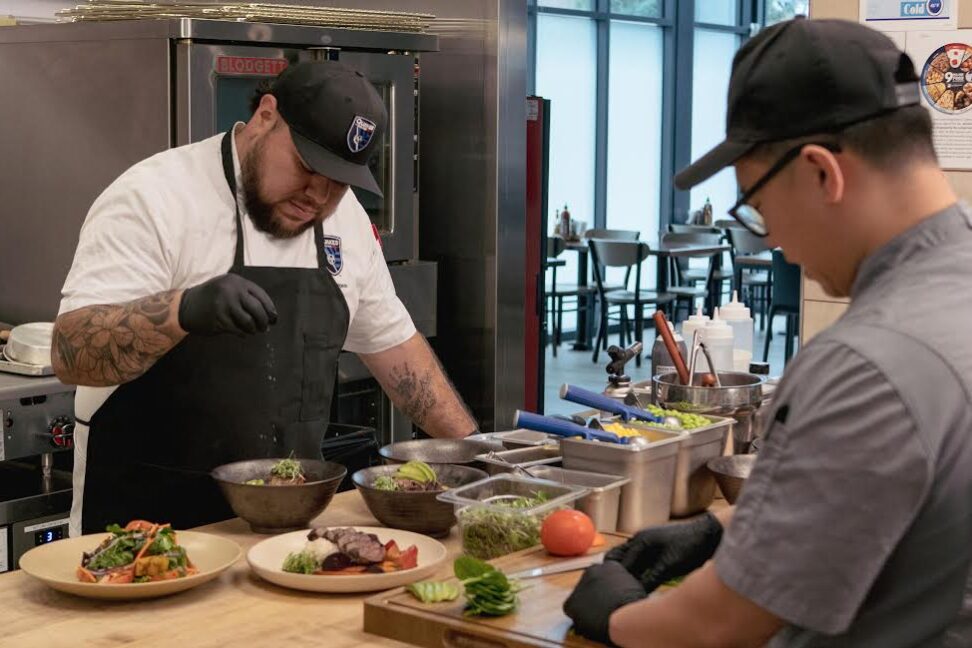 Chefs for the Quakes prepare tailored meals for players. (PHOTO: THOMAS CUISINE-QUAKES)
The forward and goalie may enjoy a meal together but not necessarily eat the same thing.
“We can customize to each individual because we are not serving a huge group of people where all the food needs to be the same,” Patt said. “The Quakes are able to do this custom work for each individual player.”
From steak to pasta, Mexican cuisine, Asian rice bowls, Poké bowls and other grain-style bowls, variety and nutritional standards are the ultimate goal.
“It’s great because each body is different and so are the goals for each person,” Patt said. “We try to be as nimble and customizable as possible. It’s the cornerstone of how we are going to continue to grow this space.”
Prior to the partnership, players ate meals in a conference room, but the Quakes have gone the length of the field, adding a new dining hall and a renovated kitchen. Catering has been kicked to the curb.
“I believe a lot of the players think of our chef as their own personal chef,” Patt said proudly. “The dining experience is far more personal than institutional.”
Plus, using “real” food to help players recover quicker and better from injury or fatigue is a major point of emphasis, a key element of Pinsky’s diverse background and training.
“Being exposed to physical therapy and people rehabbing and community nutrition, and then officially entering sports nutrition, it really became clear to me that nutrition is a pillar of health and performance,” she said. “Nutrition is a science and there is a whole model that can be used when it comes to enhancing recovery for a player.”
Nutrition is scientifically proven to amplify or limit the work athletes do in the gym or on the field. Protein and foods rich in micronutrients and antioxidants to help support immune function have earned roster spots.
“There is a common misconception, even among athletes themselves, about not fully understanding where nutrition falls in terms of the value it brings to their performance and recovery,” said Pinsky, who experienced her share of injuries during her playing days.
“These all come into play when it comes to recovery and taking recovery to the next level. I’m working directly with players who are in an injured state and going through various rehabilitation stages.”
“As an athlete, overall, you feel better when you are fueling right before practices and then after games,” Bouda said. “It goes a long ways.”
Sometimes, a long way, Bouda realized, can mean looking back downfield.
“I felt lucky to have had the university cafeteria or dining hall in college, but I wish I had taken eating more seriously when I was younger,” he said. “Playing in college, I was not in charge of my nutrition. I was eating everything without necessarily thinking about my portions and what specifically I should be eating to help my body as an athlete.”
Patt hopes the rumble this partnership has stirred up will lead to more mergers in the sports world.
“The Quakes have been so good in allowing us to customize to the players and in the ways it matters to them,” she said. “Food equals performance, and we’re also building something repeatable and replicable for us to grow.”
Primarily focused on providing a REAL (Robust flavor, Exceptional ingredients, Avoiding additives and Loaded with nutrients) food philosophy to an array of clientele in the health care industry, senior living communities, and for corporations including Blue Cross and Simplot, Thomas Cuisine now boasts a roster of 2,300 employees throughout 16 states.
“From a history perspective, we have been focused on what we call real food,” Patt said. “In our world, that means thoughtfully sourced, scratch-cooked food. And we always look for areas in a partnership that benefit from scratch cooking, or better-for-you food.”
A new niche for Thomas Cuisine, and one that Pinsky would not have any other way.
“This food service model we operate is very atypical being that most dieticians are actually hired by the athletic team,” she said. “But being on the Thomas Cuisine side, I have so much support with food service management and operations. I’m really able to make adjustments on the fly and in the kitchen.”