
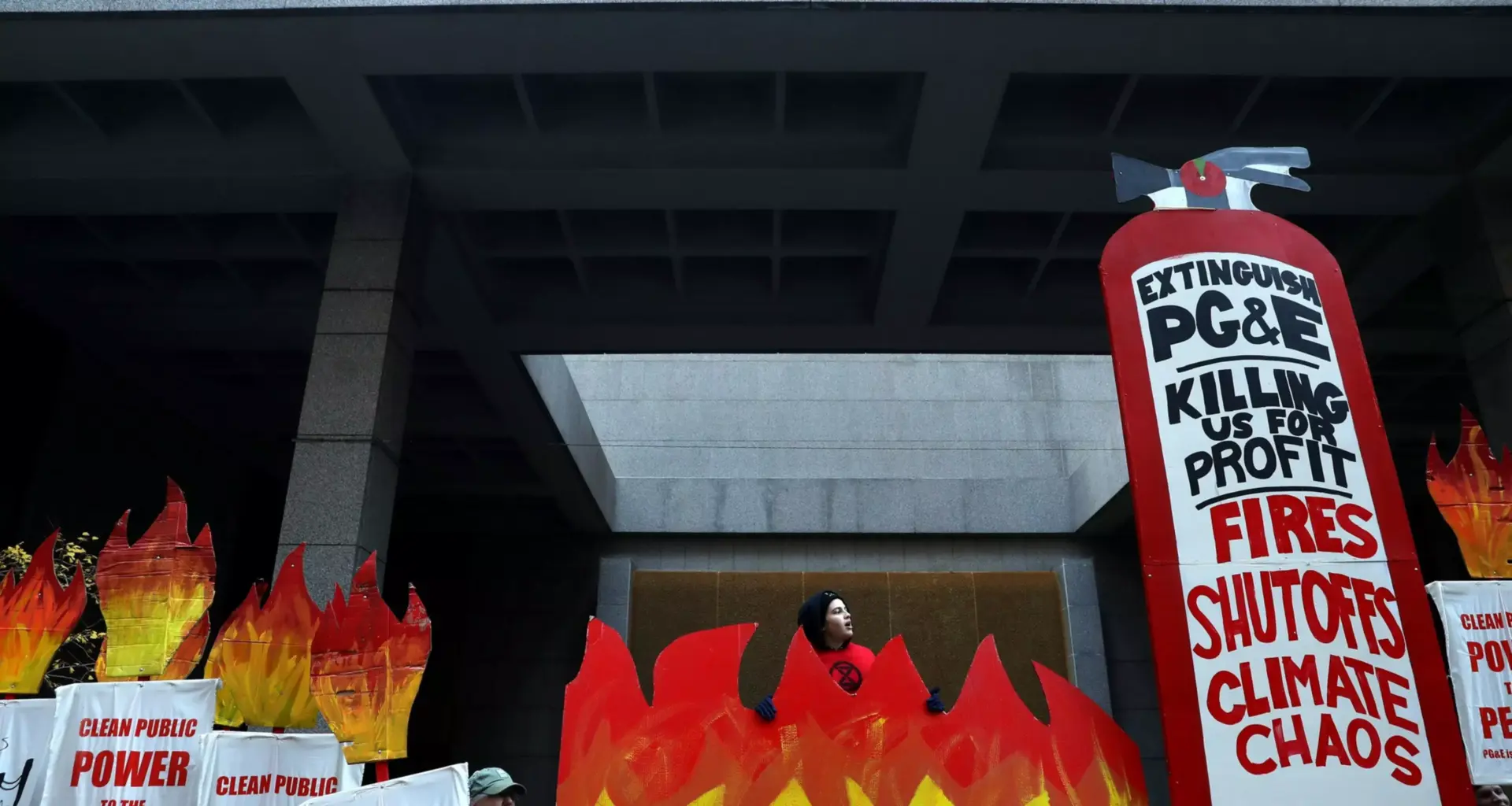
Just before Christmas, 130,000 PG&E customers across San Francisco were plunged into darkness for hours — with some enduring blackouts that stretched days. The timing couldn’t have been worse: It was the year’s most critical shopping weekend, when small businesses depend on last-minute gift buying to make their year.
It was an unacceptable yet predictable result of a system that allows utility monopolies to charge more and deliver less, year after year.
A utility company like PG&E is a monopoly, and the first thing you learn as a businessperson is that monopolies are terrible for customers, delivering the worst product at the highest possible price.
The blackouts are why I’ve highlighted the issue of utility monopolies as I campaign for governor. California has the second-highest electricity rates in the country (opens in new tab). We have to change the system to get different results. California needs to break up these monopolies.
I’m not suggesting the state take over all electrical infrastructure, from wiring to power poles. It’s about providing consumers with more choices. That starts with making sure households can choose their electricity provider. Some residents of areas with community choice aggregators — which pool residents’ purchasing power to lower energy costs — have this option. But many do not.
As a first step, we need to fundamentally change the perverse incentive structure that’s failing California families and businesses. Put simply, PG&E and the other utility monopolies profit more by spending more. State regulators allow them to earn returns based on their capital investments, so expensive projects mean higher profits. As a result, there’s no reason for them to find cheaper solutions or cut costs.
In fact, they’re rewarded for doing the opposite. A prime recent example: PG&E’s insistence on spending billions on “undergrounding” power lines as a fire-mitigation strategy, instead of opting for the far cheaper and more efficient method of installing “covered conductors,” essentially wrapping existing overhead wires in protective insulation. The latter option could be done at roughly 10% the cost of the former.
But when PG&E can choose between a $100 million project and a $10 million project that does the same thing, it’ll pick the expensive one every time. And guess who pays for it? Consumers.
The results speak for themselves. PG&E has doubled electricity costs (opens in new tab) over the past decade. Meanwhile, PG&E customers experience an average of 276 minutes without power annually (opens in new tab), more than double the national average (opens in new tab). In 2024, PG&E reported record profits of $2.47 billion (opens in new tab). Its CEO regularly takes home $15 million or more in compensation (opens in new tab).
Californians are paying for failure. We’re being charged more to cover the costs of an aging, poorly maintained grid and decades of mismanagement that left our communities vulnerable to catastrophic wildfires.
So what’s the alternative? Competition and a refusal to tolerate wasteful utility investments. Right now, utilities miss deadlines for approving new energy interconnections to the grid as much as 73% of the time (opens in new tab). That’s new, cheap, clean energy sitting on the sidelines while restaurant owners and supermarkets have to toss food from their fridges and freezers.
We need to give Californians a larger selection of energy suppliers. I’ve spent the better part of the last decade running an investment firm, Galvanize, working to accelerate the clean energy solutions of the future, like community solar, rooftop solar, battery storage, and microgrids. We need to move with urgency to feed these alternative energy sources into the grid.
These solutions don’t require rebuilding the grid; they use existing infrastructure while expanding supply, cutting costs, reducing wildfire risk, and increasing resilience by eliminating single points of failure.
We also need to appoint Public Utilities Commission members who will actually stand up to utility monopolies instead of rubber-stamping their requests for double-digit “return rates” — the percentage of profits that go back to shareholders and cost ratepayers hundreds of millions of dollars every year.
The same San Francisco substation that failed in December also caught fire just before Christmas in 2003. That’s not bad luck — it’s a clear sign of systemic failure.
The question for Californians is: Who do you trust to fix this?
We can’t expect the people who created the problem to solve it. We have to make Sacramento work for all of us, not just for them.
Tom Steyer is a candidate for governor of California. He has spent his career as a business leader and climate advocate.