
Supermodel Bambi Northwood-Blyth wears a Dexcom glucose monitor. So does your next-door neighbor with type 2 diabetes and your fit-fluencer friend.
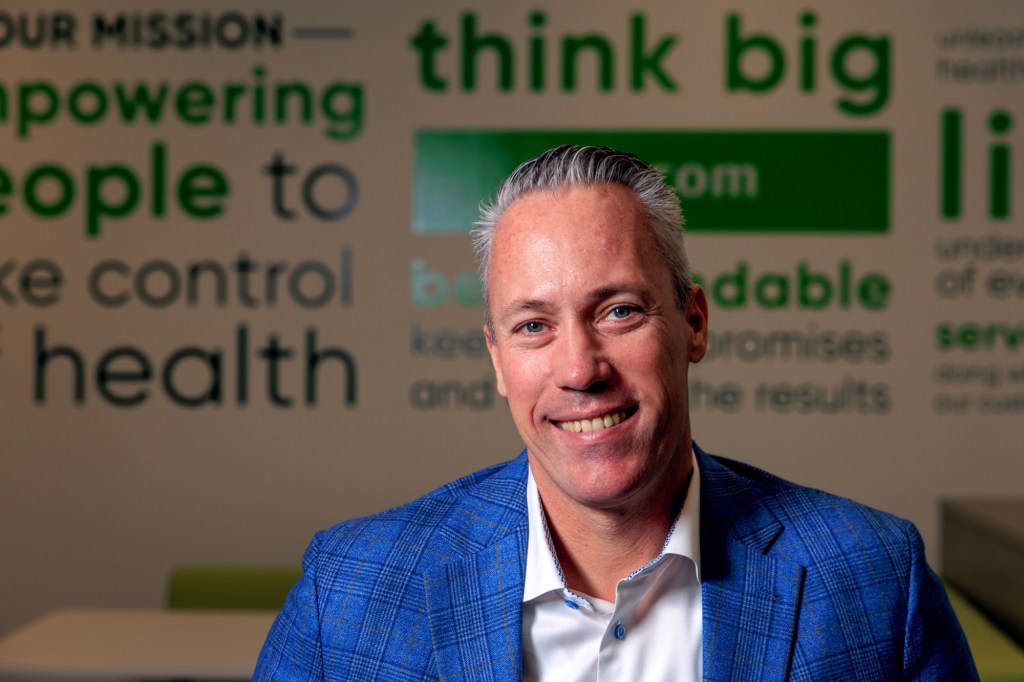
Jake Leach, who took over as Dexcom CEO today, wants you to wear one, too. The new chief executive is attempting to grow Dexcom’s customer base amid scrutiny after an FDA recall and manufacturing issues led to device shortages last year. Leach’s goal is to make sure “everybody who could benefit from a monitor has access.” The San Diego-based company develops and manufactures continuous glucose monitors — small, wearable sensors that track blood sugar levels every few minutes and deliver real-time data.
The importance of monitoring glucose levels is obvious for diabetics. They need to be alerted when blood sugar is low to prevent seizures and comas, and to watch out for elevated blood sugar, which can lead to heart disease, stroke, and in some cases, amputation of limbs.
About one in 10 Americans have diabetes and nearly half of the country is at risk for developing it. While the technology is designed for diabetics, Dexcom is seeing interest from health-conscious consumers.
Leach gave his personal trainer the consumer product, Stelo — a 15-day wearable glucose monitor that can be purchased on Amazon for $99. The sensor alerts users when blood sugar spikes and helps them understand how different foods affect their bodies.
The trainer found out he was struggling with prediabetes. “He actually is unbelievably physically fit. It wasn’t because of lack of exercise. It was really around diet,” said Leach.
After two months of using the CGM, the trainer was able to lower his blood sugar levels and reverse his prediabetes, Leach said.
Everyone knows to eat well and exercise, but “everybody’s unique. That’s one of the powerful things in CGM — it shows you what works and what doesn’t,” he said.
Leach uses a Stelo himself. His blood sugar spiked when he sipped his morning latte, so he switched from skim milk to whole milk, and it settled. (Skim milk has low fat and higher sugar content than whole, making it quick to absorb in the bloodstream causing spiked glucose levels.)
After 22 years at the company, Leach is taking the helm at Dexcom following Kevin Sayer’s 10-year tenure. (Sayer remains as chairman of the board.) Leach has worked at Dexcom since 2004. As a 26-year-old engineer, he’d compete with Medtronic and Abbott to roll out cutting-edge CGMs. One of the earliest iterations involved jerry-rigging a Motorola to enhance mobile connectivity, Leach laughed.
To maintain market share, Dexcom brings a new device to market every few years.
Dexcom’s newest device is the prescription G7 15-day glucose monitor. While the device retails for around $380, Dexcom discounts the device for anyone with a valid prescription and without coverage to below $200. A majority of users with insurance pay around $40, according to Dexcom.
Like the Stelo, the G7 sensor continuously tracks glucose levels for over two weeks and syncs with a smartphone. Its built‑in AI, powered by Google Gemini, analyzes how different foods affect blood sugar: Users snap a photo of their meal, and the AI analyzes the potential glucose impact.
The AI models are being trained based on current user activity. Down the road, “it’s going to start pointing out which ones are the best for you,” Leach said, providing personalized food insights for users.
When asked how Dexcom maintains data privacy between its prescription devices and consumer platforms, Leach said the company follows each country’s regulations. To share data, Dexcom needs user consent.
As the population of prediabetics increases, so does Dexcom’s earnings. In its most recent quarterly report, the company posted a profit of $283.8 million in Q3, up from $134.6 million in the same period last year. Revenue was $1.21 billion compared with $994 million a year ago.
Today, Dexcom serves over 3 million individuals, but Leach believes that he could reach millions more by increasing production — a new factory in Ireland is slated to open by the end of the year — and continuing to market Stelo to health-conscious consumers.
But Leach must expand carefully as major manufacturing problems and supply shortages defined much of Dexcom’s coverage last year.
In 2025, Dexcom shares fell more than 25%, driven largely by FDA warnings and a product recall.
Dexcom manufactured more than 100 million sensors but, due to difficulty scaling, was forced to recall over 700,000 CGMs and replace thousands more.
Posts on Reddit and Facebook show some users needing to replace dozens of devices a year due to monitor malfunctions, adhesive issues with the sensors and accuracy problems.
At the same time, Dexcom faced supply shortages, unable to provide monitors to diabetics while simultaneously producing the consumer product.
These supply shortages started after Dexcom had made major moves across its manufacturing sites.
In June 2024, it stopped manufacturing in San Diego and moved G6 and G7 sensor manufacturing operations to Mesa, Arizona. The company opened another facility in late 2024 in Batu Kawan Industrial Park in Malaysia.
Leach acknowledged the manufacturing issues: “We’ve done some pretty fundamental changes to the way we manage suppliers. It’s highly regulated, highly controlled, and it is life or death, so the quality of the products is paramount. As we’ve scaled, we’ve learned many things about how we can continue to get better.”
Leach and the engineering team spent significant time on the ground at each facility to ensure sensor quality. “It’s not just about ‘make this part to this spec.’ We’re going to go along the journey with you as a supplier and invest in you as a supplier.”
Now, Leach is confident Dexcom can supply across Europe, particularly Germany, and break into what he calls the “fastest growing region” — the Asia-Pacific, particularly India.
Leach believes the proliferation of these devices lies in partnerships. To date, Dexcom has over 90 partners, including Google, Oura and Levels — a CGM platform that caters to athletes.
In November 2024, Dexcom invested $75 million in Oura’s Series D funding. The Oura Ring tracks key health metrics to predict stress levels and readiness. Combined with Dexcom’s continuous glucose monitor, users can get a more holistic view of their health, explains Leach.
“Early on my job was figuring out how to make a sensor that could accurately measure glucose continuously,” said Leach. “Now my job is figuring out how to get that technology to as many people as possible.”