
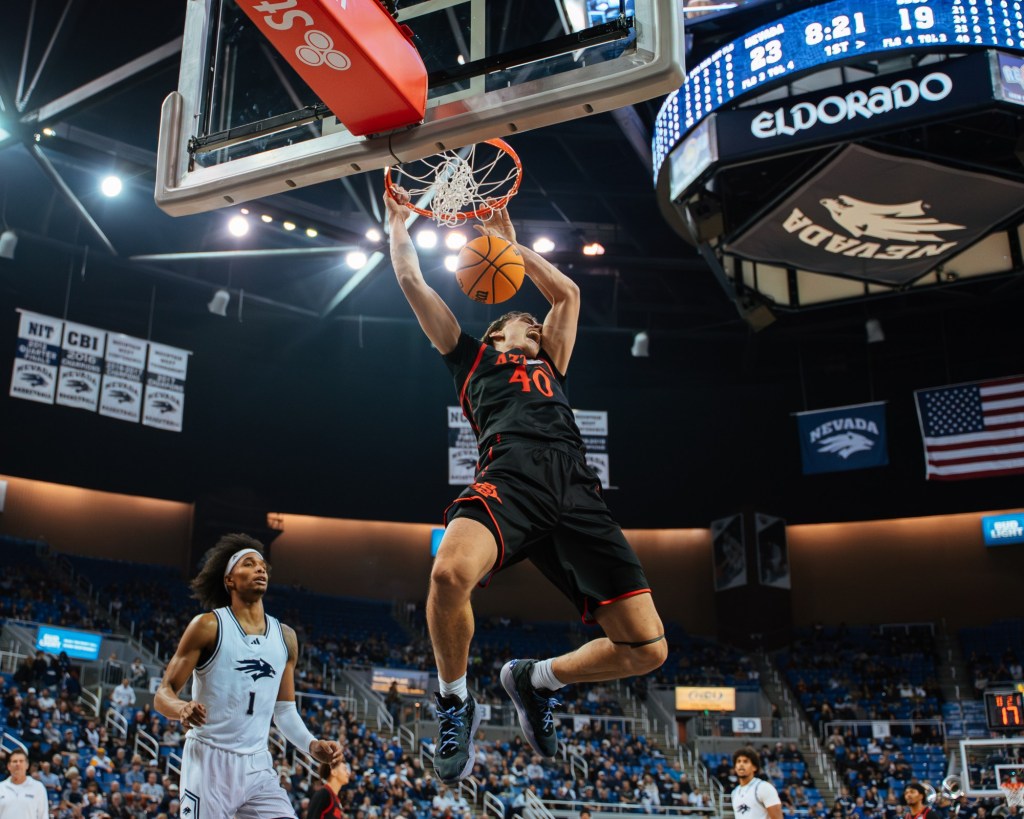
RENO, Nev. – Three thoughts on San Diego State’s 73-68 win at Nevada on Tuesday night:
1. The timeouts
You get four timeouts in college basketball. SDSU coach Brian Dutcher used three Tuesday, and all three tilted the outcome of a tight affair.
The first came just 3:52 in the game and the Aztecs down 12-2. The under-16 media timeout was seconds away, and his usual preference is to save them, letting his team sort through problems on its own early in games.
“We weren’t playing very well,” Dutcher said. “I wanted to get a timeout and not panic but let them know, ‘Come on, we’ve got to move better, we’ve got to spread them, we’ve got to be more active.’”
The Aztecs listened, and outscored the Wolf Pack 19-11 over the next seven minutes and climbing back in the game.
His second timeout came with 3:34 left and the Aztecs trailing by one, despite the next stoppage bringing a media timeout. But Dutcher’s team had scored on only one of its previous three possessions, and he had a set play in mind that required getting Magoon Gwath on the floor.
The timeout allowed him to sub in the 7-foot Gwath for 6-1 Sean Newman Jr., switching from a four-guard, one-big lineup to three guards and two bigs. Nevada either didn’t recognize it or did and opted not to counter by subbing in a forward of its own, keeping its small lineup on the floor.
The play had Gwath inbounding on the far sideline to BJ Davis, who passes to Miles Byrd at the top of the key. Gwath then heads to the block to set a screen for a curling Reese Dixon-Waters.
So it’s designed to get Dixon-Waters a jumper?
Nope. Gwath slips the screen and positions himself for a lob from Byrd.
It’s a play SDSU has run before and Nevada no doubt scouted. But the Wolf Pack likely repped it in practice with a forward covering Gwath, not 6-3 guard Amire Robinson.
Robinson got confused, tried to switch onto the curling Dixon-Waters while his defender, Chuck Bailey III, also trailed him to the wing, leaving Gwath alone under the basket for an easy dunk.
“We scored on it twice the year before against them,” Dutcher said. “It’s a play, to be honest, I run away from the opposition’s bench. Their whole bench was up, yelling: ‘Lob!’ But when the play is going on, these guys at this end can’t hear it. The coaches knew it was coming, but unfortunately – fortunately for us – their players didn’t recognize the play and we got Goon a dunk out of a timeout, which was really important.”
His third timeout, with 2:07 left in a one-point game, was expended for a coach’s video challenge on a possible flagrant foul against the Wolf Pack. In reality, it had little chance of being granted and Dutcher was merely buying a longer break than a 30-second timeout. The real purpose was to tweak their ball screen defense.
The Aztecs had been switching the point guard-center ball screens, which put guards on 6-9 bouncy Nevada forward Elijah Price under the basket. That led to numerous offensive rebounds and fouls on Price (he shot 12 free throws in the second half alone). Dutcher and his staff took off the switch, keeping 6-9 Miles Heide on Price.
What happens?
Nevada turns it over on its next two possessions and doesn’t make a basket in its final five.
2. Taj
When Dutcher put freshman guard Elzie Harrington into the starting lineup in the sixth game and demoted sophomore Taj DeGourville, he used Davis as an example for what DeGourville faced, noting the junior guard had worked through his disappointment about not starting and “came out the other side.”
Now DeGourville appears to be coming out of the other side.
He had arguably his best game of the season: 10 points, six rebounds and two assists and a team-best plus-11 points in his 20 minutes on the floor.
“You just have to fight your way to the other side,” Dutcher said. “He played well against Boise (on Saturday). We just didn’t get him in down the stretch, coach’s decision. But he’s played a couple good games in a row.
“He’s just a sophomore who is getting better. He’s in his second year. All the stuff he’s worked on for two years is starting to show in games. Not as many mistakes defensively. He had to major in the minor to be good. He’s doing all the little things better, and that’s all it takes.”
DeGourville credited a newfound aggression and “looking at the rim more” with flipping the switch. He took nine shots, his most since the season opener against Long Beach State, back when he was starting after winning the job during the slog of summer and fall practice.
“This is just one game,” DeGourville said. “Now I’ve got to do it again and again and again. Just staying strong mentally, to be honest. Anything can happen in any game, so it’s just being ready when my number’s called.
“Sometimes I feel like I’m a little passive, and today I played more aggressive and it opened up the game for me and my teammates.”
3. A new home
Viejas Arena is 28 years old. That’s one of the newest basketball venues in the Mountain West.
Four date to 1970 or earlier. Four others opened in the 1980s.
But just as SDSU is leaving, the conference is scheduled to get a sparkling new one. On Sept. 30, Reno’s Grand Sierra Resort broke ground on a $435 million arena that will replace 42-year-old Lawlor Events Center as the home of Nevada basketball.
The initial plan was to be ready for next season. That has been revised to 2027-28.
The project will receive nearly $70 million in tax-increment financing that created a stir among rival casino properties in Reno and was ultimately approved in a 5-2 vote last May by the city’s redevelopment agency.
Mountain West commissioner Gloria Nevarez spoke at the public board meeting, saying: “I think Reno deserves a venue like this and deserves this national attention.”
It is projected to seat 10,000 — about 1,000 fewer than Lawlor, which is beginning to show its age and had become a seasonal home for bats (that occasionally dive-bombed spectators and players during games) before a recent deterrent campaign seemed to work.
Lawlor, however, is across the street from thousands of student residences. Grand Sierra Resort is four miles away on the opposite side of downtown, about a 10-minute drive that could reduce already struggling student support.
And the Wolf Pack are stuck in the Mountain West as SDSU and four others join a relaunched Pac-12 next season that, with the addition of Gonzaga, should be a far superior basketball league.
“For us, it is about our opportunity as an athletics program to move forward,” athletic director Stephanie Rempe said at the May meeting. “And this is something that allows us to do things that we wouldn’t otherwise be able to do. You’ve heard me say this forever: It’s about creating a college town and getting this community behind it, behind us.
“There’s nothing that brings a community together like sports, and it helps us move the needle.”