
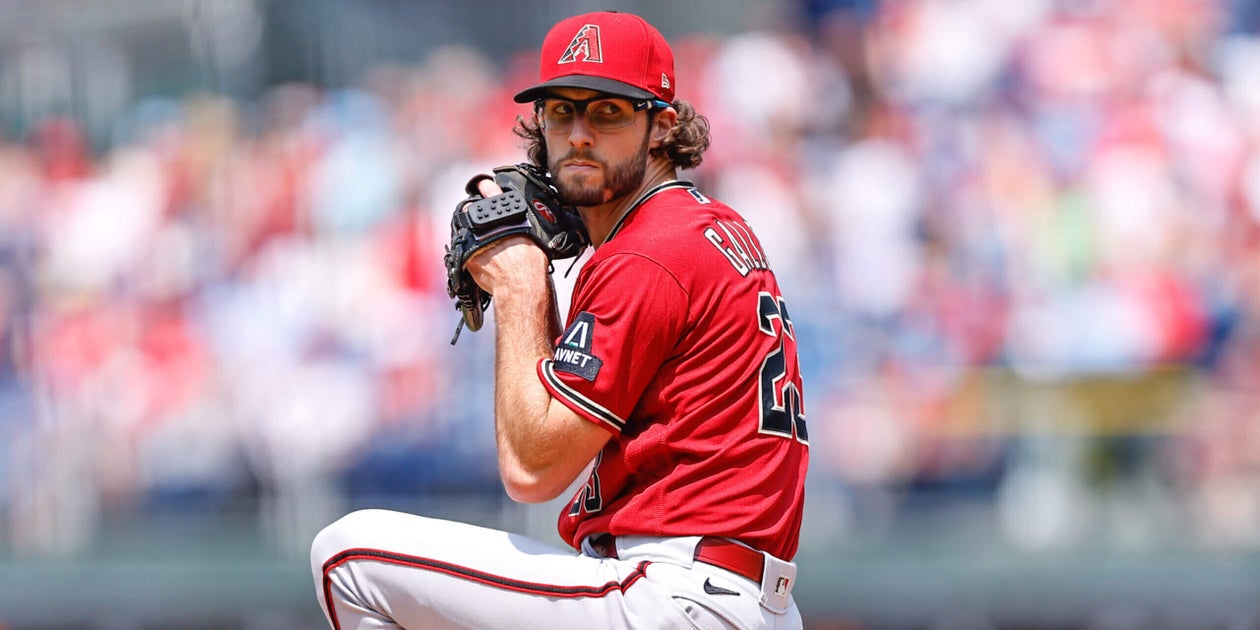
Zac Gallen isn’t on the San Francisco Giants yet, and you’re just as surprised as I am. The odds are always against the Giants signing a free agent who can help all 30 teams, but there’s something about the pairing that has felt natural since the offseason started. Familiar presence. Big ballpark. Eats innings. Good enough to start a Game 2 or 3 in a postseason series. There are concerns, which we’ll get to, but Gallen always been an easy free agent to imagine the Giants pursuing.
Except, as of this writing, it appears that nobody is pursuing him? That’s an oversimplification, but the last rumor about him logged on MLB Trade Rumors was over a month ago. It’s been a slow market for most pitchers, and Gallen was always likely to wait for other dominoes to fall before he signed. It’s still a curious lack of respect for a pitcher who has been an All-Star and had a top-10 finish in the Cy Young voting in three seasons.
Four months. That’s how long it takes to become an enigma. Gallen had a rough four months, followed by two solid months in 2025. The pitch data at Baseball Savant and FanGraphs didn’t care for his season at all, with enough blue ink on his Savant page to make you think he was on the Dodgers. If he repeats his 2025 season in a Giants uniform, he might as well be.
Do you know what came before those four months, though? About 25 months where Gallen was one of the better pitchers in baseball. Those months came over the span of six seasons, when he was almost certain to sign a contract with lots of zeros and commas. It should be hard for four months to spoil that kind of momentum, but here we are.
Zac Gallen could be exactly what the Giants are looking for, unless he’s an abject disaster, or unless he’s somewhere in the middle. Welcome to the most confusing free agent of the season.
Why the Giants would want Zac Gallen
First, note that Gallen is just 30, which is about three years younger than I would have guessed. Watching him make a couple dozen starts against the Giants over the years can warp your perspective, but he’s the same age that Kevin Gausman was in his breakout season. Gallen isn’t a grizzled vet, and he doesn’t have to fade away because of age for a few years yet.
Now consider that he doesn’t have major red flags, physically speaking. His fastball averaged 93.4 MPH in 2021, and it averaged 93.5 MPH last season. He’s made an average of 32 starts over the last four seasons, and he’s been on the IL just twice since July 2021, both times with a hamstring strain. Even last season, when he often scuffled and had nightmare innings that ruined an entire outing, he finished third in the National League in innings pitched, behind only Logan Webb and Cristopher Sánchez.
There is the more important issue of run prevention, yes, but for a team that’s trying to build a bullpen out of wattle and daub and counting on oft-injured pitchers to fill out the rotation, it would be a huge boon just to have another innings-eater in the rotation. This is how Gallen was still a positive contributor to the Diamondbacks last season according to WAR, even as his ERA ranked 45th out of 52 qualified starters. Just taking the ball has value.
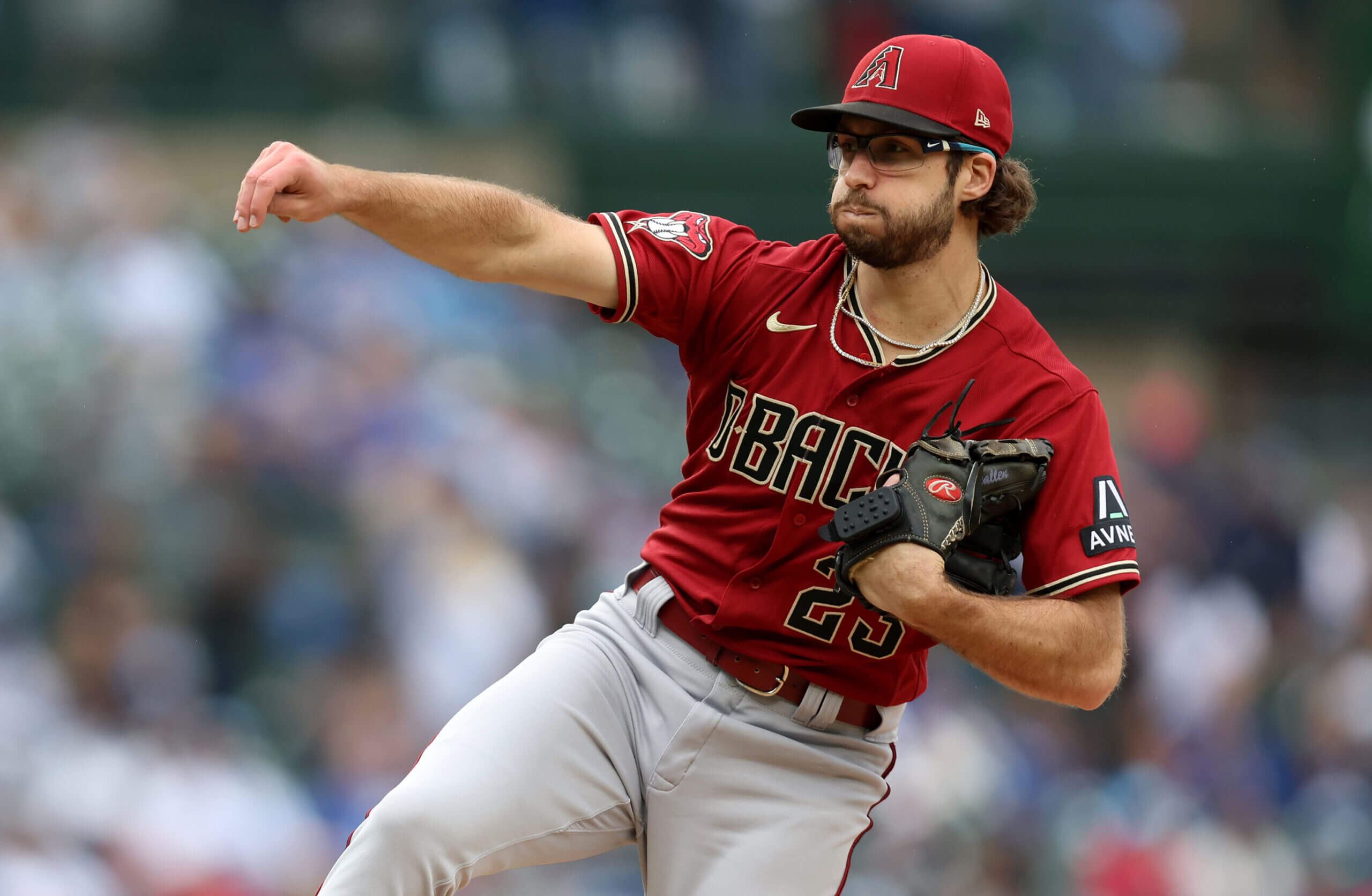
Gallen has been a reliable workhorse for the past six seasons. (Chris Sweda / Chicago Tribune / Tribune News Service via Getty Images)
Of course, the Giants would also be paying Gallen to pitch effectively, which he did from June 2019 until April 2025, give or take, before starting back up again in August 2025. If you’re worried about the questionable Savant metrics, note that they’ve never quite known what to do with a pitcher like Gallen. In 2024, the data suggested he was a pitcher with breaking pitches of the gods. In 2025, it showed the exact opposite, with some of the worst numbers in the game. His fastball has been his best pitch, his worst pitch and everywhere in between, according to the metrics, with his breaking and offspeed pitches also following the same pattern. He’s never exactly been a ground-ball pitcher, but he had a long history of keeping the ball in the ballpark before last season, which is always tricky to do in Arizona.
The best part, at least from a front-office wonk’s perspective, is that Gallen isn’t likely to want a long-term, guaranteed deal. That’s just a guess, and it’s always possible that he wants to make this his last big free-agent spin, even if it costs him tens of millions. But he fits the profile of a pitcher who would want to get back on the market right away, even with the possibility of a labor dispute. If he has another season like 2024, he’ll make a lot more money on a longer contract. If he has another season like 2022, forget about it. He’ll make Gerrit Cole money, then.
The Giants would much rather pay Gallen — or any pitcher, really — for a single season. There’s still the risk of paying him in 2027 if he gets hurt and exercises a player option, but that’s still the equivalent of a two-year deal. Most pitchers with Gallen’s upside don’t come on two-year deals. If this is the case, and he’s not looking for a five-, six- or seven-year deal, it would be hard to find a better fit.
The words “Gallen’s upside” are carrying a lot of weight in the above paragraph, though. Now we have to look at what happens if the upside is a mirage.
Why the Giants wouldn’t want Zac Gallen
The first reason is a simple one: He’ll cost the Giants a draft pick. It wouldn’t be the No. 4 pick they somehow lucked into — that one is protected — but they’d lose their second-highest pick (a high second-rounder), as well as $500,000 in international bonus money. That makes acquiring Gallen almost like making a deadline trade. The Giants might be better served by drafting the prospect they want and trading others they’re less enamored with at the deadline, making do with Adrian Houser, Tyler Mahle and the gaggle of Triple-A starters until then.
Furthermore, while Gallen has stayed healthy and continued to pile up innings, his strikeout rate dipped last season, and the reasons aren’t complicated. Batters made a lot of contact when he threw pitches in the strike zone, which he did often. They didn’t swing as much at the pitches he threw outside of the strike zone, which they had done in previous seasons. You can tell yourself that it’s a blip, and you might be right. But that doesn’t answer the most important question: Why?
If the Giants’ pitching braintrust doesn’t have a great answer for that question, perhaps they’ll favor the “blip” hypothesis. We’ve all seen Logan Webb’s strikeout rates fluctuate over the years, mostly because he’s always been a contact-oriented pitcher. Gallen’s pitching style is closer to Webb’s than the typical No. 1 starter, and maybe his problem last year was simply biting off too much of the plate at the worst possible times. (The Diamondbacks have a perfectly fine pitch framer behind the plate, too, in case you were wondering.)
My guess, though, is that they can identify a reason or multiple reasons why the strikeout rate dropped. Something about the arm slot, or supination, or spin rate, or … look, Eno Sarris is over here, go ask him. But for what it’s worth, Eno was lower on Gallen than his colleagues when they ranked the offseason’s free agents. And whatever was missing from Gallen’s repertoire of out-pitches in 2025 isn’t guaranteed to return.
Without a strikeout pitch, congratulations: You’re signing Jeff Samardzija. That’s not always a bad thing, and you can make the case that Samardzija was one of the better values the Giants have gotten in free agency. But it’s about as exciting as you remember, with ERAs that varied wildly, and a heaping pile of innings that helped in ways that you didn’t think about when he, yet again, was walking off the mound with one out and the bases loaded in the sixth inning.
The real reason the Giants wouldn’t want Gallen, though? Opportunity cost. They’d probably get value out of him, but they might project to get more out of another pitcher who is still available.
Verdict
If the offseason starts winding down and the Giants are still without someone to slot between or behind Webb and Robbie Ray, it would be a perfectly reasonable risk to sign Gallen to a two-year deal (or a one-year with a player option). As of right now, though, there are still better pitchers available. Framber Valdez is still out there, and so is Ranger Suárez, who might be just as talented. Chris Bassitt would also help absorb innings, and he could be a better bet to prevent runs, at a lower cost and without the draft-pick penalty. There are pitchers to trade for, some of whom are years away from free agency. Some trade targets are available explicitly because they’re going to be free agents, and that’s fine too.
Gallen to the Giants makes a lot of sense, and you shouldn’t think of him as a last resort. It’s a high floor and at least a moderately high ceiling. But he’s not the best option, even in early January. They’ve been patient so far. They can remain patient for a little while yet.