
This story is part of our January 2026 issue. To read the print version, click here.
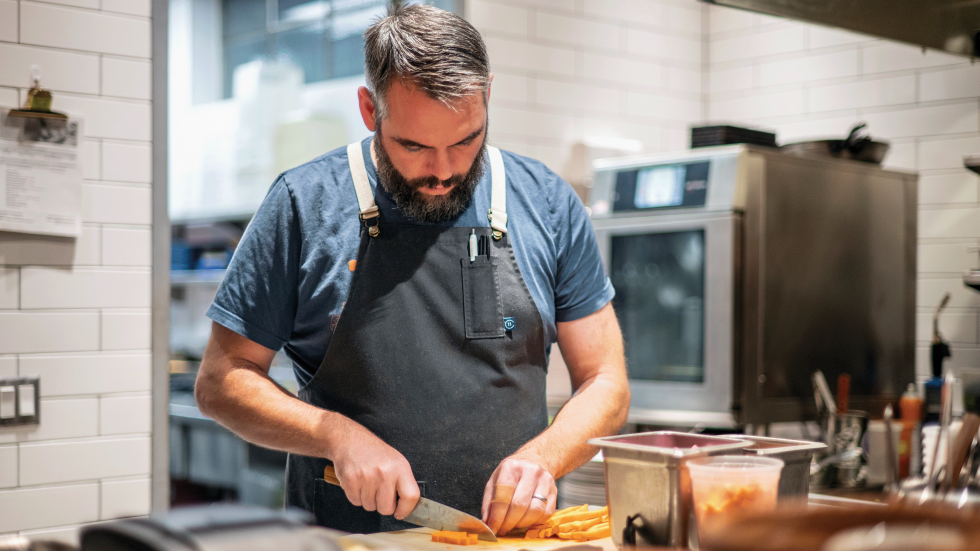
It’s late November at Canon, and Brad Cecchi is out on a
last-minute supermarket run, picking up a couple of gallons of
milk so his staff can finish preparing and packing up 65
Thanksgiving dinners for customers who don’t wish to make their
own holiday meals this year. Within a couple of hours, he’ll be
in the kitchen, overseeing Saturday night dinner service at the
popular East Sacramento restaurant he opened to great acclaim in
2017.
It’s been a busy autumn for Cecchi, who sits atop a booming
multiverse that includes three restaurants, a design consulting
business, a prepared meal program and a food innovation
incubator. But when Canon’s executive chef left in October,
Cecchi willingly jumped back into the kitchen full time, a job
that eats up 60 to 80 hours of his week. Finding a replacement
can wait. “I have to put in the time to usher in the next 10
years of Canon,” says Cecchi, who just signed a new, decade-long
lease on the restaurant space. Being a hands-on,
in-the-kitchen-all-the-time chef for a few months will give him
the chance to see what’s working and what needs tweaking.

The badger flame beet salad from Canon restaurant’s inventive
small plates menu.
Some chefs live to cook. Others love to open
restaurants. Cecchi is a different kind of chef: a
community-minded advocate and entrepreneur who sees everything
through the lens of food.
It wasn’t always like that. Like many young chefs, he had stars
in his eyes — Michelin stars. After graduating from El Camino
Fundamental High School in Carmichael, he attended the vaunted
Culinary Institute of America at Hyde Park in New York. Returning
home, he helped open Grange, the chic farm-to-fork restaurant
inside The Citizen Hotel in downtown Sacramento, starting as a
line cook and eventually working his way up to executive sous
chef.
Diving into the city’s fledgling farm-to-fork scene, he impressed
local chefs and restaurateurs, including Clay Nutting, co-owner
of LowBrau Bierhalle and, later, Block Butcher Bar. Nutting tried
to hire him away, but Cecchi had bigger ambitions.
In order to level up as a chef, Cecchi had already decided he
would have to leave Sacramento. So he moved to Cleveland to run
the restaurant and food operations at a Grange-like restaurant at
a Westin hotel. After less than a year, he returned to
California, working at Solbar restaurant in Calistoga’s Solage
luxury resort, first as chef de cuisine and then as executive
chef. While he was there, Solbar earned a Michelin star — twice.
Meanwhile, Nutting had been keeping tabs on Cecchi’s career from
afar. After splitting from his LowBrau partner to open his own
restaurant, “Brad was the first person I thought of” as executive
chef, Nutting says. But while Nutting wanted an employee, Cecchi
wanted a partner. After some back and forth, they sealed a deal
to become 50-50 partners in Canon.
“He’s an extremely talented chef. A hard worker. Incredibly
humble. Very kind. He lifts heavy things. He doesn’t need
direction or the spotlight. It sounds like I’m writing his
dating profile.”
— Mike Testa, president and CEO,
Visit Sacramento
There, Cecchi wowed Sacramento diners with bold global flavors
and artistic small plates that begged to be shared — dishes such
as housemade tater tots with a 60-ingredient mole, and chicken
drumsticks in Urfa chile sauce with yogurt. Larger platters, also
meant for sharing, might include a bison rib eye or roasted
steelhead trout in lobster broth. His food, never bashful, had as
many as a dozen complicated “touches” — chef speak for garnishes
and other additions.
At the age of 34, Cecchi had achieved his dream: back in his
hometown, running his own restaurant, cooking his food his way.
In 2019, the Michelin Guide rewarded Canon with a Bib Gourmand, a
designation for restaurants that offer cooking of excellent
quality at great value. At that point, many chefs would look for
other culinary hills to climb: reaching for a Michelin star,
perhaps, or opening a new restaurant.
Not Cecchi.
Related: Star Power: The
Michelin guide helps put Sacramento restaurants on the map
Instead, he waded into community waters, seemingly doing
everything everywhere all at once, cheffing it up at local events
like the Farm-to-Fork Festival, the Tower Bridge Dinner and Bacon
Fest. Mike Testa, president and CEO of Visit Sacramento, the
city’s tourism board, met Cecchi more than a decade ago in the
run-up to the inaugural Tower Bridge Dinner. An unabashed admirer
as well as a friend, Testa ticks off Cecchi’s positive
attributes: “He’s an extremely talented chef. A hard worker.
Incredibly humble. Very kind. He lifts heavy things. He doesn’t
need direction or the spotlight.” Testa stops short and says with
a laugh, “It sounds like I’m writing his dating profile.”

Chef Brad Cecchi just signed a new 10-year lease for his East
Sacramento restaurant Canon.
After Michelin published its first statewide
California guide, which included Sacramento, Testa wanted to
quantify the effect that Michelin recognition had on local
restaurants. He reached out to Cecchi, who told him that after
receiving its Bib Gourmand, Canon sold out its Christmas and
holiday parties — in June.
In 2024, Cecchi used his formidable skills to help Testa bring
Terra Madre Americas to Sacramento. The three-day event — part
conference, part street fest — was held for the first time this
past September at SAFE Credit Union Convention Center downtown,
drawing a stunning 165,000 people from the region and beyond.
Visit Sacramento signed a 10-year contract with Slow Food
International to host the event every other year, alternating
years with Slow Food’s massive Terra Madre Salone del Gusto in
Turin, Italy. The hope is that the event will put Sacramento on
the global food map and cement Sacramento’s place as a culinary
tourist attraction, the way it has for Turin. In the lead-up to
the conference, Cecchi proclaimed Terra Madre “our Super Bowl,
our Olympics, our Ryder Cup, all the things rolled into one.”
Testa ended up inviting Cecchi to join Visit Sacramento’s board,
and the chef now serves as the organization’s culinary adviser as
well as culinary director of Terra Madre.

A cooking demonstration at Terra Madre Americas in Sacramento
(Photo courtesy of Visit Sacramento)
With Nutting, Cecchi eventually opened a second restaurant,
Franquette, in West Sacramento two years ago. More casual than
Canon, it’s part of Fulcrum Property Group developer Mark
Friedman’s Bridge District project. Cecchi began advising
Friedman and other developers on how to design new restaurant
spaces so tenants wouldn’t have to invest beaucoup bucks on basic
improvements.
Related: Wine
Bar Brings Punk Art to West Sacramento’s Bridge District
A third Cecchi-Nutting restaurant, Cantina Pedregal, opened in
2024 in Folsom. A collaboration between Cecchi, Nutting and
Roseville restaurateurs Patricio Wise and Cinthia Martinez, it
was a rare misfire.
Cecchi and Nutting had looked at a space that had
recently housed a pizzeria and thought it was perfect for a
second outpost of Nixtaco, the hip Roseville taqueria that also
boasts a Bib Gourmand. Instead, the foursome — all friends — took
a flyer on a chef-driven restaurant, heavy on technique and
presentation (Cecchi’s specialties) and focused on the cuisine of
Northeastern Mexico (Wise and Martinez’s homeland). While the
restaurant received a lot of buzz from foodies, including Eater
SF, Folsom suburbanites didn’t embrace the concept. Eventually,
Cecchi’s initial instinct proved correct: The space now houses
another Nixtaco, with Cecchi and Nutting retaining their
ownership stake.
“Doing business in restaurants isn’t what it used to be,” Cecchi
says. “The ability to make money is much more difficult.”
The COVID-19 pandemic marked another shift in Cecchi’s
development as a chef and business person. In 2020, he signed on
for the James Beard Foundation’s prestigious Bootcamp for Policy
and Change. Cecchi came out of the program fired up. “I found my
advocacy voice,” he says.
As the hospitality industry reeled from the pandemic’s
government-mandated restaurant closures, Cecchi, Nutting and Chef
Patrick Mulvaney created a program called Family Meal to support
local restaurant workers and farmers. Canon and Mulvaney’s
B&L turned their restaurant spaces into commissary kitchens
that eventually produced more than 2 million packaged meals for
low-income families, seniors and others in need. He’s now working
with local health systems UC Davis and Kaiser Permanente, along
with the United Way, to turn Family Meal into a medically
tailored prepared meal program for at-risk populations such as
Afghan refugees and young people exiting the foster care system.
Related: How
Are Sacramento Restaurants Handling the Coronavirus?
Cecchi has also teamed up with Honey Agency founder Meghan
Phillips to start an organization called Food Frontier. “The
future of food is challenging us as the population grows
globally,” he explains. Cecchi believes the Sacramento region
could become the Silicon Valley of food: an innovation center
that finds solutions to meal insecurity and other issues around
food. This past June, the group took two dozen local business
leaders to Europe to learn about food innovation at Wageningen
University in the Netherlands and tour food research stations in
Belgium.

A panorama of the campus of Wageningen University in the
Netherlands. (Photo by Van Gooien via Wikimedia Commons, licensed
under CC BY-SA 4.0)
Before Cecchi jumped back into the kitchen last autumn, you were
more likely to find him wearing a collared shirt and nice jeans
than a chef’s jacket as he pursued the many avenues that take up
his typical day. Now back in chef’s whites at the age of 42, he
has discovered that his cooking has changed as he has matured.
“I’m different, and so is my food,” he says. “There are fewer
‘touches’ than before. What I really enjoy is taking the bounty
of Northern California and the techniques I love and mashing them
together.
“Being a chef is hard,” he continues. “It’s a labor of love. But
I couldn’t imagine doing anything else. All the moving around I
did, it was always to find my way home.”
–
Stay up to date on business in the Capital Region:
Subscribe to the Comstock’s newsletter
today.