
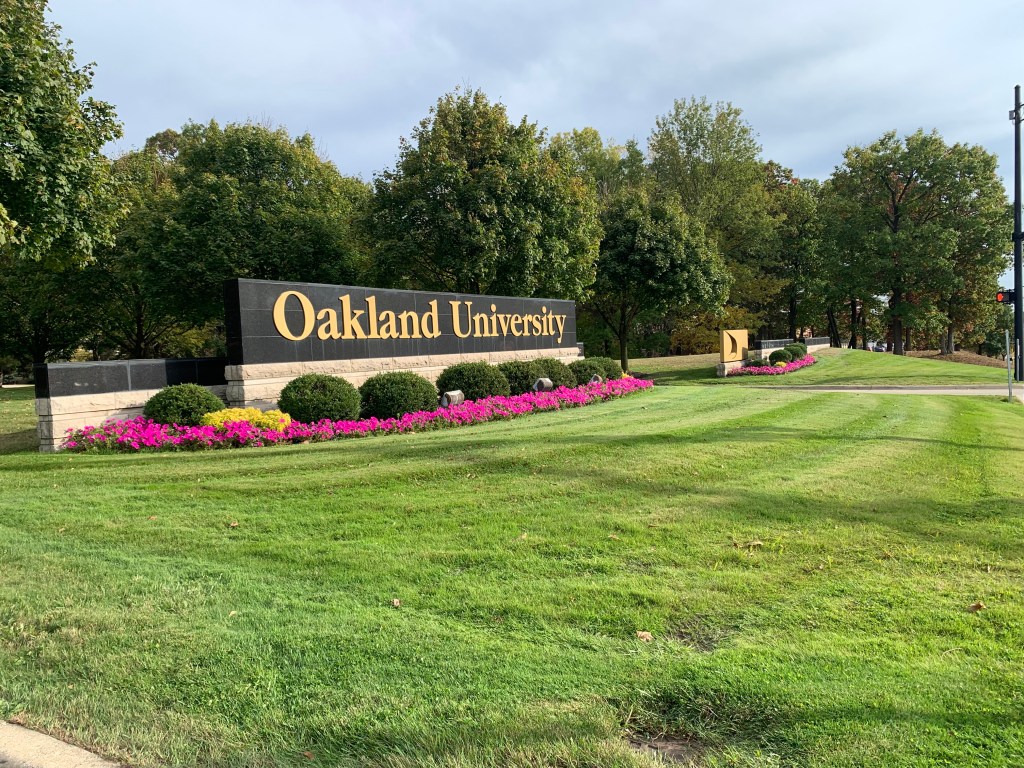
Oakland University is moving forward with a new data center with an industry partner to take advantage of open space and access to a power source on campus.
They have chosen Ohio-based Fairmount Properties to work on a new building located in Parking Lot 35, on the southwest end of campus adjacent to a DTE substation. It would include space to relocate OU’s current data center in Dodge Hall so the university can expand its research space and new artificial intelligence institute.
The university will be looking for tenants for the 26 megawatt data center.
Penny Vigneau, OU’s executive director for Economic Development, and Steven Mackey, senior vice president for Finance and Administration, gave an overview of the project to OU students last November.
“We can partner with the data center and the tenants on different types of academic programs whether it be data center operations, data center safety, or cyber-security,” said Vigneau. “We want to participate with these tenants with data that is actually in the center and do research, whether that is (artificial intelligence), whether it’s related to education. All of those fields that are important to OU, those are the tenants we want to see.”
The proposed data center is different from larger data centers that have been in the news over the past year.
The Edge and hyperscale data centers are distinguished by two main elements: physical proximity to the end-user and physical size of the data center.
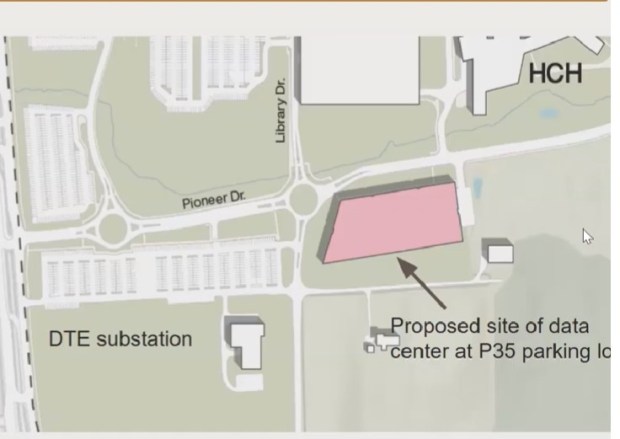 The proposed building would be located on the southwest end of OU’s campus. It was chosen based on its proximity to a DTE substation.
Photo courtesy OU
Edge data centers are located closer to the end-user and are often smaller in size. They can be onsite in an urban office or local warehouse, in cell towers, or in regional centers. Size constraints often mean edge data centers consume less energy because they are equipped with less local processing power.
Hyperscale data centers typically built in rural areas spread out over hundreds of acres, often for one user such as Google or Microsoft and are pumped with enough energy to power cities.
“While OU may attract hyperscale-level tenants, this is not a hyperscale data center,” said Vigneau. “Hyperscale data centers (are) those are extremely large facilities with thousands of servers. This is not that.”
There was no cost estimate given for the building, but the cost would be covered by Fairmont, who would work with OU to vet tenants for the building.
But the project is far from guaranteed.
OU will sign a contract with a firm within the next week to conduct a feasibility study which will include an environmental site assessment, evaluate utility services, site plan options, test for market potential for prospective tenants and find out if internet service providers have the bandwidth to support it.
The university will also create a website for information on the project, hold feedback sessions and continue with presentations around campus.
Mackey said he expects to complete due diligence by spring or summer 2026, before going to OU’s board with a business plan.
“It will be a very transparent process, but we are only at the start right now,” said Mackey. “There will be a feasibility phase, a due diligence phase and then we will construct. If we get to the point where due diligence is a go, then we will be moving into the phase of development which is where we put a shovel into the ground.”
“We are just starting this process to see if this is even going to work,” said Vigneau.