
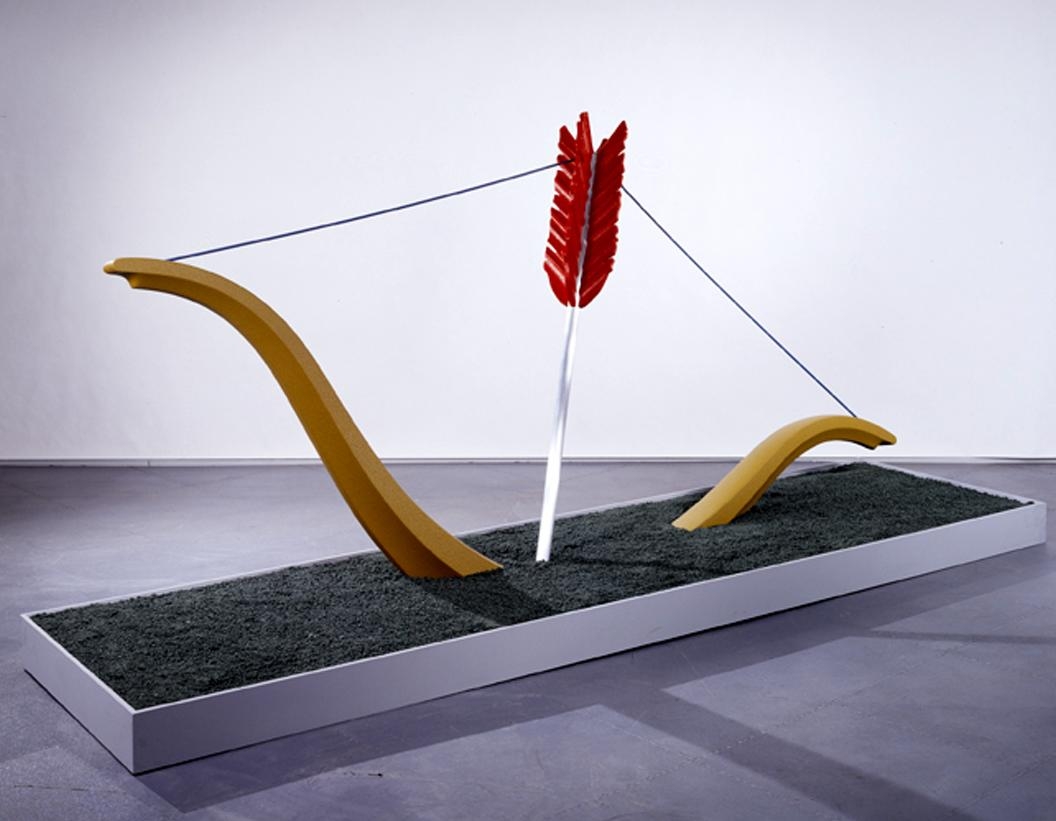
The show is a revision of what is known as a “white cube gallery,” a stark white-walled presentation of objects typically without much explanation. The inspiration for Apple Stores and third-wave coffee shops was a type of purist modernism championed by mid-20th-century art critic Clement Greenberg. For SFMOMA’s Chief Education and Community Engagement Officer Gamynne Guillotte, the white cube gallery is now a “period room,” an inherited historical vestige she describes as “an austere white space, the hard benches with no place to sit.”
“What is the museum of 2026?” Guillotte asks. “What does it look like if it’s not a white cube?”
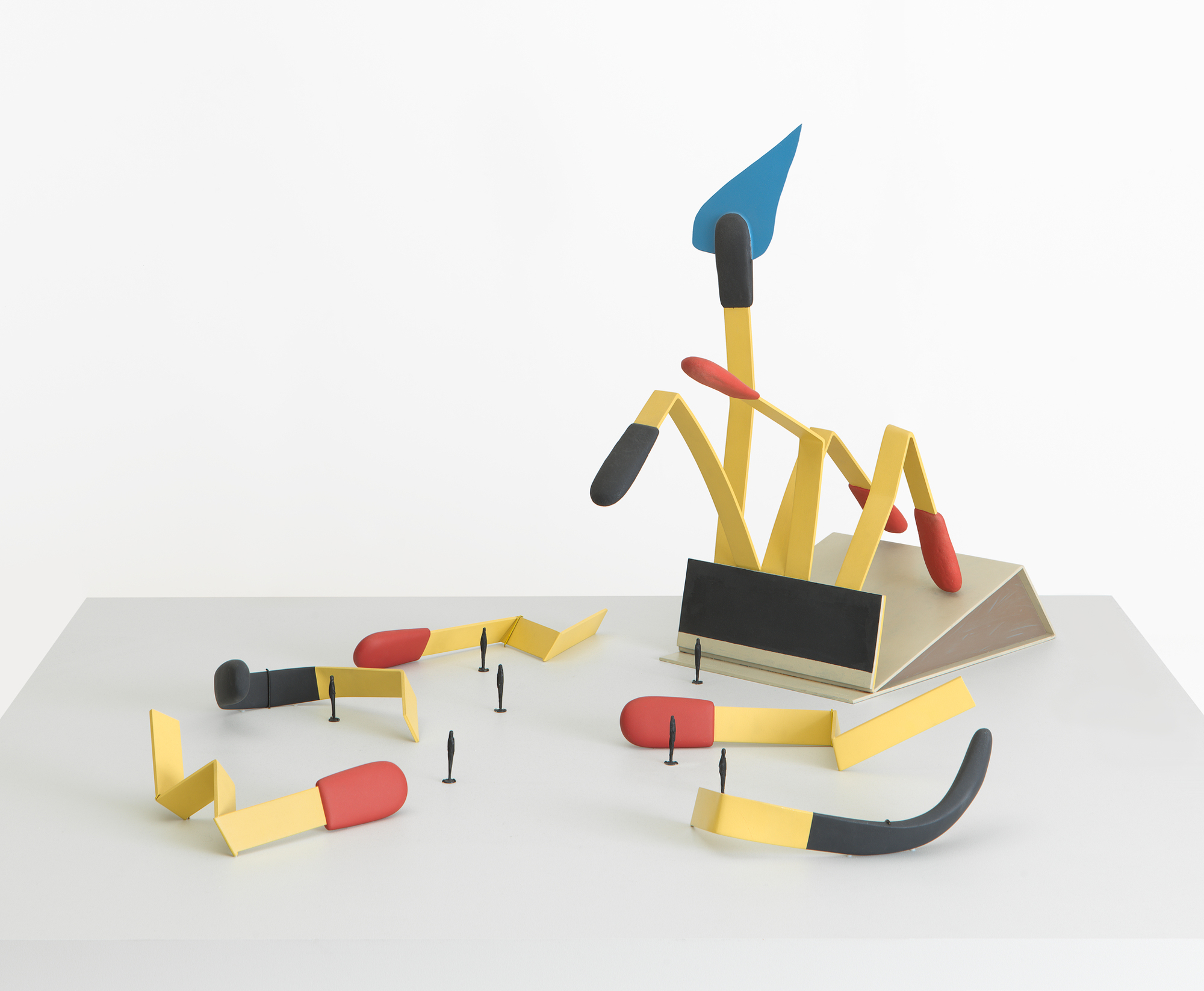 Claes Oldenburg and Coosje van Bruggen, ‘Sculpture in the Form of a Match Cover,’ 1987. (SFMOMA)
Private money, public spaces
Thinking Big arrives in a city that is not at all sure what it wants to do about public sculpture. Controversially, the Vaillancourt Fountain is slated for storage, while a billionaire’s foundation has circumvented the San Francisco Art Commission’s review processes to install a sculpture of a giant nude woman outside the Ferry Building.
The persistent — and unsubstantiated — rumor that Cupid’s Span was commissioned to prevent any building from ever blocking the bay view from Gap’s headquarters across the street indicates a longstanding discomfort with the outsized power wealthy individuals wield to shape space for everyone.
Ted Mann, SFMOMA’s project assistant curator for the Fisher Collection, noted that the Fishers did not dictate the form of Cupid’s Span nor would van Bruggen and Oldenburg have accepted it: “They really insisted that they maintain full authorship and control over the work.”
Oldenburg and van Bruggen
Claes Oldenburg (1929–2022) and Coosje van Bruggen (1942–2009) began their three-decade-long collaboration in 1976, one year after they met. Oldenburg was installing a sculpture at the Kröller-Müller Museum in the Netherlands, where van Bruggen was working as a curator. They wed in 1977.
Oldenburg had built his career with renditions of everyday objects that playfully flipped their characteristics. Small objects became large. Hard objects became comically soft — e.g., Soft Typewriter, a collapsing vinyl pillow of a nonfunctional machine. Van Bruggen studied art history at the University of Groningen before working as a curator at the Stedelijk Museum in Amsterdam.
Their collaborations are characterized by humor and a novel approach to monuments. (It was van Bruggen’s idea to point the arrow of Cupid’s Span into the ground as if the god of love had crashed into San Francisco, leaving more than just his heart behind.)
As might be expected, a fabrication model of the sculpture is on view in Thinking Big. “The Fisher Collection is amazing,” says Mann. “It has enabled the museum by bringing works that the museum would not otherwise have the capacity to collect from a high-value perspective.”
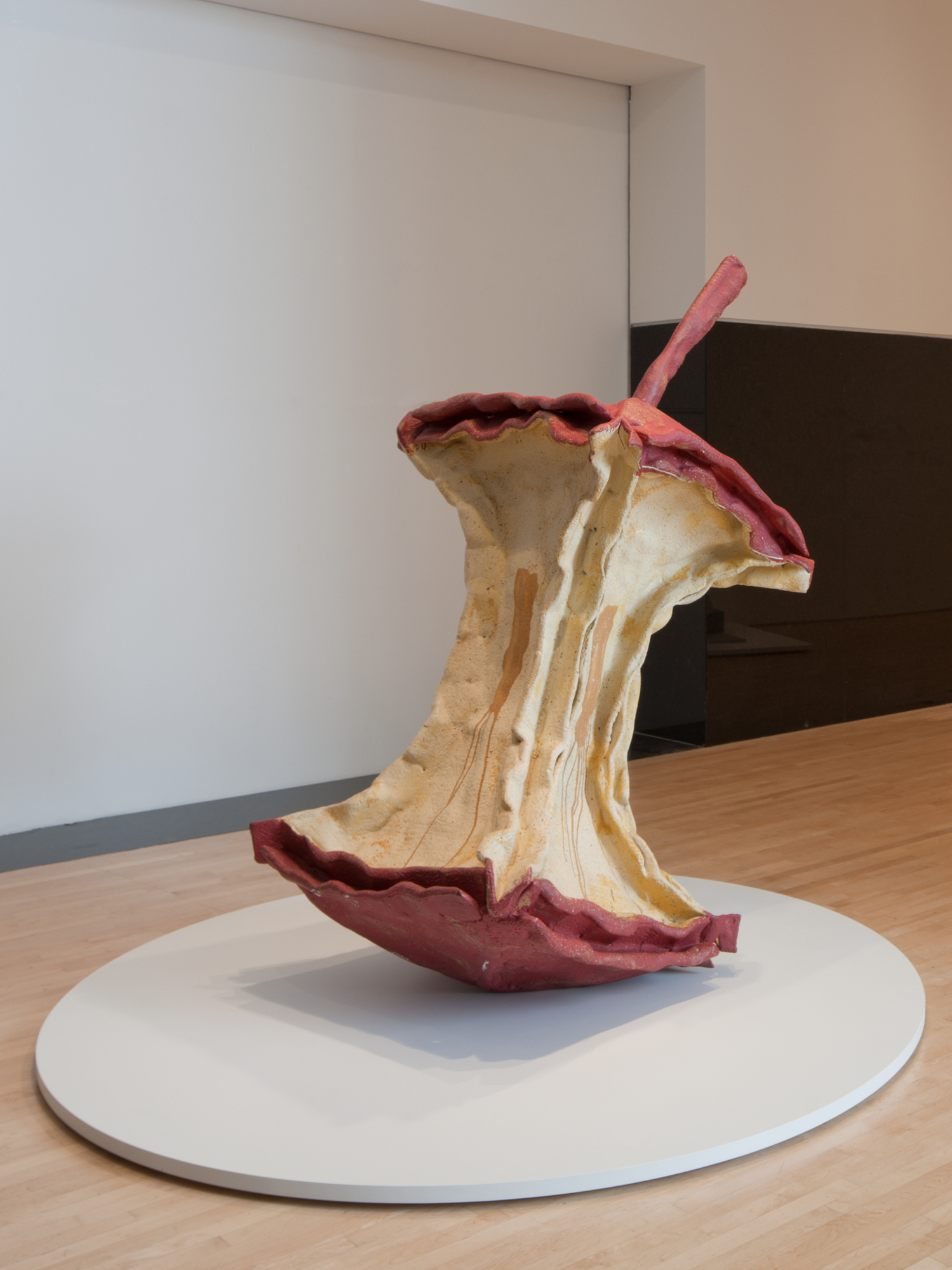 Claes Oldenburg and Coosje van Bruggen, ‘Geometric Apple Core,’ 1991. (SFMOMA)
It’s true, we are lucky to be able to see playful works like Oldenburg and van Bruggen’s Inverted Tie in person. At the same time, we might wonder how the choices made by private collectors shape the histories of art presented by museums.
The full-scale Inverted Tie, a striped necktie coiling upwards like a charmed snake, stands in the middle of Frankfurt’s banking district. Made for DZ Bank, the 39-foot-tall sculpture pokes fun at the strangled and strangling habits of white-collar life.
“Coosje especially talks about [their sculptures] as kind of humane statements because there is this relation to the human body,” Mann says. At full scale, their monuments skewer domesticity with humor — it’s an effect that doesn’t quite happen at two to three feet. The museum visitor instead regards someone else’s domesticity: the unusually famous and unusually valuable personal art collection of the Fishers. Did they keep the maquettes in their living room?