
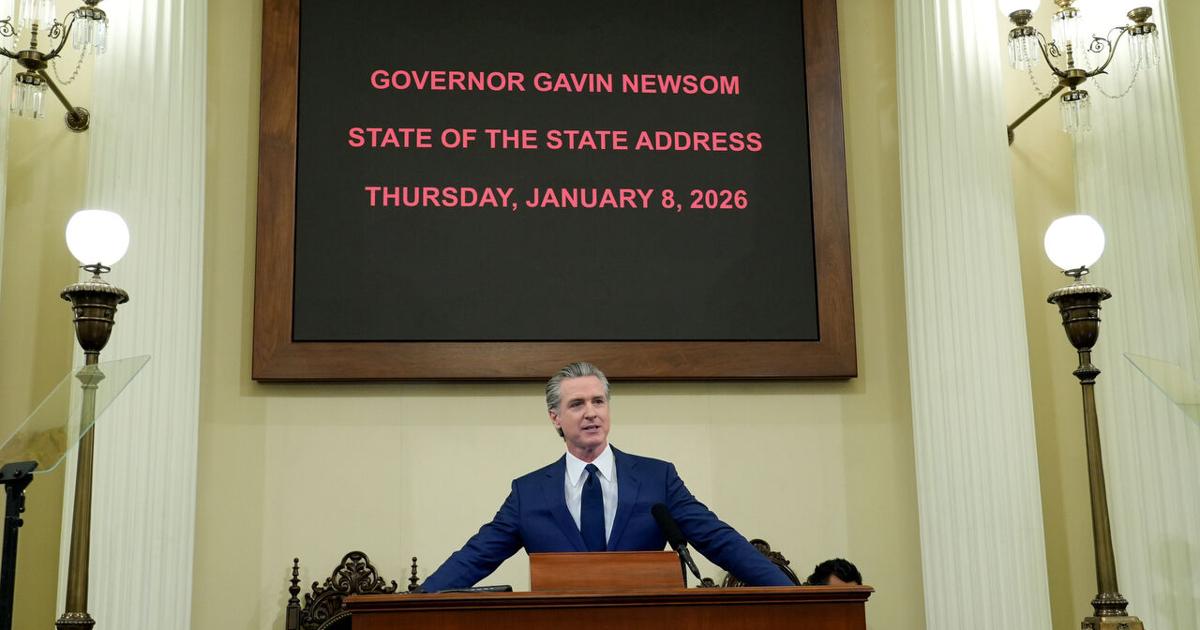

California Governor Gavin Newsom delivers his State of the State address at the State Capitol in Sacramento, Calif., Jan. 8, 2026. (Rich Pedroncelli for POLITICO)
Rich Pedroncelli
In his final address to the state of California, Governor Gavin Newsom painted a positive outlook for the state. The governor focused on the state’s affordability goals, achievements in education and technology and used his time to renew his criticisms of President Donald Trump’s leadership.
Thursday’s State of the State address served as Newsom’s final chance to address the State Legislature and provide a snapshot of California’s present and future before the end of his term in November.
“For 175 years, California has been a marvel of invention and reinvention, disaster and recovery, grit and ingenuity,” said Newsom, adding “we have found a way to build the future, over and over. But today, that California spirit is being tested. We face an assault on our values unlike anything I have seen in my lifetime.”
Newsom got his Trump punches in early, calling out the president’s immigration crackdown and tactics, as well as the deployment of the California National Guard, which a federal judge later declared unlawful and unnecessary. The governor said the federal government has become “unrecognizable,” and is relying on fear to lead.
“Secret police, businesses raided, windows smashed, citizens detained, masked men snatching people in broad daylight, using American cities as training grounds for the US military – purposeful chaos emanating from the White House,” said Newsom.
Before the governor took his perch on the Assembly Floor, Assembly Speaker Robert Rivas led the Assembly chamber in a moment of silence for Renee Nicole Good, the 37-year-old U.S. citizen killed by an ICE agent in Minneapolis on Wednesday. Rivas also took the moment to speak against ICE’s “deplorable” treatment of immigrants.
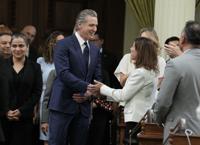
California Gov. Gavin Newsom is greeted by members of the Legislature as he enters the Assembly Chambers to deliver his final State of the State address before a joint session of the legislature at the Capitol in Sacramento, Calif., on Jan. 8, 2026. (Rich Pedroncelli for POLITICO)
Rich Pedroncelli for POLITICO
A point of pride for the governor, Newsom focused some of his speech on the state’s strides in education. In particular, the governor shouted out the Los Angeles Unified School District (LAUSD) for its gains in test scores, specifically for Black and Latino students.
Last year’s state test data showed the rate of students who met or exceeded the standard in English Language Arts increased by 3.4%, 3.9% in math and 3.3% in science; these are the highest recorded levels for LAUSD students since the statewide Smarter Balanced Assessment launched in 2015.
“To the teachers, classified employees and the parents of LAUSD: you should be proud of the progress you’re making, and particularly proud of the leadership of Superintendent Alberto Carvalho, who is here today,” Newsom said. “Under his stewardship, the district is outpacing statewide progress, exceeding pre-pandemic levels in every category and reaching the highest levels recorded since the current state assessments were launched a decade ago. And yes, the superintendent would be the first to acknowledge: we have a lot more work to do.”
The governor dove into health care, pointing out Trump’s “One, Big, Beautiful Bill” is set to dramatically raise health care costs across the country.
At the same time, Newsom touted California’s uninsured rate of 6.4%, one of the lowest in the country. While the rate is low, the rate of uninsured Californian Latinos remains high, at around 9% according to the latest data from 2022. Despite that the rate continues to decline, Latinos continue to be uninsured at rates up to three times as high as their White counterparts, according to the California Health Care Foundation.
Latinos do, however, make up a big percentage of Covered California’s enrollees, with 32% of new enrollees in 2024 identifying as Latino. The in-state service connects Californians with health insurers.
Because of the One Big, Beautiful Bill, monthly premiums are expected to rise by 97% on average for Californians, according to Covered California, and individuals making less than $62,600 will see premiums rise from $97 to $182 per month.
In an attempt to mitigate these premium increases, the State Legislature allocated $190 million for Covered California in the 2026 budget to provide new tax credits for the program’s lowest-income enrollees.
“The work we do, building a California where every person can see themselves, is never-ending,” Newsom concluded on Thursday. “So we continue on because, years from now, we can tell our children we did not settle for the world as it was. We can say with pride: we built something worthy of them. We built the future.”