
Love what you read? Love that it was free?

Mission Local will never have a paywall. All our articles are free for everyone, always. Help us keep it that way — donate to our end-of-year fundraiser to make Mission Local free for your neighbors.
Michelle Wilson sat patiently in the first row of Judge Karen Schulz’s courtroom on a recent Thursday afternoon.
On Wilson’s lap lay a large, green Strathmore sketchbook, down to its last few pages. By her side were graphite pencils of various widths.
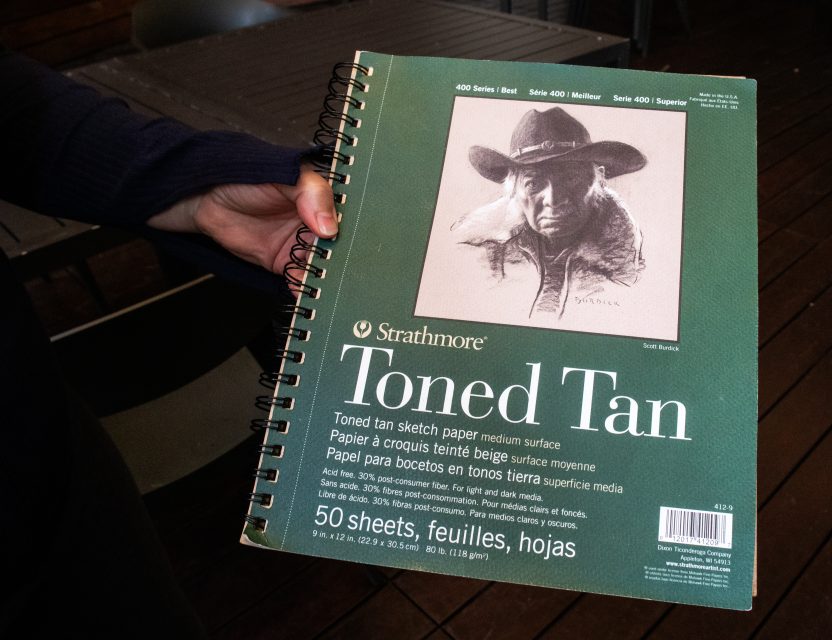 Michelle Wilson holds the sketchbook she uses to sketch hearings at immigration court. Photo by Mariana Garcia.
Wilson has been attending the immigration court at 100 Montgomery St. since August. She attends both the juvenile and adult dockets — typically about two hours — drawing the scene in front of her.

Want the latest on the Mission and San Francisco? Sign up for our free daily newsletter below.
On this Thursday, Judge Karen Schulz walked into the packed courtroom wearing her usual black robe, sat down, and swiveled between her computer screen, the respondent and the interpreter. Wilson began sketching. She drew Schulz and the court’s Spanish-language interpreter. She began to draw the girl whose case was before the court, who appeared to be about 6.
The Latina girl, accompanied by a young attorney, wore her black hair short with bangs. She had on plaid pajama bottoms and a sweater with a heart. Schulz handed the interpreter a bag of toys to keep her occupied during the hearing. The interpreter passed them on to the girl.
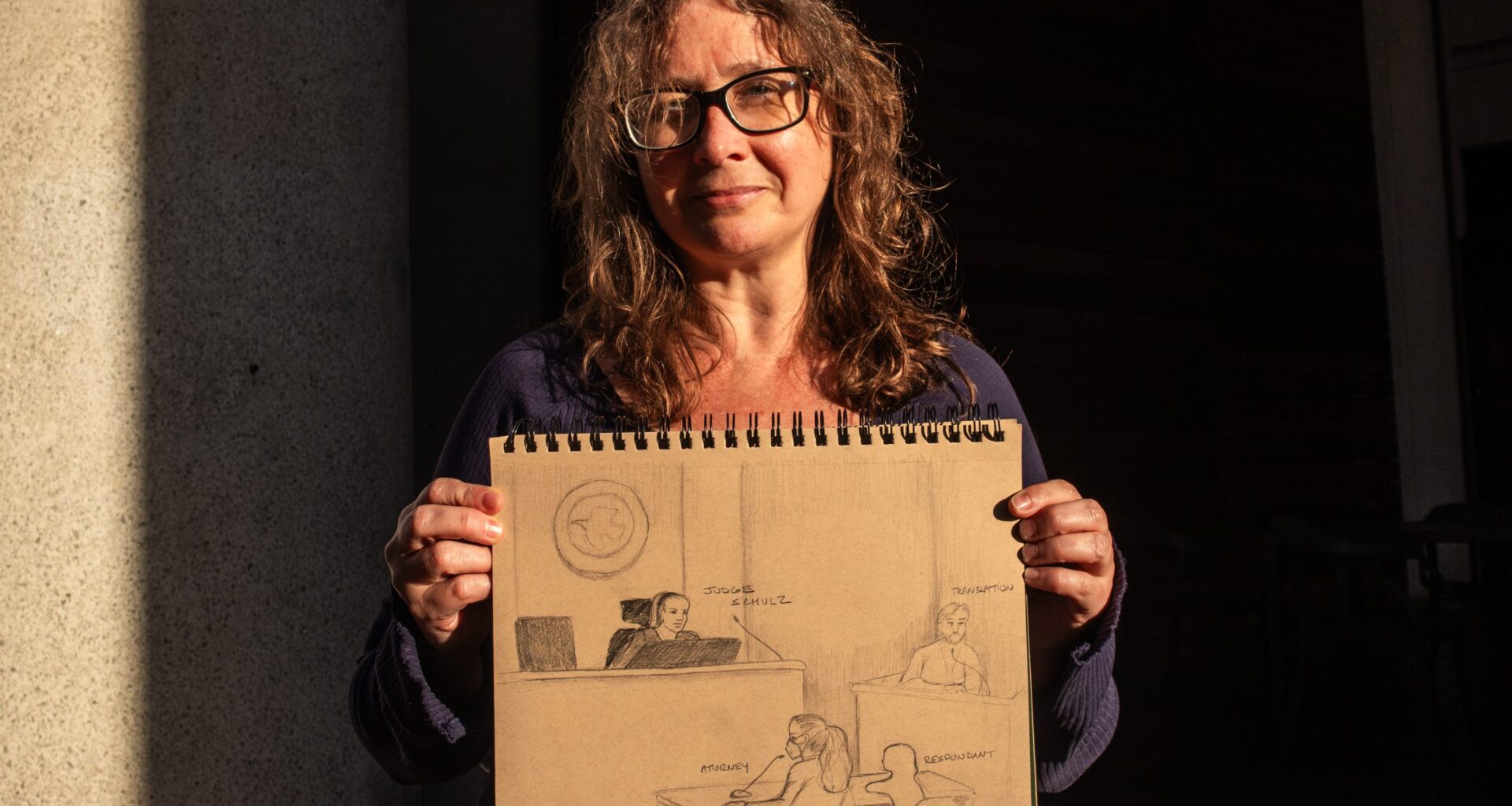
On a light brown sheet of paper, Wilson sketched the faces of Shultz, the DHS attorney, and the interpreter. She left the little girl as a silhouette. Wilson does this with every respondent, she said.
Sometimes she’s worried that not drawing them with detail is “erasing them from their stories,” but she doesn’t want to reveal features that could be used to identify them; they are just too vulnerable. Wilson shares her work online to more than 3,400 Instagram followers, along with a caption about the day’s events.
Wilson filled in more details of the scene: Schulz sitting behind the judge’s bench with a large, round Department of Justice seal behind her. The little girl with her attorney, and the Spanish-language interpreter behind his desk.
Wilson labeled each figure in her drawings: “Judge Schulz,” “attorney,” “respondent,” and “translation,” and added the date at the bottom.
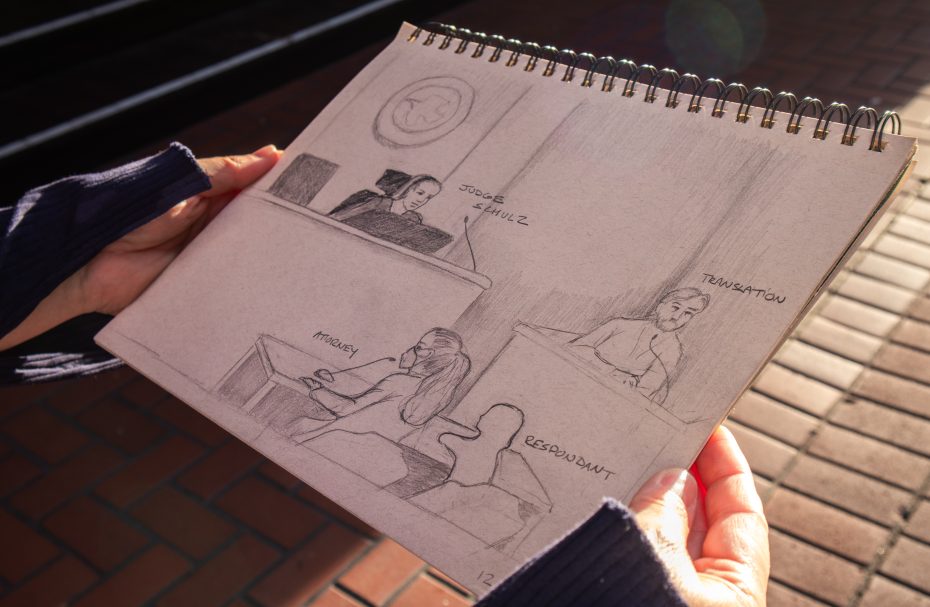 Michelle Wilson holds her sketch from immigration court in downtown San Francisco. The sketch features Judge Karen Schulz, a Spanish-language interpreter, an immigration attorney and a child respondent. Photo by Mariana Garcia.
The first time Wilson showed up at the court with her sketchbook, she was incredibly nervous. “I was trying to walk in and be like, ‘I’m confident.’ You know? Nope, that’s not me.”
She now considers the security guards on the fourth floor friends. Still, she’s cautious, tearing out the drawings in her sketchbook after every visit, so that if one of them confiscates her sketchbook, she won’t lose any of her work.
The second or third time she attended court, Judge Steven Kirchner asked her from across the courtroom if she was drawing.
“He’s like, ‘you’re getting my good side, right?’”
From there on out, Wilson felt a sense of relief.
But sketching a judge’s good side is not easy. Judge Schulz, for instance, moves around a lot.
“I’m trying to get it, and erase it and draw it again.”
Sometimes, it takes her two to three tries, Wilson said. After more than two hours of court time on Thursday, she had two complete sketches. The side of her palm was covered in dark gray pencil lead.
The Philadelphia, Pennsylvania native attributes her early artistic inclinations to her mother, a textile artist. She received her bachelor’s degree in art from the Moore College of Art and Design and went on to earn a master’s degree from the University of the Arts, both in Philadelphia.
Now, she is a lecturer at Stanford University, where she teaches a class on printmaking activism. At San Jose State University, she teaches a class on the role of artists in contemporary culture.
Her pursuit of art, she said, was “trying to figure out how to understand the world. And I think that’s kind of what I’m still trying to do.”
Her students at Stanford are trying to do the same by learning about the intersection of art and activism. Many of them, from art to sociology majors, “want the world to be different,” she said.
“We’re in this really scary time,” and showing up to draw in court is her way of acting as a “witness.” Wilson said she can only handle attending court once a week, and thus focuses on producing truthful sketches in the moment, rather than the distress of the difficult scenes she sometimes witnesses.
It’s wrong, she says, to put kids in court, and hopes that putting kids on trial is “inconceivable” in the future.
Join the 3,250 readers who keep Mission Local free for all!
Because of you, Mission Local reached and surpassed our $300,000 year-end fundraising goal. All we can say is thank you.
Thank you for choosing to invest in a local newsroom rooted in San Francisco’s communities — one that listens first and reports deeply.
If you haven’t yet had a chance to give, it’s not too late to be part of this community. Your contribution today helps sustain the reporting our city relies on all year long.
We’re grateful you’re here — and we’d be honored to have you join our donors.