
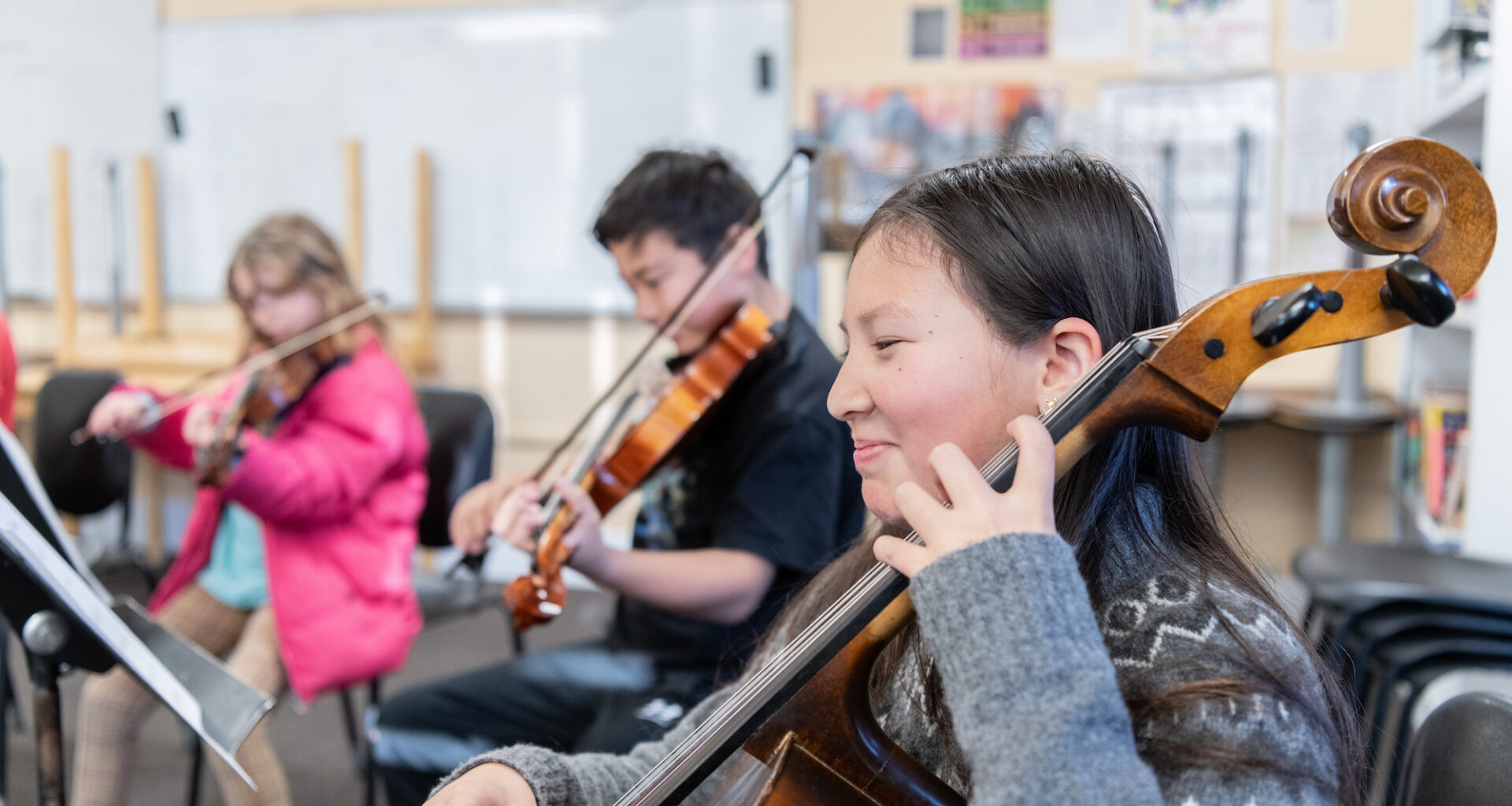
Crowden School in Berkeley has brought together music and academics for over 40 years. Once a middle school only, Crowden now admits students as young as kindergarten, with no musical experience. The school, at Sacramento and Rose streets, also receives new students in all grades, including at the start of middle school years.
Music instruction at Crowden — about one hour per day for the youngest students and two hours per day for third grade and up — includes strings and piano. The emphasis on chamber music — in small groups — plays a central role in shaping not only how students play, but how they think, communicate, collaborate and connect.
Beginning the journey at kindergarten
Kindergarten is a strong and natural place to begin at Crowden School. Students engage in a carefully designed academic program that builds early literacy, numeracy, curiosity and social awareness through small class sizes and close teacher guidance.
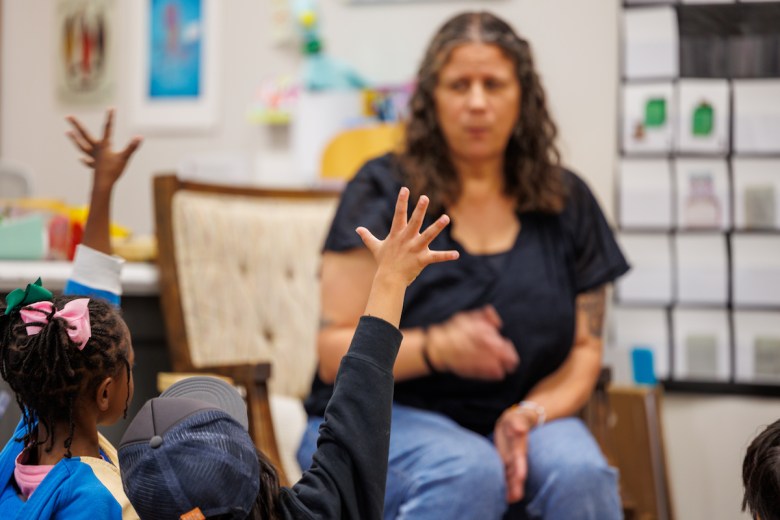 With hands raised and ideas shared, kindergarten students learn alongside teacher Cheaunie Sparks. Courtesy of Crowden School
Music is integrated into the kindergarten with instruction on bowed string instruments — violin and cello. Kindergarteners are introduced to instrumental learning in a structured, supportive environment, developing posture, listening skills, coordination, and comfort with their instrument. Music faculty observe each child closely and adjust pacing and expectations to support steady growth.
A ‘music and movement’ curriculum reinforces rhythm and physical awareness in the service of instrumental learning, helping children connect movement to sound and attentive listening.
“At this age, it’s about building confidence and focus,” said Shamal Ranasinghe, a parent of two Crowden students. “The children are learning how to listen closely and feel capable as learners — both academically and musically.”
Elementary years: Building focus and readiness
In first and second grade, students select a primary instrument, violin or cello. Teachers continue to meet students at their level, gradually increasing the challenge while reinforcing healthy habits of practice and listening.
Beginning in third grade, students have about two hours of instrument study each morning, integrated with a robust academic program. They participate in ensembles and orchestras, playing classical repertoire while learning how to work as part of a group and respond attentively to others. They start to play more often in small-group chamber ensembles, reinforcing habits of communication, accountability and shared responsibility.
Throughout grade school, music teachers adjust repertoire to support each student’s pace, while moving students forward together.
Music instruction is organized by skill rather than age, which allows students entering at different grades to receive appropriately-leveled instruction. While students may enter Crowden with different levels of experience, what matters most is the opportunity to grow through consistent practice, attentive coaching and a learning environment that values progress over perfection.
Sixth grade: Commitment
Sixth grade at Crowden marks a clear and intentional shift. While students may enter middle school with different musical backgrounds, the program is designed for those who are ready to commit seriously to music as a daily practice.
Middle school students continue to spend about two hours a day on music learning, now with greater independence and depth. Faculty coaching becomes more individualized and demanding, supporting students as they take on more advanced repertoire and greater musical responsibility. Music is not an elective or enrichment; it is a primary way students develop focus, discipline and collaborative leadership.
While new students without prior experience can be supported by faculty instruction, success at this stage requires motivation and readiness to engage deeply.
Music, academics and the developing brain
Research in neuroscience suggests that sustained musical practice engages multiple brain systems at once, including attention, memory, executive function and emotional regulation. Learning classical music requires students to read complex notation, anticipate structure, listen with precision and coordinate closely with others — all while managing stress and maintaining focus. These same cognitive and social demands form the foundation for collaborative academic work.
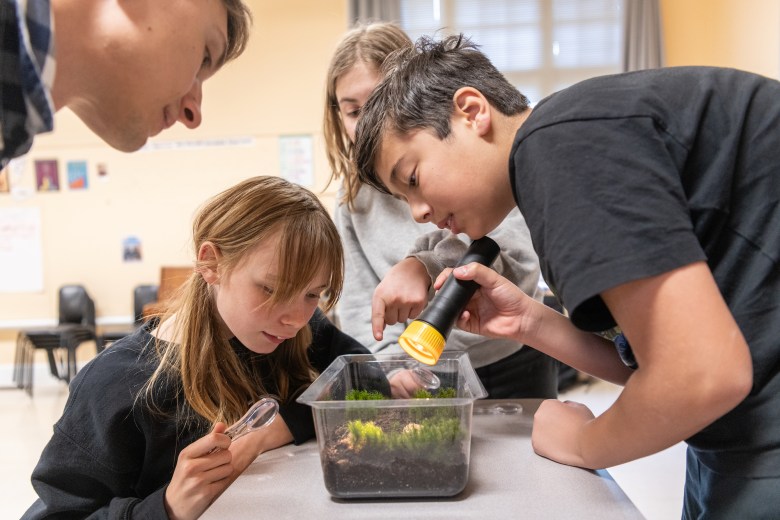 Crowden Students engage in hands-on science learning, working on a collaborative project with a 5th-grade teacher, Tyler Powles (at left). Courtesy of Crowden School
Crowden’s academic program is designed with this understanding in mind. The habits students develop during daily music study — listening carefully, contributing thoughtfully, revising in response to others, and taking shared responsibility — carry directly into the classroom. Small class sizes support discussion-based, project-centered learning, where students communicate their ideas clearly, work through problems together, and refine their thinking over time. In this way, the values of the music program undergird the academic program, fostering active minds and collaborative learners.
From grades three through eight, students regularly perform at a high level, including college-level classical repertoire. They also benefit from coaching by visiting international musicians. These experiences challenge students intellectually and artistically while building confidence and leadership.
The K-8 experience
Children change dramatically between the early years of elementary school and the start of adolescence. Curiosity gives way to concentration, play evolves into purpose, and students begin to take greater responsibility for their learning and for one another. Many schools struggle to intentionally support these transitions, especially as academic expectations rise and students are asked to engage more deeply with peers, ideas and themselves.
At Crowden School, these years are viewed as a deliberately designed developmental journey. Crowden integrates a rigorous academic program with daily music learning rooted in the classical tradition. While expectations evolve as students mature, the underlying philosophy remains consistent: students learn best when intellectual challenge, creative practice, and human connection develop together, supported by close teacher guidance and instruction that responds to each student’s growth.
Prepared for what comes next
By eighth grade, Crowden students are academically prepared for a wide range of public and private high schools. About half go to local public high schools in Berkeley and Albany. The other half go to private schools including College Prep, Head Royce and The Athenian School. More importantly, they leave with habits that extend beyond school: focus, communication, collaboration and confidence.
“*” indicates required fields