
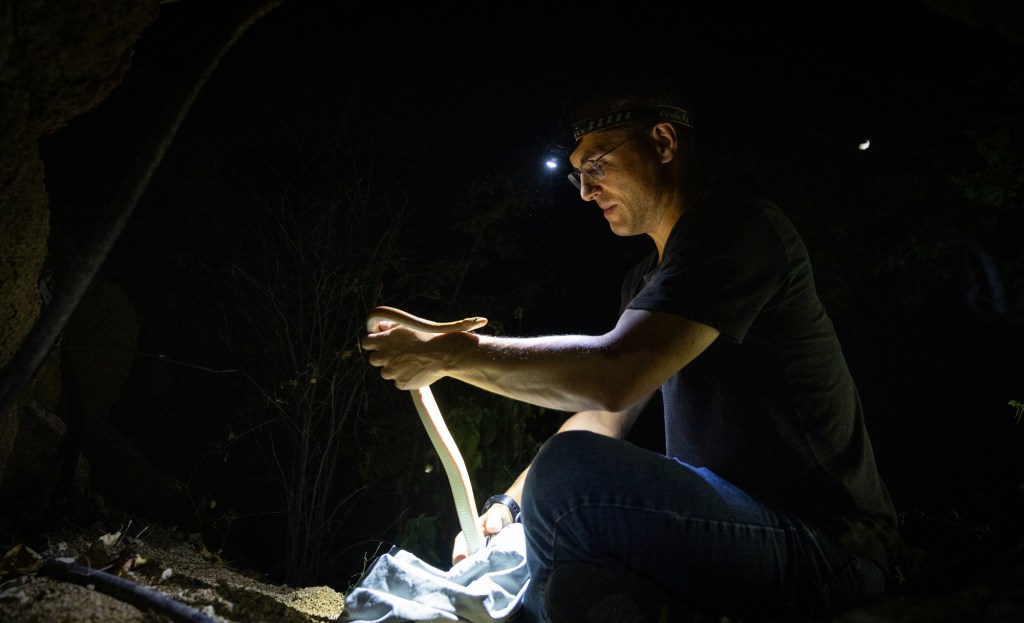
I never expected to find myself crouching in a humid mining tunnel, waiting — even hoping! — for a snake to slither its way toward me in the dark.
But in late October, on an expedition in Baja California Sur with scientists from the San Diego Natural History Museum, that’s exactly where I was.
In many ways, it’s where I was meant to be: I had traveled to the Sierra de las Cacachilas, mountains just outside of La Paz, to join the scientists as they explored the region to learn more about its biodiversity. Seeing the science up close was part of the reason I was there.
On this particular evening, a group of scientists were releasing a rat snake back into an abandoned mining tunnel, where it lives and feasts on the cave’s bats.
Before this expedition, scientists didn’t know much about the eating habits of this species. Only two previous predation events had ever been recorded.
“It’s an elusive species that’s rarely seen,” said Adam Clause, the NAT’s herpetology collections manager, on the short hike to the cave.
Clause held the snake in a cloth bag as we walked, and our conversation was lively as he recounted how the scientists found the snake in the mine the night before. Part of why he loves his work is sharing the ecology with people like me.
“There’s a lot of people all over the world that don’t like snakes, so there’s an opportunity to change people’s minds and educate folks about what the real story is,” Clause said.
Still, there I was in a cave, watching a snake — docile and non-venomous, admittedly — slither by, as giant cockroaches crawled on the sand around my boots and as bats swooped low overhead. What am I doing here? I wondered.
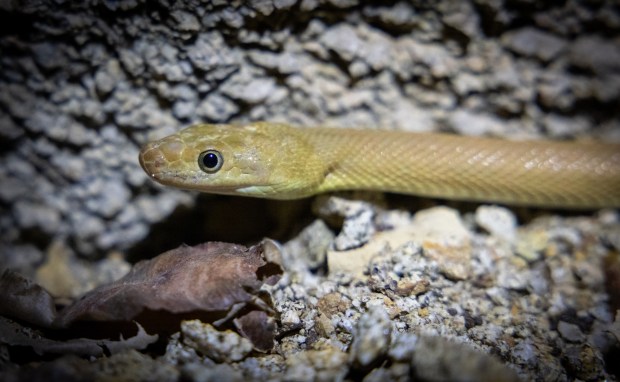 A Baja California rat snake is released back into a an old mining cave in the Sierra de las Cacachilas on Monday, Oct. 27, 2025. It was discovered during the trip that the reptile eats bats. (Ana Ramirez / The San Diego Union-Tribune)
I’m an adventurous person, and I love wildlife. But during the three days I joined the expedition, I felt braver, and even more curious about critters and places that would typically frighten me.
I said yes to crawling to the back of the narrow mining tunnel. I said yes when scientists offered to let me hold a live tarantula and a rosy boa, and to place a beetle into a vial out in the field.
Part of it was novelty — this was a once-in-a-lifetime thing. But there was also a contagious enthusiasm — people so passionate about their life’s work that I couldn’t help but want to join.
Read more about the NAT’s expedition in Las Cacachilas in my recent story, along with a Q&A with a Mexican ornithologist who helped us spot the world’s smallest owl species.
I love Baja, and I hope to keep exploring its natural wonders. But for adventures closer to home, this week I hiked at the Torrey Pines Extension. My short, easy route under the iconic trees made for a nice way to start the year, and I’d especially recommend it for a cloudy, lazy day.
It’s also the only way to hike at Torrey Pines State Natural Reserve until March, as the main park’s trails are closed for improvements.
Thanks for reading — and happy exploring, wherever this week takes you. See you next Friday.
—Maura
Hike of the week: Start the new year with a quiet exploration at the Torrey Pines Extension
Ongoing construction at Torrey Pines reserve aims to improve utilities and access
Birding, waterways and a wildlife refuge: 5 South County hikes
Carlsbad declares local emergency to repair eroded beach bluff