
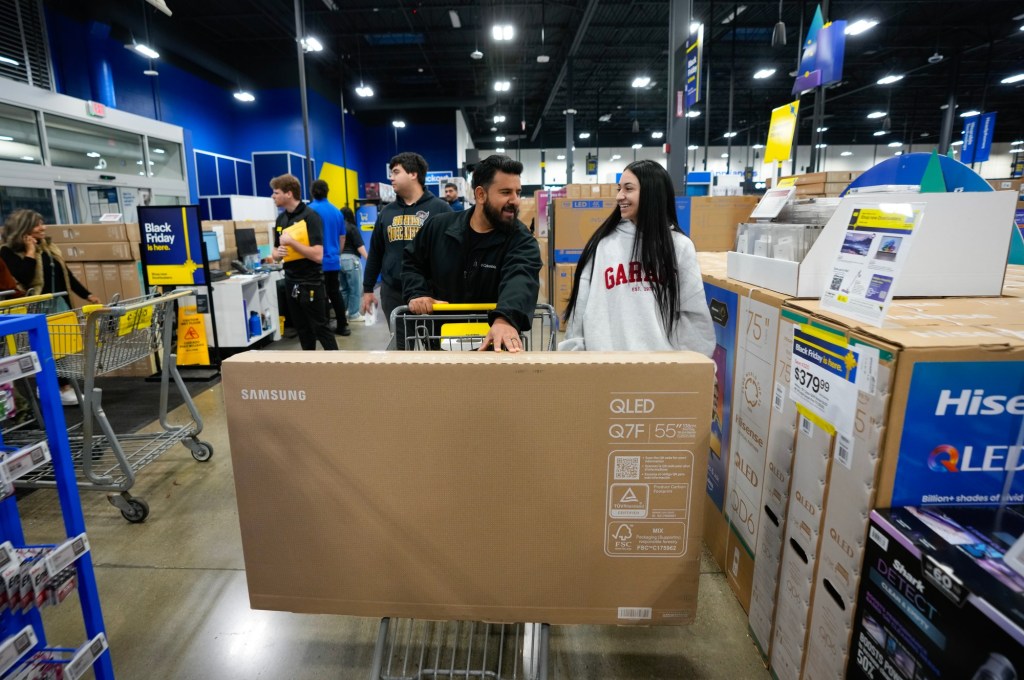
Holiday retail hiring helped drop the San Diego jobless rate in November to one of its lowest rates in months.
The region’s unemployment rate was 4.6%, state labor officials said Friday, down from 4.9% in the last report for September. California’s Employment Development Department was unable to determine a jobless rate for October, the same as U.S. labor officials, because of a lack of data collection during the federal shutdown.
San Diego County’s unemployment rate hit a low of 4% in May but had been rising for much of the rest of the year — reaching a high of 5.2% in July. The reversal in November was mostly led by retail and government hiring.
Several economists Friday described the labor market as being stuck in a “low-hire, low-fire” mode and Kevin Carroll, executive director of industry trade group Tech San Diego, said that fits with what he has seen in the past few months.
“I’m hearing less about reductions in workforce,” he said. “(Employers) remember how tough it was to get good talent.”
Carroll said San Diego tech companies want to hang on to people because they want to be ready for what they see as an unpredictable year ahead.
San Diego’s unemployment rate of 4.6% was lower than the 5.4% rate in California but higher than the nationwide rate of 4.3%. The delayed statewide data for November, caused by the shutdown, was different than the nationwide report for December, also released Friday.
That report, which was dominating headlines on Friday, showed U.S. employers added 50,000 jobs in December — down from economists’ expectations for a 73,000 increase. It also showed employers added 584,000 new jobs in 2025, down from 2 million in 2024. It was the lowest job growth year since 2020.
San Diego County appeared to be on a slightly different trajectory. The region had added 11,800 jobs annually through November, up from 8,600 in November 2024.
From October to November, the biggest job gainer was in the trade, transportation and utilities sector, which is mainly retail, that added 5,400 jobs. It was followed by government, which added 3,000 jobs, with mainly state jobs related to education.
Other job gainers were private education and health services (nursing, social assistance, private schools and universities) with 2,700 new jobs; leisure and hospitality (hotels, casinos, bars and restaurants) with 800; professional and business services (legal, scientific, waste management, architectural) with 400; and financial activities with 100. Job losses were in construction, which shed 1,000 positions, and manufacturing, down by 400.
When adjusted for seasonal swings, San Diego County’s unemployment rate was also 4.6%, according to Beacon Economics. That compares to the recently revised November 4.5% U.S. average jobless rate and 5.5% in California.
On an annual basis, the biggest gains were private education and health services, adding 6,200 jobs. It was followed by government, with 4,100; leisure and hospitality with 2,100; and other services (laundry, maintenance, religious) with 1,700.
Annual job losses included professional and business services (legal, scientific, waste management, architectural), which shed 6,200 positions; manufacturing, down 2,400; construction, down 2,200; financial activities, down by 1,200; information (telecommunications, newspapers, publishing industry), down 800; and trade, transportation and utilities, down by 400.
The position with the most job openings in November in San Diego County was retail salespersons with 1,688 ads, according to state data that aggregates job postings during the month. It was followed by registered nurses, with 1,488 ads, home health and personal care aides with 942 and software developers with 901.
Employers with the most job ads were Qualcomm, UC San Diego, General Atomics, Apple, Sharp Healthcare, Scripps Health and Intuit.
State officials do not seasonally adjust jobless rates for individual counties. Compared with other parts of California, San Diego County was in the middle of the pack with its unadjusted rate of 4.6%.
The unemployment rate was 5.7% in Los Angeles County, 4.1% in Orange County, 3.9% in San Francisco County, 4.2% in Santa Clara County, 5.9% in Santa Cruz County and 5.5% in Riverside County.