

By many indications, San Francisco’s all-important tech industry is on the upswing.
The City has become the center of the artificial-intelligence boom, hosting the two most valuable startups in the sector and numerous other smaller venture-backed companies. Record amounts of venture capital are flooding in. Leasing by AI companies is starting to make a dent in The City’s glut of vacant office space, and mass layoffs have slowed to a trickle.
But all that has left one big mystery: Where are all the jobs? Despite all the money and activity in the sector, tech employment in The City is well off its peak and has barely budged in recent months.
Why that’s so is the “million-dollar” question, said Abby Raisz, vice president of research at the Bay Area Council Economic Institute, a think tank within the business-backed advocacy group.
“I think everyone is very perplexed by this,” she said.
As of November, tech employment in the two-county San Francisco-San Mateo region was down about 14% from its peak of 222,400 in August 2022 and off by about 2% from the previous year, according to the latest figures from the state Employment Development Department.
Although the most recent numbers are subject to revision, they indicate that employment in the tech sector fell in January and February and has barely budged since. As of November 2025, there were 190,800 tech jobs in the two-county area, compared with 190,000 in March 2025 and 194,500 in November 2024.
One might have expected tech employment to be going in a much different direction, in part because the layoff numbers have been improving.
Typically, the number of people laid off in mass layoffs — defined as job-cutting events involving 50 or more workers at companies with at least 75 employees — moves in the opposite direction of employment.
In April 2020, right after local governments implemented lockdowns in response to the onset of the COVID-19 pandemic, employment in the San Francisco region plunged and mass layoffs jumped. In 2021 and early 2022, as the local economy started to recover and the tech sector boomed amid a gradual loosening of COVID restrictions and a huge injection of cash from the Federal Reserve, employment in the region rose — particularly in the tech sector — and layoffs plunged.
Then in late 2022 and early 2023 — as tech companies cut staff in response to a stock-market sell-off and a slowdown in sales — employment in the local tech sector dropped markedly and layoffs soared.
Since then, though, there’s been something of a disconnect. Layoffs have been dropping and fell to a relative trickle in the last six months of last year.
In the last six months of 2025, employers let go 1,131 people in San Francisco — 793 of which worked for tech companies or in tech jobs — in mass layoffs, according to EDD data. That was less than half the number laid off in mass layoffs in the same period in 2024. It also represented the fewest let go in such events in a comparable period since the go-go days of 2021.
“The rate of jobs losses [is] slowing in tech,” said Ted Egan, San Francisco chief economist.
But, he said, “There isn’t yet sign of a durable jobs recovery, and the jobs we’re seeing in AI are not enough.”
Again, one might have expected a different situation, given what’s happening in the AI sector. Since OpenAI’s launch of ChatGPT in late 2022, San Francisco has become the epicenter of AI development.
The two most valuable startups in the sector — OpenAI and chief rival Anthropic — are both based in The City, and each has raised tens of billions of dollars, including OpenAI’s record $40 billion round in March. The sheer concentration of skilled AI engineers in San Francisco and the surrounding region has encouraged hundreds of other AI startups to launch or relocate here.
Thanks in large part to the AI sector, startups based in the San Francisco metro region — which includes Oakland — raised $111.7 billion through the first three quarters of 2025, according to PitchBook and the National Venture Capital Association. That figure set an annual record with three months still left in the year. That tally represented nearly 45% of all the venture money invested nationwide in a year in which the total amount of venture investment reached the second highest level ever.
Although much of that cash went to OpenAI, Anthropic and a handful of other companies, hundreds of other local startups also garnered funds. All told, companies in the San Francisco metro area closed 1,818 funding deals in the first three quarters of last year, or 17% of all deals closed nationwide.
In the past, a surge in venture investment has typically translated into a corresponding rise in hiring in the tech sector, Raisz said. Startups use the money they’ve raised to hire new people to grow their operations and their sales, she said — but so far, that’s not happening this time around.
“For the first time, maybe ever, venture capital and AI investment are still flowing very strongly in San Francisco, but the capital is not translating into these sort of broad-based hiring upticks,” she said.
Raisz and other analysts have some theories about why San Francisco hasn’t seen a hiring surge even as layoffs are down and venture funding is up.


Larkin Street Youth Services program helped unhoused San Franciscans find stable housing, according to its preliminary data

San Franciscans will head to the polls to decide Pelosi’s congressional seat, hot ballot measures and more

No matter what happens in 2026, the president will claim progress
Perhaps the biggest factor is that much of the funding being raised is going to the biggest AI companies, and they’re using the money to build or use data centers built around pricey and energy-gobbling Nvidia chips to train and run their models. OpenAI, for example, has committed to spending $1.4 trillion on data-center infrastructure in coming years — far more than it has raised in venture capital.
In other words, where startups in the past would use venture money to hire workers, the AI companies are using it for capital expenditures — theoretically long-term investments in equipment and computing.
“All that money” OpenAI and other companies are raising — “most of it has been going toward the capex, the cap expenditures on AI,” said J.P. Allen, a professor at the University of San Francisco’s School of Management.
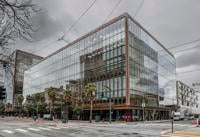
OpenAI subleased the buildings at 1455-1515 3rd St. in Mission Bay, pictured above, from Uber in October 2023.
Craig Lee/The Examiner
Last year, generative-AI companies such as OpenAI and Anthropic listed an average of 410 jobs in San Francisco each month, according to data Egan gleaned from labor-market analysis company Lightcast. That was up from 240 per month in 2024 and 85 per month in 2023. AI positions accounted for 18% of all monthly tech job listings in San Francisco last year, up from just 4% in 2023.
But that jump in AI hiring hasn’t made up for the overall hiring decline in the tech sector.
For each year between 2019 and 2022, the average number of tech jobs listed on a monthly basis never dipped lower than 3,875, and it went as high as 4,798 in 2019, according to data from Lightcast compiled by Egan. No year since then has seen an average monthly listing count higher than than last year’s 2,295.
“AI in its own terms is growing pretty fast,” Egan said. “It looks like it’s an important part of the tech [industry] turning the corner, but it’s got a ways to go before AI itself is going to take us back to pre-COVID levels of hiring.”
Another possible explanation for the seeming disparity between the low layoff numbers and the decline in tech employment is that the latest layoff figures are actually understated, Raisz said. EDD’s numbers don’t include layoffs made by smaller companies or by those that let go fewer than 50 workers at a time. So it could be that many more people in the area are being let go than show up in EDD’s figures, she said.
But there are likely other factors weighing on tech employment in the area, analysts said. There continue to be concerns about broader economic uncertainty, relatively high interest rates, the effects of tariffs and the overall geopolitical situation, they said.
Following their big layoffs of 2022 and 2023, the big tech companies appear to be hesitant to go back on the hiring kick they were on before then, the analysts said. In part, that might be due to AI itself, either because the technology is already being used to replace workers or because companies are trying to find out whether it can do so.
“I think it’s clear that one of the reasons [tech companies] aren’t hiring is because of AI,” Egan said. “One of the sectors where AI has gotten the most adoption is in tech.”
Recent reports have indicated that big companies have struggled to find any economic benefits from adopting new AI technologies. But anecdotal reports have suggested that AI tools are allowing at least some new startups to develop products with much smaller teams than they might have used in the past.
Being AI-focused from the start, “probably allows these companies to just hire fewer folks,” Raisz said.
That said, the analysts were optimistic that hiring will pick up as AI is adopted more broadly. In past tech cycles, big jumps in business and employment growth were typically tied to the move from developing the underlying technology to developing applications for it, Egan said.
And he and the others are bullish that San Francisco, as the center of the AI industry, will benefit when that shift happens.
That shift to application development “takes a lot of work,” Egan said. “That takes a lot of funding and trial and error and collaboration, and it doesn’t happen overnight.”
But the fact that San Francisco is already seeing a disproportionate number of venture-funding deals in the sector and office leases by AI companies are increasing is a good sign for the future, he said.
“That’s really what you want to see at this stage,” he said.
If you have a tip about tech, startups or the venture industry, contact Troy Wolverton at twolverton@sfexaminer.com or via text or Signal at (415) 515-5594.