
Tickets for the 2028 Olympic and Paralympic Games go on sale this month – another marker that shows the countdown to the big event is accelerating.
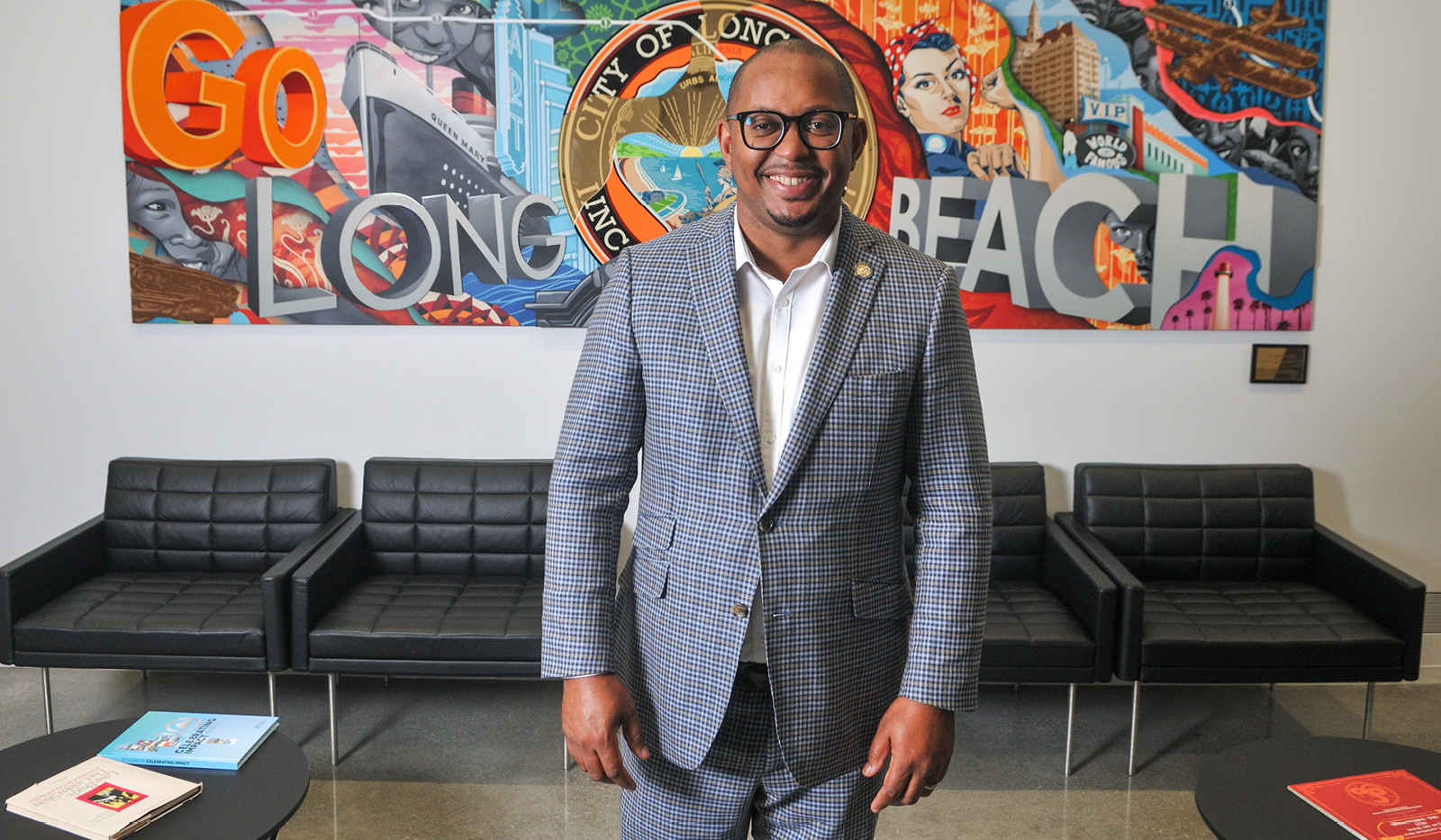
Long Beach is emerging as one of the region’s most dynamic host cities. With more than a dozen events planned along its waterfront and across its neighborhoods, Long Beach Mayor Rex Richardson believes the Games will serve as both a global showcase and a long-term investment in the city’s future.
In an interview with the Business Journal, Richardson and Protocol Officer Beril Unver discuss how they’re preparing the city for the world stage – balancing infrastructure, economic impact and community legacy as 2028 approaches.
This will be the third time the Los Angeles region including Long Beach has hosted the Games. What can Olympic fans expect to experience in Long Beach in 2028?
Mayor Rex Richardson: Long Beach is already (a) very beautiful, engaging and livable city. We have a very walkable downtown that’s integrated with an entertainment district, with the convention center, and it’s on the beach with 7 and a half miles of coastline. (The city) is already designed to be an aquatic sort of a waterfront playground, and so when you add the activation of 18 different sports over the 2028 Olympic and Paralympic span, you’re really going to see the city highlighted and displayed in a way that really compliments our natural advantages.
In the downtown area, we’ve had the (Acura) Grand Prix, and we’ll get like 200,000 people (for that event); we’ve had big activations on the beach like Kaskade’s (music festival) would have 40,000 people on the beach for the EDM concert or when we did the NFL kickoff experience, we had thousands of people there and we’ve had sailing regattas and hosted the Olympics here before – but this will be all of it activated at the same time (during the 2028 Games), showing the very best of Southern California’s premier waterfront.
Beril Unver: I’ve been in this role now for 11 months … It’s the first time the city has had an official protocol officer. It’s the vision of this city, and of course (Mayor Richardson), to make sure that we’re really taking this opportunity with this global athletic interest and turning it into a sustained economic legacy. . .
 Beril Unver
We’ve had about 45 international visitors, and 19 of which were Olympic Committees that have come in less than a year. And they have found that, aside from the fact that we are completely walkable, we’re very committed to sustainability, inclusivity. We’re the friendliest city they said. We’ve given them this kind of concierge experience; and I don’t think they realize how big Long Beach is until we tour them around.
But we’ve had a lot of national Olympic Committees come, and (so far) we’ve had two declared hospitality houses. (One is) by Greece – which is its first ever, considering they’re the founders of the Olympics – and by Denmark.
A year ago, the city released its Strategic Roadmap for the games. Can you share the most important, or even critical, priorities identified and how that has shaped so far and will continue to shape decisions in the next few years?
Richardson: Some of our initial goals are that this needs to be a smart and responsible bet for our city; and the way that we are approaching the Games really is a very responsible and proactive strategy. We don’t have to build any permanent infrastructure for the Games, but we will leverage the Games to improve the infrastructure that we have …
We’ve invested through our LA28 capital plan (about) $1.1 billion over five years into our roads, our parks (and) our public facilities. So, the Olympic games have really been a catalyst for more investment into our publicly owned assets.
(Also) we are seeking full-cost recovery. When the games are presented here, our goal is to ensure the investments that we do make have a full recovery on the costs of the event … but also we maximize the economic impact for our small businesses and our residents. The way we leverage the Olympics to create a lasting economic impact is by making sure that our receptors – our hotels, our small business, our retailers (and) our restaurants are open, prepared and staffed, and (a) sponge to soak up the economic benefit of the Olympics.
The third piece: how do we create a city-wide experience, not just for the coastline and the waterfront? How do we create zones and fan activations? How do we make sure that young people and children who are inspired have access to actually attend and participate in the Olympics and create memories? So, a big part of our strategy is getting the Olympics out of just the downtown, the coastline and out into the communities so (our residents) can benefit.
(For example), (we) may have festivals that take place in other parts of town. (We) may have our own sort of torch-relay experience … For that to happen, we really have to have private sponsors and have the capital ready for that city-sponsored activation.
Can you walk us through the timeline for the next couple of years? What are some of the key milestones?
Richardson: There are still agreements to be worked out with LA28 around the venue use and what those boundaries are. If anything, our plan is going to ramp up this year. So, you’re going to see more engagement … Beril was brought on to really be the liaison to the international community, who are now beginning to move into the city and really claim pieces of the city and establish an anchor into our city. Beril has really been the concierge for that to happen. … You’ve already seen we’re the first city to announce two international team houses (for Long Beach) … and we’re going to continue that. There’s (also) significant interest in brand activation and sponsorships.
This summer will be a test because (FIFA World Cup 2026) is coming to the region … and we’re going to be engaging in some activation with FIFA and official fan zones.
And then we’re opening additional venues like the amphitheater, and the amphitheater will be a test of our mobility. We’re going to be using water taxis for the amphitheater. (If that works out,) then that’s the strategy we can use to connect the waterfront during the Olympics; and so you’re going to see a lot of stress testing take place this summer to build up for 2028.
Unver: We’re the largest venue city after the (main) host city. Every other city is equipped with 10 times the amount of staff who’re working on these things. So, we’re a small but mighty team. Again, it’s that special touch, and (Mayor Richardson) makes time to meet with these international delegations.
I think something to note that’s interesting, and that will also make more milestones happen, is we’re the only city in the region that has an inventory of businesses … so those who want to take part in activation. … We’ve opened it up to every business across Long Beach, not just downtown, all the way across (the city), for them to let us know if (and how) they would like to participate in some way, either as a vendor (or service provider.) … We’re empowering locals to get those opportunities.
In addition to that, we have a link that we’ve created for the National Olympic Committees and Paralympic Committees, so that they can actually look at the properties and they can reach out to me or directly to the business owners themselves. … We’re hoping to have a couple of villages together, which would be a couple of countries coming together showing off kind of a regional vibe.
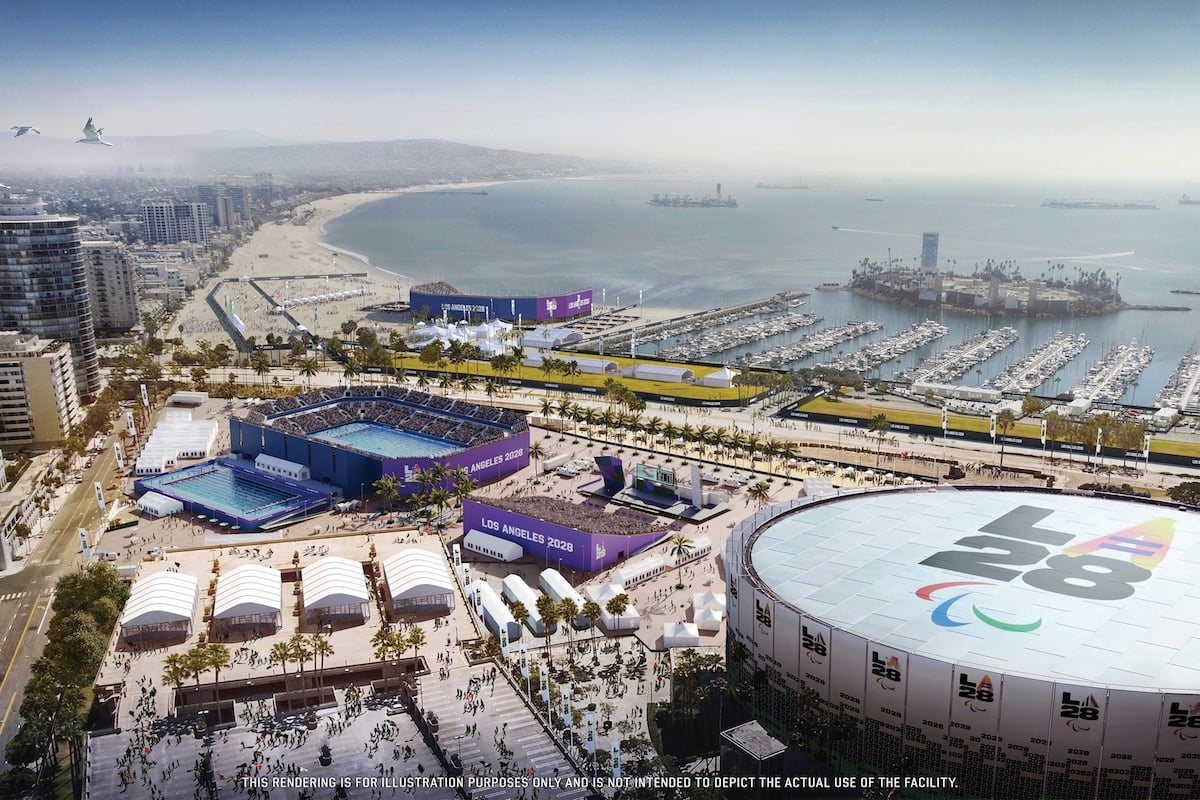 LA28 sports venues in Long Beach along the shoreline. (Rendering c/o LA28)
Have you measured the economic impact that the Games will have for the city alone? If so, what’s that looking like?
Richardson: One of our next steps is for us to do a comprehensive economic study that looks at all of it, but we can tell you (that) this will be the largest event that we have ever hosted in the city. We have 2 million tickets that are reserved to be bought for events in the city.
There are 161 ticketed competitions just on the Olympic side, not including the Paralympic side … The scale of this will have a significant impact. And if we compare it to the Grand Prix, the Grand Prix weekend is our most economically successful weekend in our downtown. Last year, we brought on Vans Warped Tour, which brought 85,000 people a day for two days to our downtown, and that was our second most economically successful weekend, second only to the Grand Prix. So, imagine that for two weeks during the Olympics … and then 10 additional days for the Paralympics. We look forward to that experience, and we’re ready for it.
What’s the collaboration like between Long Beach and the LA Organizing Committee to align planning efforts and share resources effectively?
Richardson: So, you’ve got sort of the technical folks at LA28 – the attorneys and operations folks – who work with our city managers’ team or special events team.
In terms of leadership, we have a table of mayors from venue cities … and we meet on a regular day. We try to do it quarterly. And then we each have liaisons with LA28 that we can talk to, we work together as mayors and we do research together. A number of us went to Paris to really see how Paris (hosted the games). Paris is really spread out across a number of cities, but it worked together. So, there’s a spirit of collaboration on how we’re approaching these Games… This is an opportunity for the whole region, and it’s going to require some shared sacrifice and some shared commitment from all of us to deliver the best Games experience … That’s really why Long Beach is stepping up in the way that we are.
Unver: We’re in those planning phases but something Long Beach has done that no other city has done is we have a bunch of committees (including community members) – (like) committees on legacy, on the arts … we’re making sure that everyone in the city is consulted along the way, so that they feel like these Olympic games are theirs.
From your visit to Paris, what lessons did you learn as you become a new host city?
Richardson: Paris was great! The city of Paris put together workshops (for our teams). (For instance), our public works team, that is going to have to keep the city clean and maintained during the games, went out and saw how Paris handled waste and water and all these systems that people take for granted. … (So) they had different workshops put on by different experts to where folks could go and really learn about anything you can think about – sustainability, transit, all of those issues. It was very informative.
And then, just to see the scale of (the Games in Paris) was important, like the amount of people that are in your restaurants and walking down your streets, and to see what preparation work had gone into that.
When we think of these major cities and other parts of the world, we may think that these are utopias that don’t have the same social challenges we do. Well, that’s not necessarily the case. We went all around Paris, and we saw where they had challenges with homeless encampments and where there was graffiti downtown. All of our urban centers are the same. We deal with the same social challenges, but that didn’t prevent them from putting their best foot forward and presenting a quality experience for the Olympic Games.
I think that helps to ground us … we need to be authentic in how we present these games. … I think it’s an opportunity for us to show how we’re coming together, stepping up to meet those challenges. So going out to a different part of the world and seeing how they step up and show up really is an inspiration for us that we’re going to step up in this moment.
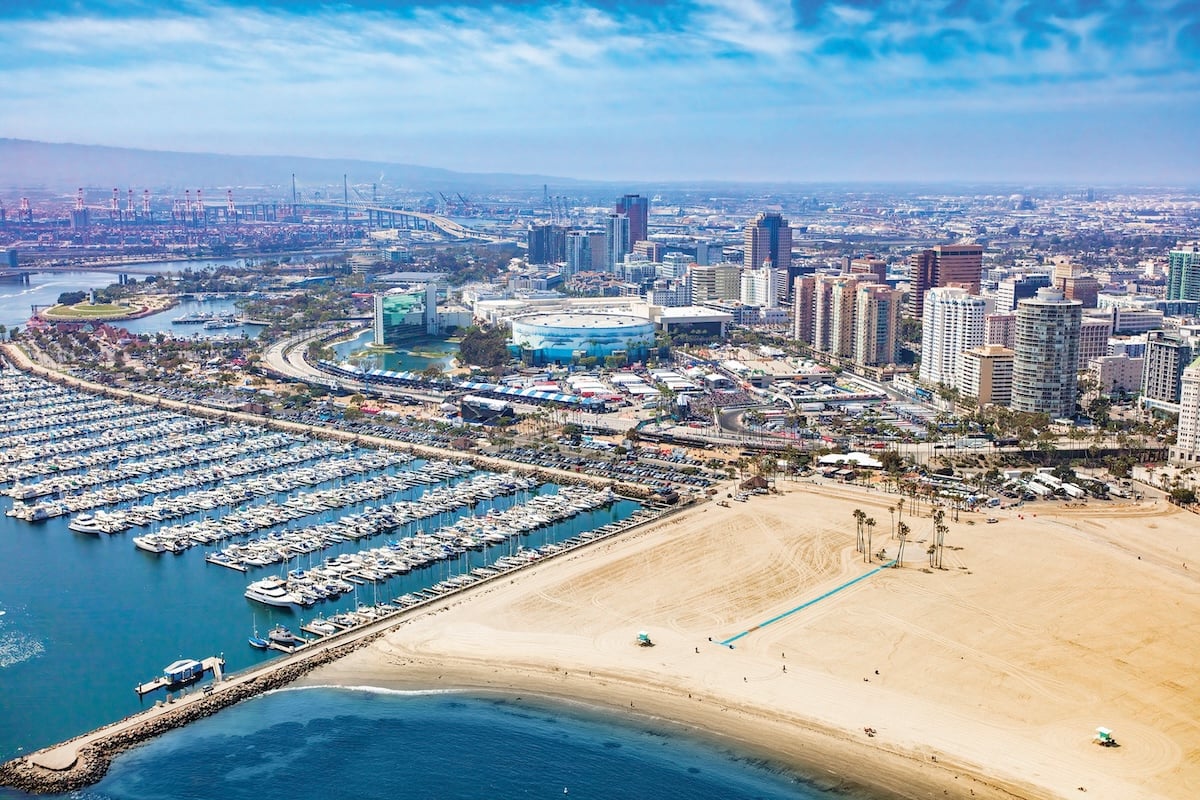 Site: The Long Beach marina, beach and waterfront. (Photo c/o City of Long Beach)
What’s the legacy you hope the games will have for Long Beach?
Richardson: A few things. For one, this is our third time serving as a venue city, but there are no Olympic rings in our city. There’s nowhere to go and actually see and hear about the history. Whereas I visited Qingdao – (which) hosted sailing in 2008 for Beijing – and (there) they still have the flags up from all of the countries that sailed, and they have a sailing center memorializing the moment. … They hosted one event, one time.
We’ve hosted dozens of events, and this is our third time hosting the Olympics, but there’s no physical way to recognize that. We also have a legacy of athletes who have come from Long Beach.
So, we’re exploring ways to memorialize this moment moving forward for our city through an actual physical memorial. We’re also thinking about ways that when people come to our city, how we can create something of a welcome center that really tells that story.
We also want to make sure that we learn from LA84 on how they established (the) LA84 Foundation and an endowment that’s continuing to support youth sports into the future. So, we are planning for an Olympic legacy fund that can help support youth sports in our city and continue legacy building to recognize our athletics, our arts, our culture and our community. So that’s a big part of our plan.