
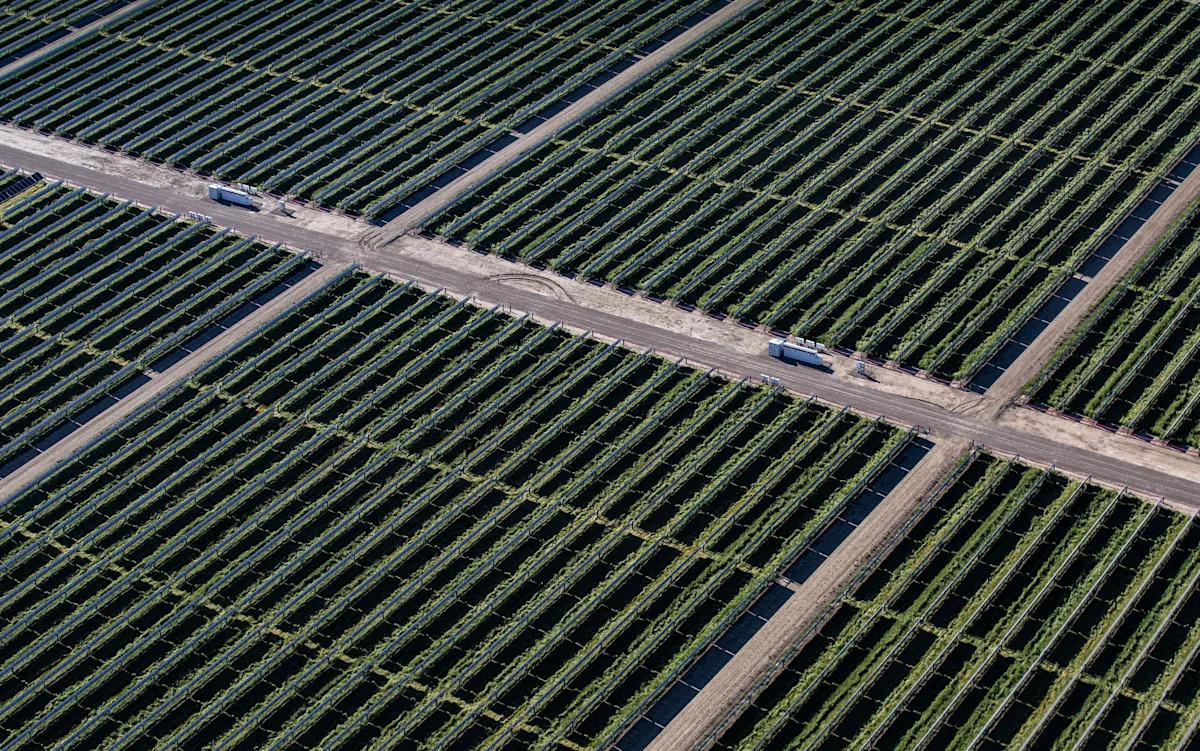
Out in the fertile yet water-constrained farmlands of California’s western Central Valley, a massive solar, battery, and power grid project that could provide a quarter of the state’s clean energy needs by 2035 has taken a critical step forward.
In December, the board of directors of the Westlands Water District, the agency that manages water delivery to more than 600,000 acres in California’s agricultural heartland, approved the Valley Clean Infrastructure Plan. VCIP calls for building up to 21 gigawatts of solar energy and an equivalent amount of battery storage across up to 136,000 acres, along with a series of high-voltage transmission lines to connect the electricity generated to the state’s grid.
That would be the largest solar and battery project in the country, and it will take up to a decade to be completed. But Patrick Mealoy, a partner and chief operating officer of Golden State Clean Energy, the company developing the master plan in partnership with the district, said it’s expected to move quickly, with the first construction work potentially happening within the next two years.
Golden State Clean Energy will carry out only a small part of the project, Mealoy said. It will mostly seek third-party solar and battery developers, with individual installations ranging in size from 100 to 1,150 megawatts.
Mealoy, a 30-year solar veteran, codeveloped Westlands Solar Park, the first major solar farm in the district. When fully completed, that project will be one of the largest in the Central Valley and produce 2.7 gigawatts — a fraction of VCIP’s scope.
The VCIP is designed to manage the multiple challenges that can stymie piecemeal solar and battery projects, such as winning environmental approvals, securing buy-in from landowners and communities, and interconnecting to the state’s congested transmission grid, Mealoy said.
“We’re doing the transmission studies, the environmental impact studies, and outreach to communities, all at the same time, to make sure there are no showstoppers.”
The VCIP is as much about preserving the region’s agriculture industry as it is about generating clean electrons, said Allison Febbo, the district’s general manager. That’s because the plan will allow the district’s more than 700 growers to redirect increasingly limited water supplies from land slated for clean energy development to land that remains under cultivation.
“The real benefit to us is that it gives our growers another crop to grow, which is the sun,” she said. “Our growers have this issue: ‘I have 100 acres of land but only enough water to irrigate 50 of those acres. What do I do with the remainder of those acres?’”
For decades, California’s Sacramento–San Joaquin River Delta has delivered water via the Central Valley Project’s system to irrigate the Westland Water District, the largest water district in the country. But in recent years, restrictions brought on by environmental and endangered species regulations for the delta have forced Westlands to fallow an increasing amount of farmland, expanding to more than one-third of its total acreage. And under the state’s Sustainable Groundwater Management Act, farmers will soon face stringent restrictions on how much water they can pump from the region’s long-stressed aquifers.
As more and more land has been left uncultivated, farm employment and property tax revenues have declined in the region. “The schools can’t be supported, the businesses can’t be supported,” Febbo said. “This is a way to maintain economic viability and support our communities.”
Mealoy said the VCIP could revitalize the region’s economy. “The cost of building solar is well north of $1 million per megawatt, probably closer to $1.5 million,” he said. Spread across 21 gigawatts of planned development, “that’s billions and billions of dollars that could be built on fallowed ag land, creating jobs and creating an enormous tax base for Fresno County,” which encompasses the land being set aside for development.
The economic benefits would extend beyond the region. An analysis commissioned by Golden State Clean Energy last year found that the clean energy and transmission congestion relief the plan would deliver could yield annual electricity cost savings of about $850 million and reduce the state’s power-sector carbon emissions by 15% through 2050.
The plan will also help reduce the grid congestion that’s created yearslong interconnection delays for large-scale solar and battery projects throughout the state, Mealoy said. In 2024, state lawmakers passed Assembly Bill 2661, a law that allows the Westlands Water District to develop its own transmission grid to get solar to market.
The project’s transmission infrastructure will be constructed under a project labor agreement using 100% union labor. That has won it the backing of the International Brotherhood of Electrical Workers Local 1245, which represents workers at Pacific Gas & Electric, the state’s largest utility.
Westland Water District’s approval of VCIP’s programmatic environmental impact report last month will allow the next big phases of the project to move ahead, Febbo said.
“With this master-planned approach, we’ll have one set of guidance, one set of rules. We’ll be able to handle how land is managed, how pests are managed, dust control — all of those things can be dealt with on a large scale.”
The project should deliver other benefits to the surrounding communities as well. Westlands Water District is bound by state law to develop community benefits agreements to provide funding for job training, environmental remediation, economic development, and other community needs for the roughly 15,000 people living nearby.
Those residents don’t want energy extraction to come at their expense, said José Antonio Ramírez, city manager of the town of Livingston and acting director of Rural Communities Rising, a newly formed collaborative of unincorporated communities. An earlier endeavor, the Darden Clean Energy Project, to be built on land to be purchased from Westlands Water District, has been criticized for having an inadequate community benefits plan.
Febbo said the district is “committed to a community benefit program, so tax revenues and other revenues will be spent on the communities that need it,” but that this work has only just begun.
Ramírez said his group is pressing for the unincorporated communities it represents to have a say in how that plan is shaped. “A lot of people out here are just making ends meet on a day-by-day scenario,” he said. “I don’t think our communities know the opportunities before them — and that these opportunities can go south if they don’t speak for themselves.”