
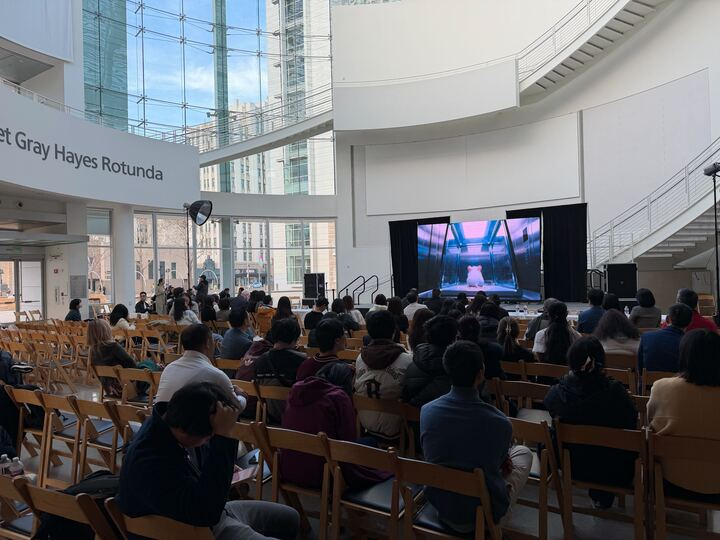
On Jan. 10 and 11, San Jose hosted the first-ever Silicon Valley AI Film Festival (SVAIFF), a self-described “fusion of artificial intelligence, cinema and creative technology.”
Event-planning service Star Alliance Company Inc. presented SVAIFF, which showcased a number of panels, exhibitions and film advancements in the world of AI technology.
The Festival primarily focused on AI’s effect on cinema from artistic and business perspectives. Jonathan Yunger, a Festival partner and founder of AI Studio Arcana Labs, presented several AI-generated film trailers. These included “Revolutionary,” an upcoming AI-generated docuseries on George Washington, as well as former Epic Games’ Art Director Chris Perna’s “Cosmic.”
Yunger described AI as a tool for democratizing the film industry. “The barrier to entry in Hollywood is very difficult. Actual creativity is difficult … And I think [about] AI tools, and real creativity, artists in mind, that starts with humans first,” he said.
Cynthia Jiang, a co-founder of SVAIFF, spoke to the human impact of AI in filmmaking.
“Especially with production companies, there’s a significant number that are using AI post-production. Or even developing the concept with AI from the start,” she told The Daily in Mandarin. Jiang, who is a partner at the law firm East & Partners, cited the immense economic benefits of using AI models over outsourcing production costs to human workers. She also referenced the growing trend of studios incorporating AI into the movie-making process.
“We all know about the 2023 actor and actresses strike in Hollywood. But these strikes did nothing to influence the development of AI. Absolutely nothing,” Jiang said.
However, she also acknowledged the resistance AI filmmaking continues to face among audiences. “Especially with older producers — we have a few clients [like that] from Beijing — they’re very conservative about using AI. They continue to think that AI can’t replicate the very real, human style of actors and actresses,” Jiang said.
Olivia Doman ’26, spoke to this distinction. “When you are making an AI film, you are continuously promoting a model until you achieve the desired result,” she said. “[With] human film making … there is so much more thought and effort that is required, and I believe that time can be seen in the results.” Still, Doman — who has worked at Rodeo FX in the technology and innovation side of cinema — acknowledged that some upsides did exist, with AI models being “fiscally efficient for previsualization and ideation stages.”
Despite its name, film was only a minor focus of the Festival’s scheduled programming, with frequent panels, keynote speakers and even fashion shows occupying much of the two days. The shows, in particular, featured both human and automated models, with Unitree Robotics’ G1 model serving as a dynamic humanoid performer. Human models were oftentimes dressed like living robots, with color palettes of blue, black, and silver overlayed on sleek futuristic dresses.
The Festival featured speeches by a number of local elected officials, including California State Treasurer Fiona Ma.
“I think this film festival is opening up a lot of opportunities for new filmmakers, creatives, [and] artists who didn’t necessarily have the pedigree or the training to move up the ladder in Hollywood,” Ma said.
In addition to its events, SVAIFF also presented the awards to its AI-generated film competition, which received over 2000 entries, according to Festival media representative Tianye Song. Wenqing Shanguan’s “White Night Lake,” which tells the story of a boy’s kite possessed by the soul of its lonely and vengeful owner, took home the Grand Prix Award. Self-described AI Co-Creator Wenye Bot, who directed “A Tree’s Imagination,” won Best Animated Short.
In addition to spotlighting its finalist and shortlisted films, SVAIFF marked the global premiere of “The Wolves,” a feature-length film by director Bing He. Set in the wild, untamed grasslands of Inner Mongolia, “The Wolves” follows the story of a chase gone violent as policemen and vigilantes hunt child traffickers in Inner Mongolia.
“I’ve already [published] a dozen long-feature fictions, all published in China,” He said. “But none of my fiction has been brought to TV and film.” He credited generative AI as an alternative method for him to realize his vision of transforming his work into an audiovisual medium. Despite said, he said he draws the line at using AI to write scripts.
“As a writer, it’s a problem for me because I found such [chatbots] as DeepSeek or ChatGPT — their abilities of writing are very, very good,” he said. “But for me, I never use this model to write scripts or even sentences of my fiction. Because, if I use this, I will lose my ability [to write]. I will lose my soul.”