
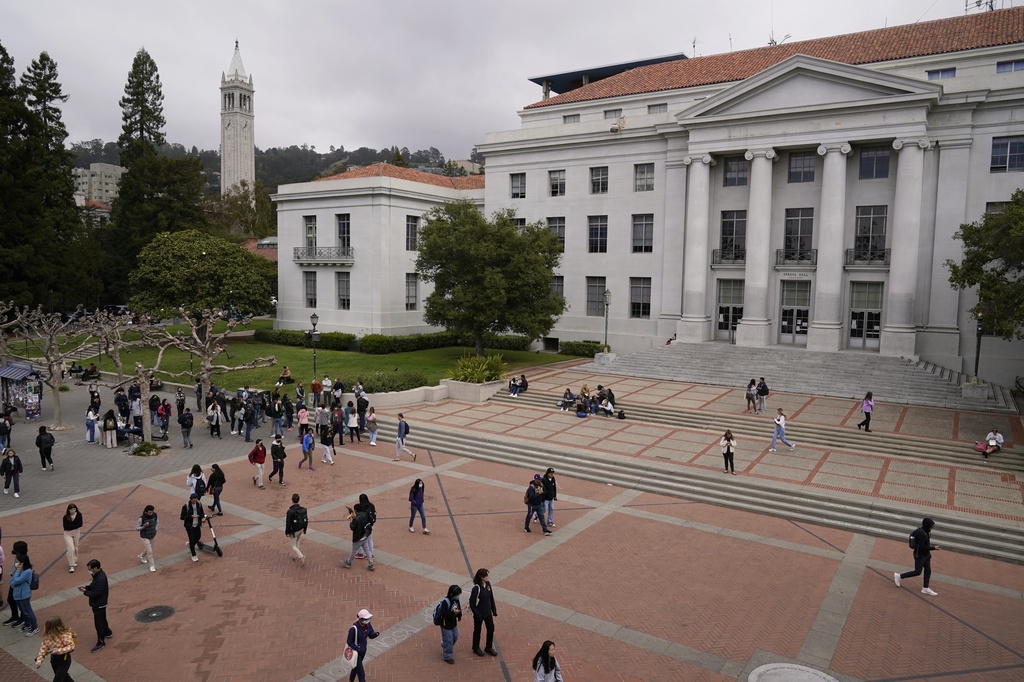
 Students walk through Sproul Plaza on the UC Berkeley campus in March 29 2022. Credit:AP/Eric Risberg
Gov. Gavin Newsom’s budget proposal unveiled Friday provided hopeful news for California’s public university systems, which would get funding increases that leaders say are desperately needed amid hostility from the federal government.
See the full higher education budget
The University of California and California State University would receive a combined $716.3 million in new base funding — $350.6 million for UC and $365.7 million for CSU — under the proposed budget.
In total, UC would get $5.3 billion from the state’s general fund and CSU would receive $5.6 billion.
The proposal wasn’t, however, a best-case scenario for the university systems. Both would see some previously promised money deferred until next year: $129.7 million for UC and $143.8 million for CSU.
That funding was originally deferred from the universities’ budgets last year amid weak state revenues.
Newsom’s plan is also subject to change between now and the summer when the budget is finalized. Last year, he initially proposed 8% cuts for UC and CSU, but the systems were mostly spared when the final budget was enacted. Unlike the state’s community colleges, UC and CSU are not guaranteed minimum funding and must compete with other legislative priorities.
Still, university leaders said Friday that the proposal is an encouraging sign.
“The budget introduced today by Governor Newsom continues to provide critical support for the University and our students,” UC President James B. Milliken said in a statement. He added that the support is especially important because UC faces “tremendous financial pressures stemming from rising costs and unprecedented federal actions.”
California universities — and especially UC campuses — have faced intense scrutiny from the Trump administration over the past year.
Most notably, the U.S. Department of Justice last year charged UCLA with antisemitism and demanded it pay a $1.2 billion fine and make a number of changes to campus policies in exchange for restoring $584 million in frozen federal grant funding. A federal judge has since blocked the fine, but the Department of Justice has said negotiations with UC are ongoing.
CSU is also under multiple investigations and facing its own federal funding uncertainties.
CSU Chancellor Mildred García praised Newsom’s budget proposal, calling it “a bold stand for higher education in what has been a very challenging time for California’s colleges and universities” and higher education nationwide.
“With this budget proposal, Governor Newsom has made it clear that higher education remains a key priority for California,” García added.
Compact and deferrals
The $716.3 million in new funding for UC and CSU is money that was promised years ago as part of a multiyear deal between Newsom and the university systems. Under the so-called compact agreement, the systems are supposed to receive annual budget increases of 5% in exchange for working toward increasing graduation rates and enrolling more California residents, among other goals.
The state, though, has not consistently provided UC and CSU with those increases in the year they were expected, with the money sometimes being deferred to future years. Last year, UC was due $240.8 million and CSU was due $252.3 million as part of the compact, but that funding was deferred.
This year’s proposal includes partial payment of what was owed last year: UC is getting $96.3 million, and CSU is receiving $100.9 million. The remainder would be paid in future years.
Separately, the systems would receive the 5% increases that are due to them this year: $254.3 million for UC and $264.8 million for CSU.
The proposal would also defer $273.5 million — $129.7 million for UC and $143.8 million for CSU — until next year. That funding was cut from each system’s budget last year, with Newsom and lawmakers at the time pledging to restore it this year. Instead, Newsom is now proposing to repay it in 2027-28. In the meantime, UC and CSU would be able to use state loans to access that money.
State lawmakers could look to get some of that deferred money to UC and CSU on a faster timeline. Assemblymember Mike Fong, D-Alhambra, who chairs the Assembly’s Higher Education Committee, said he plans to work with Newsom and the Legislature to “consider options for providing funding earlier in order to maintain stability and effectively deliver expanded access to educational opportunities.”
Financial aid
The budget proposal also includes $3.2 billion to support Cal Grant, the state’s main financial aid award that is available to students attending UC, CSU, community colleges and many private universities.
That’s $488 million more than last year, according to a state Department of Finance spokesperson, who said the increase is due to higher tuition at UC and CSU and increased eligibility among students because more are completing financial aid applications. Many students who meet income requirements are automatically awarded Cal Grants to cover the full cost of tuition.
Those changes might not satisfy lawmakers who have called for a more comprehensive reform of the Cal Grant program. In the past, they have pushed to remove grade point average requirements, get rid of age cutoffs, and give more awards to cover living expenses. In 2021, Newsom vetoed legislation that would have made major changes.
Fong suggested the Legislature could make another attempt this year at reforming the Cal Grant. “Several years ago, the Legislature took action to reform Cal Grants in order to streamline and expand access,” he said. “I look forward to working with my legislative colleagues to explore opportunities for implementation.”
Berkeleyside is a media partner of EdSource, a nonprofit newsroom dedicated to providing analysis on key education issues across California. Berkeleyside occasionally republishes EdSource stories we believe will be of interest to our readers.
“*” indicates required fields